When you click on links to various merchants on this site and make a purchase, this can result in this site earning a commission. Affiliate programs and affiliations include, but are not limited to, the eBay Partner Network.
DISCLAIMER
This description has been created to the best of our ability, and mayoccasionally contain errors. You are purchasing the exact item shown in thephotos. Please review all pictures carefully, as they serve as the primarydescription of the item\'s current condition, features, and details.
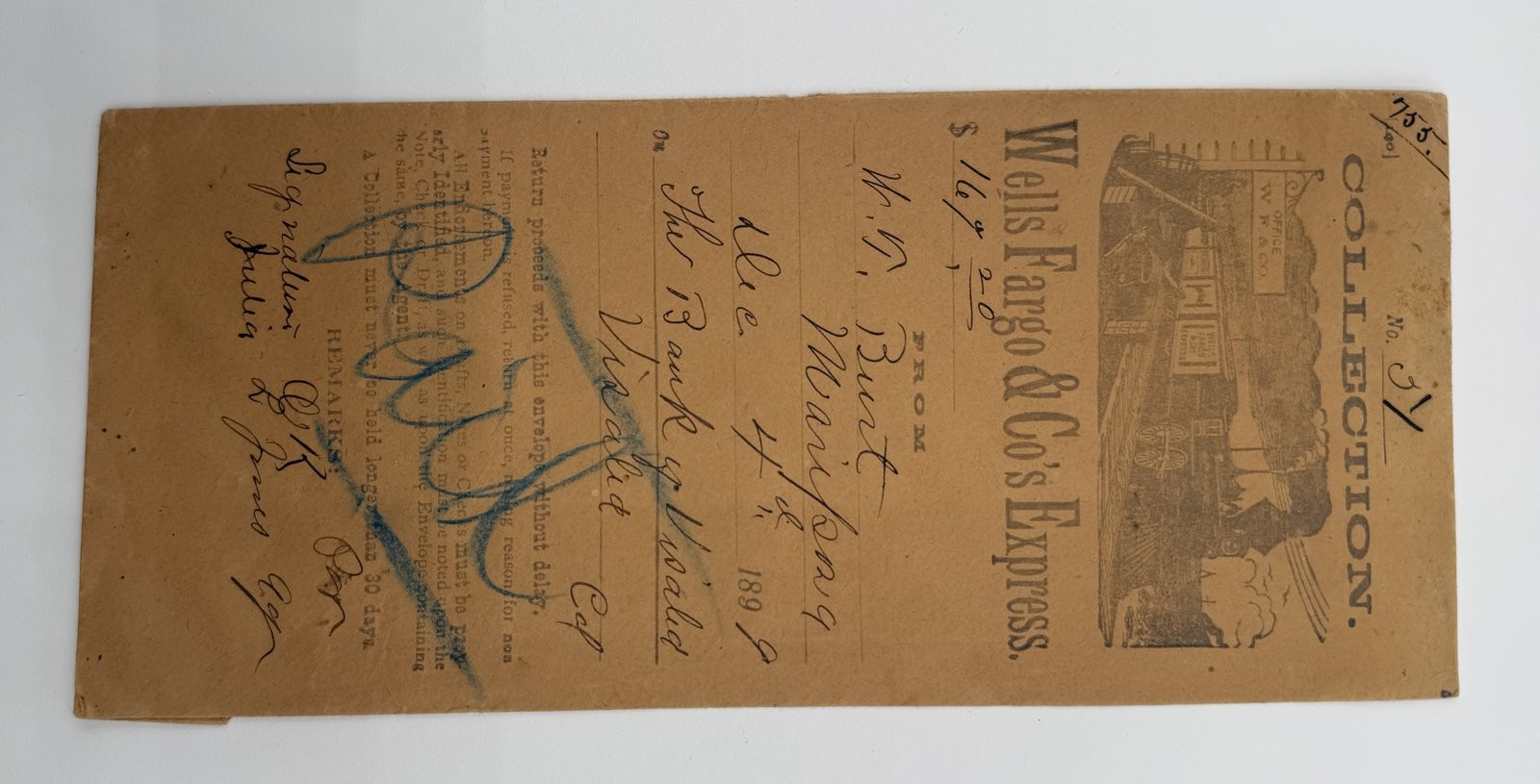
A late-Gold-Country express document: a Wells, Fargo & Co\'s Express COLLECTION envelope filled out at Mariposa, California on December 4, 1899, sending a $16.90 collection against the Bank of Visalia, Tulare County. This is express-company paperwork rather than a Post Office cover, carried outside the mails under Wells Fargo\'s own frank, with the company\'s engraved express-wagon-and-office vignette printed at the right.
1. Postal Markings & Operational Analysis
The Format: A long, legal-size buff manila express envelope, roughly 9½ x 4¼ inches as measured against the ruler, printed in black on both sides. The face carries the heading \"Wells, Fargo & Co\'s Express.\" over the word COLLECTION, a serial box reading \"No.\" at upper right, and ruled lines for the amount, the sender (\"FROM\"), the date, and the party the collection is drawn on. To the right of the heading is the firm\'s small pictorial cut showing an express wagon and team outside a building hung with an \"OFFICE W. F. & CO.\" sign - the standard illustrated device on Wells Fargo collection and C.O.D. stationery of the period.
The Entries: The amount line is completed \"$16 90/\". The \"FROM\" line reads W. T. Burt / Mariposa, dated Dec 4th 1899, and the \"On\" line names The Bank of Visalia, Visalia, Cal. In other words, a Mariposa shipper handed Wells Fargo a draft or note for $16.90 to be presented for payment at the Bank of Visalia and the proceeds returned. Mariposa sits in the Sierra foothills of Mariposa County; Visalia lies well to the southeast in the San Joaquin Valley, so the item travelled a genuine intra-California express route of roughly a hundred miles rather than a single-town errand.
Handling Marks: Heavy blue crayon strokes sweep across the face - the express clerk\'s cancellation of the collection once it was settled or returned - and the REMARKS line carries a pen notation beginning \"Signature\" (the balance of the note is difficult to read with certainty). A pencilled control number appears at the upper right corner and again, with a fraction beneath it, on the lower left of the reverse; these are period express office or file numbers.
Printed Instructions: The face carries the company\'s standing rules in small type: return proceeds with this envelope without delay; if payment is refused, return at once, noting the reason for non-payment; all endorsements on Notes or Checks must be properly identified, and such identification noted upon the Note, Check or Draft, as well as upon the envelope containing the same; and a collection must never be held longer than 30 days. The reverse repeats the Wells, Fargo & Co\'s Express / COLLECTION heading over the closing flap, with \"STITCH O HERE\" and \"and bring String over Right-Hand End of the Envelope,\" four \"SEAL\" marks and \"TIE HERE / OVER KNOT\" at the flap corners, the sidebar warning \"OPEN THIS ON THE END, cutting the twine and preserving the seals unbroken. Observe whether Seals are in good order,\" and at the foot: \"REMIT CURRENCY PAYMENTS in COLL. Envelope Stitched and Sealed. Coin must be enclosed in Bag or separate wrapper, addressed to Shipper, and MARKED ACC\'T COLL NO.___\" That stitch-and-seal protocol is the whole point of the object: the envelope was literally sewn shut with twine and wax-sealed so that any tampering in transit would be obvious.
Postal Rates & Law - Why There Is No Stamp: Nothing on this envelope bears United States postage, and it was never meant to. Under the Private Express Statutes, the federal government reserved a monopoly on the carriage of letters over established post routes, with penalties for anyone establishing a private express for that purpose. Express companies such as Wells Fargo operated lawfully in the space the statutes left open - parcels, treasure, coin, bullion and commercial paper - and the courts read the prohibition narrowly enough that firms like Wells Fargo built a nationwide business on it. A collection envelope carrying a draft for presentment was express matter, moving on the company\'s own waybills and at its own tariff, which is why the envelope shows express-office crayon and file numbers instead of a postmark and a 2c stamp.
Condition: Honest used condition. The envelope is intact and complete with its flap, with age toning typical of cheap manila stock, scattered foxing specks, a soft vertical crease and edge wear. There is a tear across the top edge of the reverse running through the printed \"COLLECTION\" heading and the upper flap area, visible in the detail photographs. The ink entries and the blue crayon remain strong and fully legible. Shown in the final photograph in a protective sleeve with a ruler for scale.
2. Historical Significance
The Business Behind the Envelope: Collection and C.O.D. envelopes were the daily bread of Wells Fargo\'s express business in rural California, and the surviving record shows exactly this pattern at Mariposa. Wells Fargo\'s own historical holdings of the Wiltsee Collection include a run of Mariposa commission and C.O.D. envelopes from the 1880s through 1900 - among them an 1886 C.O.D. envelope sent by J. T. Turner of Mariposa to collect from a party at Bear Valley, an 1886 commission to forward $60 in coin to a San Francisco firm, a November 1900 commission to ship gold to the San Francisco mint, and a November 1900 commission to collect $500 from the Crocker-Woolworth National Bank. This envelope belongs squarely in that sequence: a small-town shipper using the express company as a collection agency because it was faster and more secure than the mails, and because in Mariposa County the Wells Fargo office effectively was the financial infrastructure.
The Payor: The Bank of Visalia was Tulare County\'s leading financial institution for decades. It was established in 1874 at the northwest corner of Main and Church streets in Visalia. It was renamed the National Bank of Visalia in 1908, and in 1923 it was acquired, together with the Visalia Savings Bank and Trust Co., by A. P. Giannini\'s Bank of Italy, which combined them into a Bank of Italy branch; the Bank of Italy was itself renamed Bank of America in 1930. A collection drawn on the Bank of Visalia in December 1899 therefore names an institution that was then at the height of its independent life and that would eventually be absorbed into the largest bank in the country.
Company and Place: In 1899 Wells, Fargo & Co. was under the presidency of John J. Valentine Sr., who led the firm from 1892 until his death in 1901, and had been operating coast-to-coast service since 1888. Mariposa itself was a Gold Rush town - prospectors flocked there for the mineral wealth of its streams and veins - and by the end of the century it was a county seat whose commerce still moved largely by express. Research on the individual shipper named on this envelope turned up nothing specific; he appears to have been an ordinary Mariposa businessman, and we would rather say so than invent a biography.
3. Transcription
Manuscript entries on the face, as written:
$16 90/
FROM
W. T. Burt
Mariposa
Dec 4th 189 9
On
The Bank of Visalia
Visalia Cal
REMARKS: Signature [ ? ] [ ? ]
The remarks line and the sender\'s initials are written in a hurried hand and are partly obscured by the blue crayon cancellation; readings there should be considered provisional. There is no enclosed letter - the envelope is the document.
ABOUT ELECTRO ANTIQUES
At Electro Antiques, we are dedicated to rescuing, rediscovering, andrestoring this history of electronics and computing, reviving andpreserving it for future generations.
We also specialize in signs, advertising, and some ephemera.
All of our items are genuine, vintage or antique items, unless they areotherwise noted as a reproduction.
We want you to be absolutely happy with your purchase.
PAYMENT
Payment must be made within three (3) calendar days of sale close.
Non-paying buyer Cases are automatically opened after 7 days ofnon-payment.
SHIPPING
We ship via USPS on most items.
We only ship to confirmed U.S. addresses, or international through\'s international shipment program.
Please message us through the platform if any of your purchasesarrive damaged, or you have any questions about our items we havelisted.
CUSTOMER SERVICE
Please message us through \'s message system.