When you click on links to various merchants on this site and make a purchase, this can result in this site earning a commission. Affiliate programs and affiliations include, but are not limited to, the eBay Partner Network.
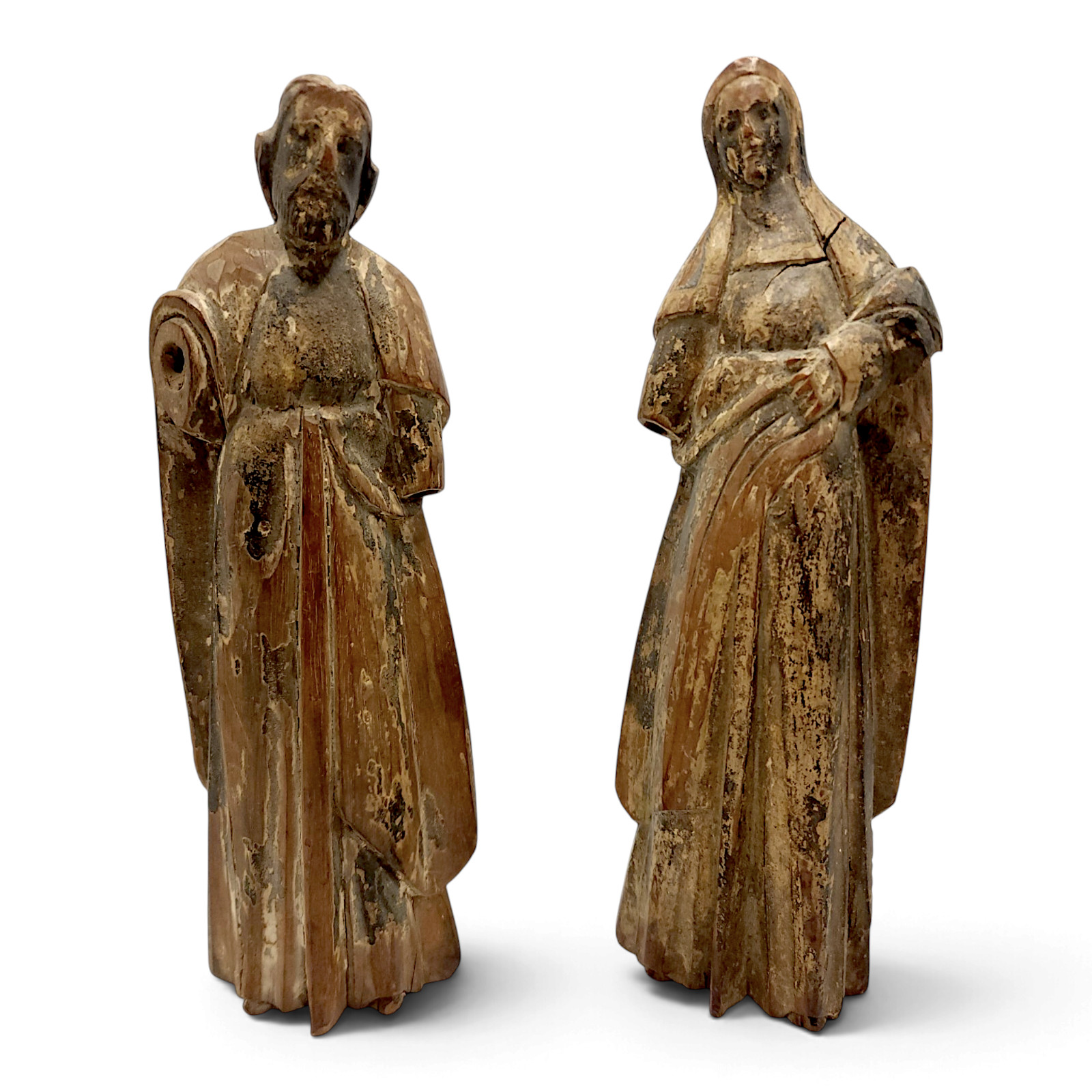
These two hand-carved wooden devotional figures are unusual survivors of an old polychrome religious tradition. Both were once substantially painted, but long use, surface alteration, and loss have left much of the carved wood exposed. What remains includes hand-tool marks, old mounting features, fragments of pale preparation, and protected areas of blue, blue-green, and yellow-colored pigment.
The figures correspond closely in scale, carving method, surface history, sleeve construction, back treatment, and mounting. Taken together, those similarities make them very likely an original companion pair. The leading identification is the Virgin Mary and Saint Joseph, possibly from a small Holy Family, Nativity, household devotional, chapel, or related religious ensemble. Saint Anne and Saint Joachim remain a secondary possibility because several original hands and identifying attributes are no longer present.
Age and Origin
The strongest working date is the 18th or 19th century. That assessment is based on the combination of traditional carved construction, separately fitted extremities, hand-tooled reduced backs, old mounting provisions, surviving polychromy and preparation, long-established losses, and the deeply integrated condition of the remaining surfaces.
A 17th-century date remains possible, although nothing presently anchors the pair that early.
At the other end of the range, a modern 20th-century tourist or decorative reproduction is a poor fit for the construction and surface evidence. Traditional early 20th-century manufacture cannot be completely excluded, but it is not the leading interpretation. The pair is best regarded as likely antique devotional sculpture, most plausibly dating from the 18th or 19th century.
The precise country of origin has not been established. European and American origins both remain serious possibilities. Several of the closest visual parallels found during research were European, including Iberian, Italian, and Central European devotional sculpture, while closely related construction methods also occur throughout Spanish American carving traditions. The surviving evidence does not separate these branches confidently enough to assign a specific country or continent.
Collectors may encounter related figures described as santos, santos de palo, bultos, altar figures, devotional figures, Holy Family figures, or folk religious sculpture. Those traditions overlap considerably in construction and appearance, so no single regional term is being treated here as a firm attribution.
Construction and Original Use
Each figure was carved primarily from a solid wooden body block. The upper sleeves are integral with the bodies, while projecting lower forearms and hands were separately carved and attached by wooden tenons inserted into mortises at the sleeve cuffs.
Both lower forearms/hands are absent from the male figure, leaving matching open cuff mortises. The female retains one carved arm and hand across the front while the opposite separately fitted lower forearm/hand is absent. This composite method is documented in older European and Spanish American devotional sculpture. Because the projecting hands were separate components, their loss is a familiar survival pattern on figures made in this manner.
At roughly 12 inches tall, the pair is at a scale compatible with domestic devotion, a small chapel, or subordinate figures within a larger religious ensemble.
The backs are solid but shallowly reduced, with long visible hand-tool facets rather than fully modeled rear drapery. Frontal presentation was clearly prioritized.
Both undersides retain flush-cut wooden mounting pegs or dowels, showing that the figures were formerly secured to bases or another supporting structure. The surviving pegs do not establish whether they originally shared the same base or how the complete composition was arranged.
Wood and Surface Evidence
Microscopic examination of the male figure’s end grain shows numerous small vessel pores distributed through the wood. This establishes that it is a hardwood rather than a coniferous softwood such as pine, fir, or spruce. The pore pattern is consistent with a diffuse- or weakly semi-diffuse-porous hardwood.
That anatomy is compatible with traditional sculpture woods such as poplar or linden, along with several other possible diffuse-porous hardwoods. The exact genus has not been determined, and the wood evidence alone does not establish geographic origin.
Although the figures now appear largely stripped to wood, protected areas preserve evidence of their former painted appearance. Microscopic examination shows blue to blue-green pigment around the eye areas of both figures and on the female figure’s robe. Yellow to yellow-ochre-colored material also survives in small areas.
Beneath and adjacent to surviving color is a pale granular layer consistent with preparation layers used beneath painted wooden sculpture. Its exact composition has not been identified. These surviving fragments are important because the present worn appearance gives only a partial impression of how strongly the painted surfaces would once have defined the faces, garments, and eyes.
Microscopic Photo Guide
Photo 10 shows the male figure’s underside/end grain at high magnification. The many small vessel pores visible in the wood are the feature used to identify it as a diffuse- or weakly semi-diffuse-porous hardwood rather than a coniferous softwood.
Photo 11 shows surviving blue to blue-green pigment around the male figure’s eye area.
Photo 12 shows the surviving layered surface, including exposed wood, pale granular preparation, and remaining surface material.
Photo 23 shows surviving blue to blue-green pigment around the female figure’s eye area.
Photo 24 shows a concentrated area of surviving blue pigment on the female figure’s robe.
Measurements
Male figure: 11 3/8\" high × approximately 4\" wide × 2 1/2\" deep. Weight 12.1 oz.
Female figure: 11 7/8\" high × approximately 4\" wide × 2 1/8\" deep. Weight 13.8 oz.
Condition
Both figures remain extremely firm, solid, and substantial in hand despite their extensive surface history. There are no loose or weak areas.
Much of the former painted surface and preparation has been lost, with worn carving edges and surviving pigment concentrated in protected areas. The male has faint age lines visible on the underside but no comparable major body split.
The female has a long old split running upward along the side of the body toward the shoulder/neck area. The split is deeply darkened, appears to have been present for a very long time, and is stable. Her surviving hand and other high points show considerable wear.
The absent separately fitted forearms/hands are clearly shown in the photographs. The remaining bodies, sleeve mortises, backs, and mounting pegs are solid and stable.Photos have slightly increased saturation and contrast to improve visibility of surface details; tones are somewhat more muted in person.