When you click on links to various merchants on this site and make a purchase, this can result in this site earning a commission. Affiliate programs and affiliations include, but are not limited to, the eBay Partner Network.
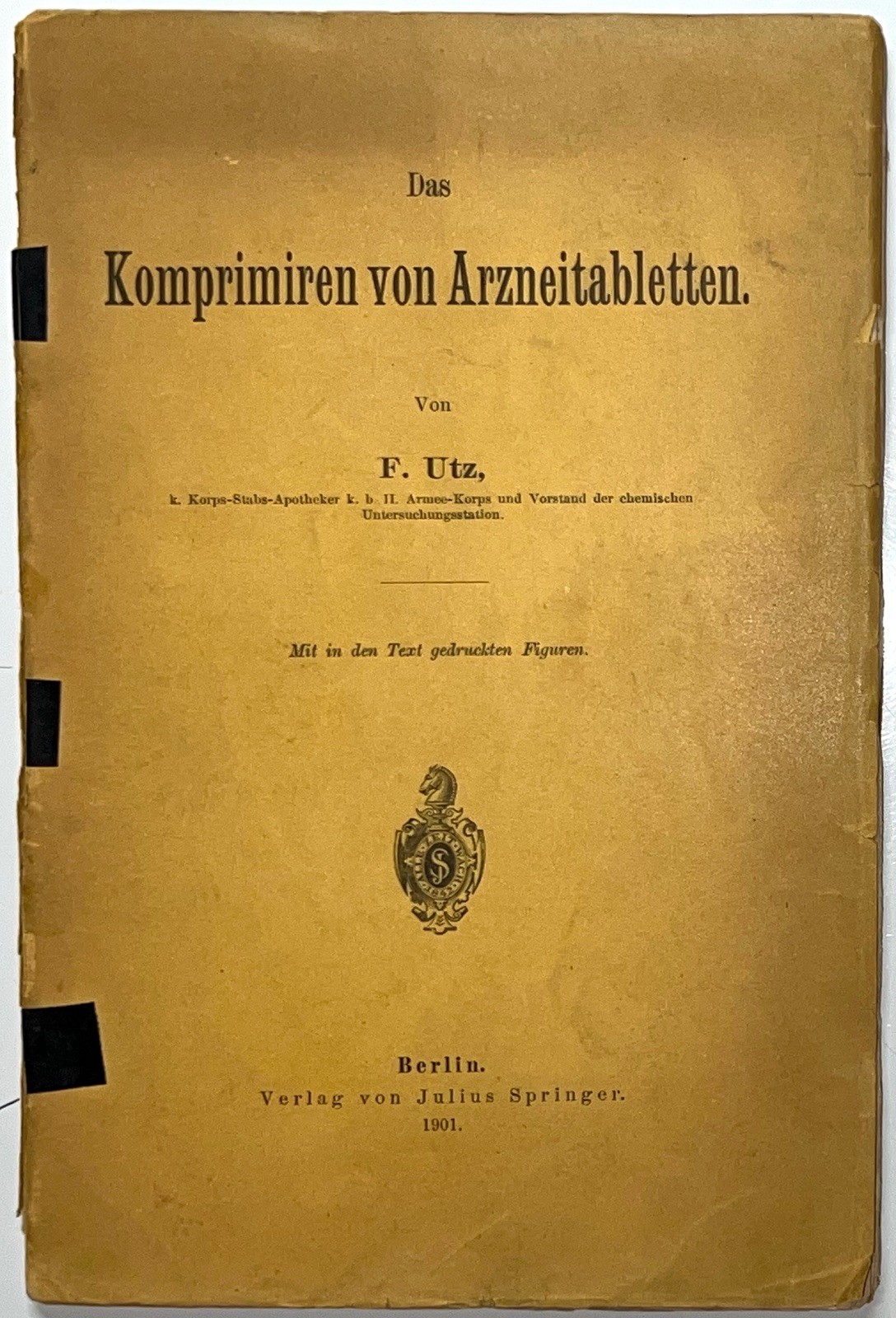
1901 DAS KOMPRIMIREN VON ARZNEITABLETTEN UTZ PHARMACY TABLET PRESSES RARE MANUAL
ITEM DETAILS
Title: Das Komprimiren von Arzneitabletten
Author: F. Utz
Publisher: Verlag von Julius Springer, Berlin
Publication Date: 1901
Edition: Not stated
Condition: Good
ITEM DESCRIPTION
Original 1901 German pharmaceutical monograph on the compression of medicinal tablets, published in Berlin by Julius Springer for army pharmacist F. Utz, k. Korps-Stabs-Apotheker des k. b. II. Armeekorps. Utz gathers his experience preparing compressed dosage forms for both military and civilian use, making this an early, focused technical handbook on the manufacture of Arzneitabletten at the dawn of industrial tablet production.
The book is complete in the original printed yellow paper wraps, with Julius Springer advertisements for major pharmaceutical reference works on the rear wrapper and inner leaves, including Hagers Handbuch der pharmaceutischen Praxis, Dieterich’s Neues pharmaceutisches Manual, Zelis on Verbandmaterialien, and commentary to the official Arzneibuch für das Deutsche Reich. The title page repeats the cover imprint and notes that the text is illustrated “mit in den Text gedruckten Figuren,” which appear throughout as detailed engravings of hand tablet presses, small & large scale compression machines, auxiliary drying cabinets, tablet molds, and related apparatus.
Front matter includes a substantial Vorwort dated Würzburg, July 1901, where Utz explains that earlier articles on compressed tablets for field and hospital use brought many requests from colleagues, prompting this expanded standalone work. The Inhaltsverzeichniss (table of contents) lays out ten sections: I. Geschichtliches (historical background); II. Komprimirmaschinen, divided into machines for small operations and for mass production; III. Nebenapparate, covering ancillary equipment such as gas- and vacuum-drying cabinets; IV. Das Vorbereiten der Arzneimittel zum Komprimiren (preparing the drugs for compression); V. Allgemeine Vorschriften für Behandlung der Maschinen; VI. Das Komprimiren der Tabletten; VII. Die Bezeichnung der Tabletten (marking and stamping); VIII. Die Verpackung der Tabletten; IX. Die Aufbewahrung der Tabletten; and X. Verordnungen, reproducing official regulations issued by the Prussian ministry at the turn of the century.
The historical section traces the evolution of compressed solid doses from earlier pressed vegetable tablets in North America, including references to Shaker communities supplying the American market with herbal tablets, to the increasingly sophisticated use of binders and compression techniques in European pharmacies. Subsequent chapters walk the reader through an array of hand and bench-top tablet machines used around 1900, showing single-punch presses, rotary-style devices for higher throughput, and specialized presses for hypodermic tablets and other dosage forms. Detailed cutaway figures and captions identify parts such as Füllrevolver, Unter- und Oberstempel, Excenter, and various feed mechanisms, making the book a rich visual record for collectors interested in the mechanical history of tablet presses and pharmacy equipment.
A long central section presents practical, recipe-style guidance for preparing powders and granules and then compressing them into stable tablets. Utz discusses drying conditions, binders, and compression pressures, then provides page after page of specific formulas for many important turn-of-the-century drugs and combinations. Among the substances treated are Acetanilidum, Antipyrinum, Aspirin, Bismuthum subnitricum, Carbo Tiliae, various morphine and apomorphine salts, migraine tablets, Ipecacuanha preparations, effervescent “brausende Tabletten,” and numerous other official and proprietary remedies. For each, Utz gives proportions per batch and the resulting tablet weight and strength, tying his instructions closely to the standards of the Arzneibuch für das Deutsche Reich and the evolving Pharmacopoea Germanica.
Later chapters address practical concerns that are highly revealing for historians of pharmacy: recommended stamps and lettering for individual tablets to ensure proper identification; packing methods for hygroscopic and light-sensitive drugs; storage of tablets in labelled tins, glass tubes, and special sanitary cases for field-medical use; and the official 1900 decree regulating prices and preparations of compressed tablets for the German Empire. Together, the work documents the transition from hand-rolled pills and lozenges to standardized compressed tablets as the dominant solid dosage form, a topic frequently cited in modern histories of tablet technology and pharmaceutical industrialization.
Physical condition is good overall for a fragile, well over 120-year-old German pharmaceutical booklet, but it does show the expected age and handling wear. The original printed paper wraps are present but loosely attached at the spine, and the whole volume feels a bit loose in the hand; the spine shows shallow splits, small chips at the ends, and old black tape segments along the joint areas on both front and rear, with associated darkening and surface abrasion. Wrap edges are rubbed with scattered short tears, corner creases, and small losses, particularly along the outer margins of the rear cover where there is additional toning, scuffing, and evidence of past tape or label removal. A “Private Library of E. J. Kennedy” bookplate is neatly affixed inside the front wrapper, lending a traceable provenance without affecting the text.
Internally, the text block is slightly shaken but still held by the original sewing, with no loose single leaves observed and all gatherings remaining in place despite the looseness of the outer wraps. The paper stock has evenly toned to a warm cream typical of early-1900s continental printing, with some pages showing mild edge darkening, the occasional small marginal nick or corner fold, and light handling smudges, but the type remains clear and the numerous in-text engravings are sharp and attractive. No significant underlining or intrusive contemporary markings were noticed beyond the private library label; the text appears complete through page 86, including the final section of official regulations and the publisher’s advertising leaves at the back.
Overall this is a solid, unrestored example of a scarce and highly specialized pharmacy manual that remains very usable for research and display despite its age-related wear.
Make sure to see the photos above for complete details.
86 pages.
Measures approximately 8 1/2 inches tall by 5 3/4 inches wide.
KEYWORDS
Das Komprimiren von Arzneitabletten, F. Utz, Utz tablet monograph, Julius Springer Berlin, Springer pharmacy history, German pharmaceutical book 1901, compressed tablets history, tablet press history, Arzneitabletten, Arzneibuch für das Deutsche Reich, Pharmacopoea Germanica, German army medical corps, k. Korps Stabs Apotheker, military pharmacy, historic pharmacy manual, tablet compression machines, antique tablet presses, hand tablet press engravings, Nebenapparate, gas drying cabinet, vacuum drying cabinet, brausende Tabletten, effervescent tablets, aspirin early formulations, antipyrin tablets, acetanilidum tablets, bismuth subnitricum, morphium hydrochloricum, apomorphinum hydrochloricum, migraine tablets, ipecacuanha tablets, radix rhei tablets, galenical pharmacy, pharmaceutical technology 1900s, industrialization of tablet manufacture, history of dosage forms, Shaker herbal tablets, medicinal Vegetabilien, apothecary reference work, rare German medical booklet, antique medical text, early 20th century pharmacology, scientific illustration of machines, pharmacy equipment collecting, pharmaceutical ephemera, history of drug regulation, Prussian ministry decree 1900, pharmaceutical machinery reference, antique science book, medical antiquarian collectible, pharmacy museum reference, German language medical book, Berlin scientific publishing, Julius Springer early imprint, historic pharmaceutical literature, mechanical engineering of tablet presses, compressed dosage forms, materia medica history, pharmaceutical industrial heritage, rare pharmacy handbook, historians of pharmacy, collectors of medical technology, niche scientific monograph, ex libris private library, original paper wraps, illustrated technical manual, early aspirin history, pharmaceutical chemistry history
_gsrx_vers_1730 (GS 9.9.4 (1730))