When you click on links to various merchants on this site and make a purchase, this can result in this site earning a commission. Affiliate programs and affiliations include, but are not limited to, the eBay Partner Network.
This is a superb example of Chinese-American postal history from California.
Postal Analysis:
1. Marking & Cancellation
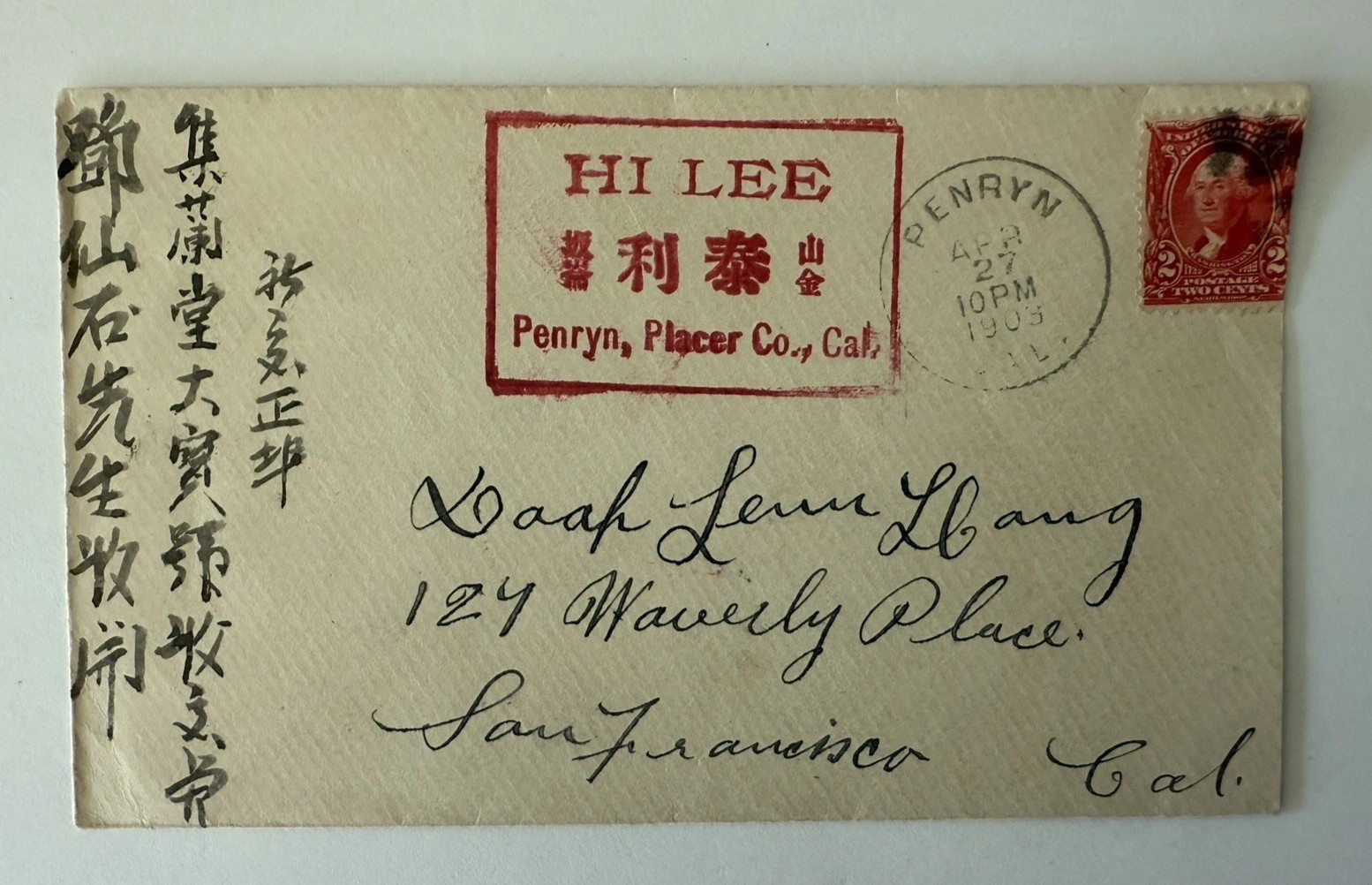
Postmark (Origin): A circular date stamp for PENRYN, CAL., dated APR 27, 10 PM, 1903.
Merchant Handstamp: A prominent red boxed cachet for \"HI LEE, Penryn, Placer Co., Cal.\" with corresponding Chinese characters (泰利號 - Taài Leih Houh).
Significance: Hi Lee was a prominent Chinese merchant firm in Penryn. During this era, Chinese merchants often acted as informal postmasters or \"letter shops\" for Chinese laborers working in the local granite quarries and fruit orchards.
Franking: A 2-cent George Washington (Series 1902) stamp, tied by the Penryn duplex cancel.
2. Addressing & Destination
Recipient: Written in both English and Chinese.
English: \"Daah Lenn Huang (or Hoang), 124 Waverly Place, San Francisco, Cal.\"
Chinese (Vertical left): The calligraphy identifies the recipient and the specific location in San Francisco\'s Chinatown.
Location Note: Waverly Place (historically known as the \"Street of the Temples\") was the heart of Chinatown’s social and religious life. 124 Waverly Place was a multi-story building that, by 1903, likely housed a district association or a merchant collective.
Reverse Side: The back of the envelope features dramatic, bold Chinese brush calligraphy—likely a summary of the contents or a formal greeting to the recipient.
3. Historical Context: Penryn, Placer County
Penryn was established around a large granite quarry (the Griffith Quarry). By 1903, it had a significant Chinese population that transitioned from railroad work to granite cutting and the burgeoning fruit industry. Covers from \"Hi Lee\" are documented in Placer County history, but they do not appear on the market frequently.
4. Translations
The calligraphy on this cover is a mix of formal merchant identification and a personal, more informal script on the reverse. Here is the breakdown of the translations:
Front of the Envelope
The Red Merchant Stamp:
HI LEE (The phonetic English name).
泰利號 (Taài Leih Houh): This is the business name. Taài means \"Great\" or \"Peaceful,\" and Leih means \"Profit\" or \"Prosperity.\" Houh is a standard suffix for a business or firm.
山金 (Saān Gām): Literally \"Gold Mountain.\" This is the traditional Chinese term for California (specifically San Francisco).
The Vertical Script (Left Side):
鄧仙石先生收 (Dahng Sīn Sehk Sīn Saāng Sāu): \"To be received by Mr. Deng Xianshi.\"
鄧 (Deng) is the family name.
仙石 (Xianshi) is the given name, which translates poetically to \"Immortal Stone\" or \"Celestial Rock.\"
金山大埠 寄 (Gām Saān Daaih Fauh Gei): \"Sent to the Great Port of Gold Mountain\" (San Francisco).
集英蘭堂 (Jaahp Yīng Làahn Tòhng): This refers to a specific \"Tong\" or association house. These were benevolent organizations that helped immigrants from the same village or clan.
The Smaller Script (Middle):
祈交正埠 (Kèih Gāau Jīng Fauh): A request to the postal carrier or \"letter shop\" agent, meaning \"Please deliver to the main port/district.\"
Back of the Envelope
The calligraphy on the reverse is written in a more flowing, \"grass-style\" (caoshu) or semi-cursive script. In 1903, it was common to write a summary of the contents or a formal closing on the exterior flap.
Transcription: 平安家信 (Pìng\'ān Jiāxìn) followed by a personal greeting.
Translation: \"A peaceful letter from home.\"
This was a very common phrase used on overseas mail to immediately reassure the recipient that the news inside was positive before they even opened the envelope.
Style: The brushwork is bold and confident. The flourishes on the right indicate a level of literacy and status—this wasn\'t just a laborer\'s scribble; it was likely written by a professional clerk or a well-educated merchant at the Hi Lee firm.
Historical Note
The address 124 Waverly Place is particularly significant. Waverly Place was known as the \"Street of the Temples\" because it housed many of the district associations (Huiguan). This letter was being sent from a rural \"Gold Mountain\" (the quarries of Penryn) to the \"Great Port\" (San Francisco), tracking the exact movement of money and news that sustained the Chinese community in California at the turn of the century.
ABOUT ELECTRO ANTIQUES
At Electro Antiques, we are dedicated to rescuing, rediscovering, and restoring this history of electronics and computing, reviving and preserving it for future generations.
We also specialize in signs, advertising, and some ephemera.
All of our items are genuine, vintage or antique items, unless they are otherwise noted as a reproduction.
We want you to be absolutely happy with your purchase.
PAYMENT
Payment must be made within three (3) calendar days of sale close.Non-paying buyer Cases are automatically opened after 7 days of non-payment.SHIPPING
We ship via USPS Ground Advantage on most items.We only ship to confirmed U.S. addresses, or international through \'s international shipment program.Please message us through the platform if any of your purchases arrive damaged, or you have any questions about our items we have listed.CUSTOMER SERVICE
Please message us through \'s message system.