When you click on links to various merchants on this site and make a purchase, this can result in this site earning a commission. Affiliate programs and affiliations include, but are not limited to, the eBay Partner Network.
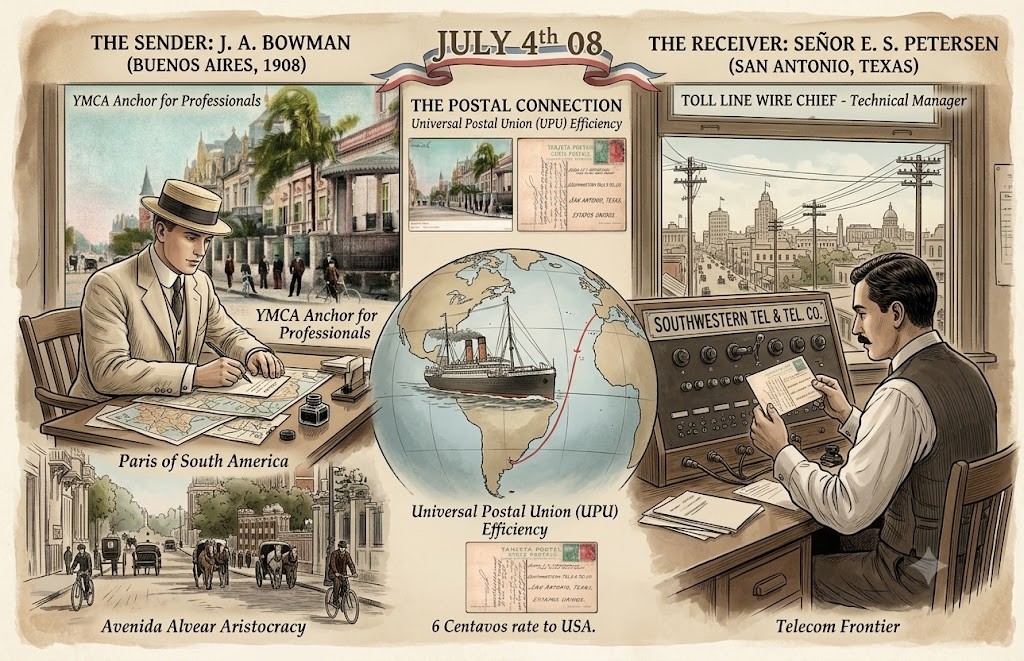
IMPORTANT NOTE REGARDING EXHIBIT GRAPHICS: Thehistorical routing maps, geographic overlays, and enhanced composite visualsfeatured in this listing are custom-designed digital graphics createdexclusively for this online presentation. They are intended to provide deepprovenance and tell the social history of the cover. No physical prints ordigital files are included with the purchase of the physical philatelic itemunless explicitly stated.
1908 Buenos Aires Argentina Postcard Avenida Alvear to San Antonio TX YMCA
ITEM SPECIFICS:
Type: Original Antique Colorized Photo Postcard (Divided Back Era)
Subject: Avenida Alvear, Buenos Aires, Republic of Argentina
Publisher: Editores Pita & Catalano (Card No. 108 / \"Red Eye\" logo)
Postmark Date: July 4, 1908 (Double-Ring Buenos Aires CDS)
Postal Rate: 6 Centavos (1c Green + 5c Carmine \"Liberty with Torch\" Definitives)
Sender Drop: Care of the Y.M.C.A., Moreno # 452, Buenos Aires, Argentina
Recipient: Señor E.S. Petersen, Toll Line Wire Chief
HISTORICAL & SOCIAL PHILATELY SIGNIFICANCE:
This is an exceptional piece of early 20th-century social philately that beautifully bridges the Belle Époque \"Golden Age\" of Argentina with the telecommunications frontier of the American Southwest.
The Front (Avenida Alvear & H.G. Olds):The front of the postcard features a crisp, early colorized street view of the ultra-aristocratic Avenida Alvear in Buenos Aires. Known at the time as the \"Paris of South America,\" this avenue showcased grand Beaux-Arts palaces built by elite families fueled by Argentina\'s massive agricultural wealth. The image was captured by Harry Grant Olds, a notable American photographer from Ohio who moved to Buenos Aires in 1900 and became famous for documenting the nation\'s dramatic modernization, urban architecture, and street life.
The Back (A Cross-Continental Connection):
The Sender: Written and mailed on the Fourth of July, 1908, by an American traveler or technical professional named J.A. Bowman. He tracks his journey (\"Arrived here May 30th\") and calls the postcard a \"racer\" (early slang for a quick message sent while moving fast). He instructs the recipient to write him back care of the Buenos Aires YMCA at Moreno 452, which acted as a vital, secure lodging and mail-drop anchor for English-speaking corporate employees and engineers in South America.
The Recipient: The postcard is uniquely addressed to Señor E.S. Petersen, who held the prestigious position of \"Toll Line Wire Chief\" for the Southwestern Telegraph & Telephone Co. based in San Antonio, Texas. The Wire Chief was a high-level technical manager responsible for testing, maintaining, and ensuring the electrical integrity of long-distance (toll) copper lines during the infancy of the American telephone network.
CONDITION REPORT:
Postal Markings: The 1c green and 5c carmine \"Libertad con Antorcha\" definitive stamps are firmly intact. They feature an exceptionally clean, crisp, and un-smudged Buenos Aires circular date stamp (CDS) postmark dated 4 JUL 08.
Card Stock Condition: Excellent structural condition for an item over a century old. It features strong corners, minimal edge wear, vibrant color retention on the front illustration, and completely legible ink handwriting on the reverse side.
A wonderful addition for collectors specializing in Argentine postal history, early telecommunications/telephone ephemera, YMCA topical collections, or the historic photography of H.G. Olds.
1. Route Timeline & Mail Handling
July 4, 1908 (Origin): J.A. Bowman drops the postcard into a postal box or brings it directly to the Central Post Office (Correo Central) in Buenos Aires, where it receives the crisp, double-ring BUENOS AIRES circular date stamp (CDS).
The Sea Voyage (The River Plate to New York): In 1908, the dominant, premium contract carrier for the fortnightly mail and passenger run from Buenos Aires directly to the United States (\"the States\") was the British-owned Lamport & Holt Line.
The Journey: The card was transferred to a Lamport & Holt steamship leaving the bustling port of Buenos Aires.
The Standard Ports of Call: The ship steamed down the Río de la Plata, headed north along the South American coast stopping at Santos and Rio de Janeiro (Brazil), and frequently paused at Caribbean hub ports like Trinidad or Barbados before crossing into North American waters.
The US Port of Entry: The vessel arrived at the Port of New York approximately 21 to 24 days later—the standard transit time for direct South-to-North American steamship mail during this era.
The Railway Transit (New York to Texas): Upon clearing customs and the New York Sea Post sorting offices, the postcard was handed over to the US Railway Mail Service (RMS). It was routed via fast mail trains running down the Atlantic coast and crossing into the American Southwest, transferring directly onto lines servicing the Southern Pacific or Missouri-Kansas-Texas (\"Katy\") Railroad straight into San Antonio.
Arrival (San Antonio, TX): The postcard was delivered directly to the downtown corporate headquarters of the Southwestern Telegraph & Telephone Co. and into the hands of the Toll Line Wire Chief, Señor E.S. Petersen.
2. Postal Rate Breakdown
The 6 Centavos Rate: The combination of the 1c Green and 5c Carmine Libertad con Antorcha (Liberty with Torch) definitive stamps precisely met the 6 centavos international postcard rate established by the Universal Postal Union (UPU).
UPU Efficiency: This single, unified rate guaranteed that a postcard processed in Argentina would be seamlessly accepted, transported, sorted, and delivered by the United States Post Office Department without requiring any additional postage or \"Postage Due\" penalties upon arrival in Texas.
The Transatlantic Racer: Social Philately and Telecommunications in the 1908 International Post
Introduction
In the first decade of the twentieth century, the world was knitted together not by digital streams, but by iron, steam, and paper. The global postal network, regulated by the Universal Postal Union (UPU), operated with an astonishing mechanical efficiency that allowed thoughts to cross oceans in a matter of weeks. An exceptional artifact of this globalized era survives in a postcard mailed from Buenos Aires, Argentina, to San Antonio, Texas, dated July 4, 1908. By analyzing the physical elements and historical contextone uncovers a rich narrative of social philately that bridges the Belle Époque \"Golden Age\" of South America with the expanding telecommunications frontier of the American Southwest.
The Front: A Vision of the South American Paris
The front of the postcard,features a vivid, early colorized photograph of Avenida Alvear in Buenos Aires. Captured by the legendary American photographer Harry Grant Olds—credited in the plate as Fot. Olds.—the image is more than a simple souvenir; it is a carefully framed testament to Argentine exceptionalism. In 1908, Argentina possessed one of the highest per-capita incomes in the world, its economy supercharged by the massive export of beef and wheat to an industrialized Europe.
Avenida Alvear was the epicenter of this spectacular wealth. The photograph documents an avenue lined with grand, Beaux-Arts palaces designed by European-trained architects to mirror the aristocratic quarters of Paris. Strolling pedestrians, early bicyclists, and horse-drawn carriages move beneath palm trees, projecting an image of an ultra-modern, highly cultured, and deeply affluent metropolis. For the sender of the card, this striking image served as the perfect visual proof of the grandeur of his new, temporary home.
The Back: A Story of Tech and Travel
Turning the card over toreveals the human element of this cross-continental connection. The message, penned vertically on the left division by an American traveler named J. A. Bowman, reads:
\"Bs Aires, July 4th 08 / Arrived here May 30th / This is simply a \'racer\' to get a line on you. / Write me care of Y.M.C.A., Moreno # 452 / Buenos Aires, Argentina / J. A. Bowman\"
Bowman’s brief message is rich with social history. His use of the term \"racer\"—early twentieth-century slang for a postcard sent quickly while on the move—indicates a desire to establish a reliable communication link with home. Crucially, Bowman directs his return mail to the Buenos Aires YMCA at Moreno 452. Founded in 1902, the Argentine YMCA was not merely a recreational facility; it functioned as an essential institutional anchor for young, English-speaking professionals, clerks, and engineers who were flooding into South America to build its burgeoning infrastructure. It provided safe lodging, an English library, and a trusted mail drop in a foreign land.
The recipient of this \"racer\" was Señor E. S. Petersen, addressed with the highly specific title of \"Toll Line Wire Chief\" for the Southwestern Telegraph & Telephone Company in San Antonio, Texas. In 1908, a Wire Chief was a prestigious and vital technical manager. Petersen was responsible for testing, diagnosing, and maintaining the electrical integrity of the physical copper wires that formed the long-distance (\"toll\") telephone networks then pushing rapidly across Texas. The professional nature of Petersen\'s title, combined with Bowman’s overseas travel, strongly implies that both men shared a background in the cutting-edge tech industries of their day—telephony, electrical engineering, or transit infrastructure.
The Journey: The Logistics of Steam and Rail
The physical journey of this card, visually mappedrepresents a triumph of Edwardian logistics. Mailed ironically on the Fourth of July—a premier American holiday—the card entered the Correo Central in Buenos Aires, where it received a crisp, double-ring circular date stamp.
To reach Texas, the card relied on the precision of the international UPU framework. Bowman affixed a 1-centavo green and a 5-centavo carmine Libertad con Antorcha (Liberty with Torch) stamp. This combined 6-centavos rate precisely met the international tariff for a postcard, guaranteeing that the item would be seamlessly handled by foreign postal administrations without any \"Postage Due\" penalties.
From the Port of Buenos Aires, the postcard was loaded onto a premier contract mail steamer—most likely operated by the British-owned Lamport & Holt Line. The vessel journeyed down the Río de la Plata and steamed northward along the Atlantic coast of South America, stopping at trade hubs like Santos and Rio de Janeiro before pausing in the Caribbean and making its final run to the Port of New York. This maritime voyage took between 21 and 24 days.
Upon clearing customs in New York, the card was handed over to the United States Railway Mail Service. Sorted on moving trains, the postcard traveled down the Atlantic coast and cut across the American South via fast mail rail lines, such as the Missouri-Kansas-Texas (\"Katy\") or Southern Pacific Railroads. Within a month of its postmark date, the card slid cleanly into the mail slot of the Southwestern Telegraph & Telephone offices in San Antonio.
Conclusion
The postcard preservedis a spectacular window into a world on the move. Through its stamps, postmarks, photography, and text, it connects the aristocratic opulence of a booming Buenos Aires with the rugged, expanding telecommunications landscape of turn-of-the-century Texas. It honors the individuals—an adventurous American traveler at a South American YMCA and a technical Wire Chief keeping the lines open in San Antonio—who helped build the modern networks of connection we take for granted today.
Track Page Views With
Auctiva\'s Counter