When you click on links to various merchants on this site and make a purchase, this can result in this site earning a commission. Affiliate programs and affiliations include, but are not limited to, the eBay Partner Network.
GEORGE BORROW — LAVENGRO: THE SCHOLAR, THE GYPSY, THE PRIEST
London: T. N. Foulis, 1914
First Edition Thus | Twelve Mounted Color Plates by Edmund J. Sullivan | Handsome Aston Commercial School Leather Prize Binding
A handsome illustrated edition of George Borrow’s extraordinary nineteenth-century classic, here preserved in an attractive English leather prize binding with gilt decoration, top edge gilt, school crest, and a dated 1931 presentation plate.
BORROW, George. Lavengro: The Scholar, the Gypsy, the Priest. London: T. N. Foulis, 1914. First edition thus. xviii, 654 pp. Illustrated with twelve mounted color plates by Edmund J. Sullivan.
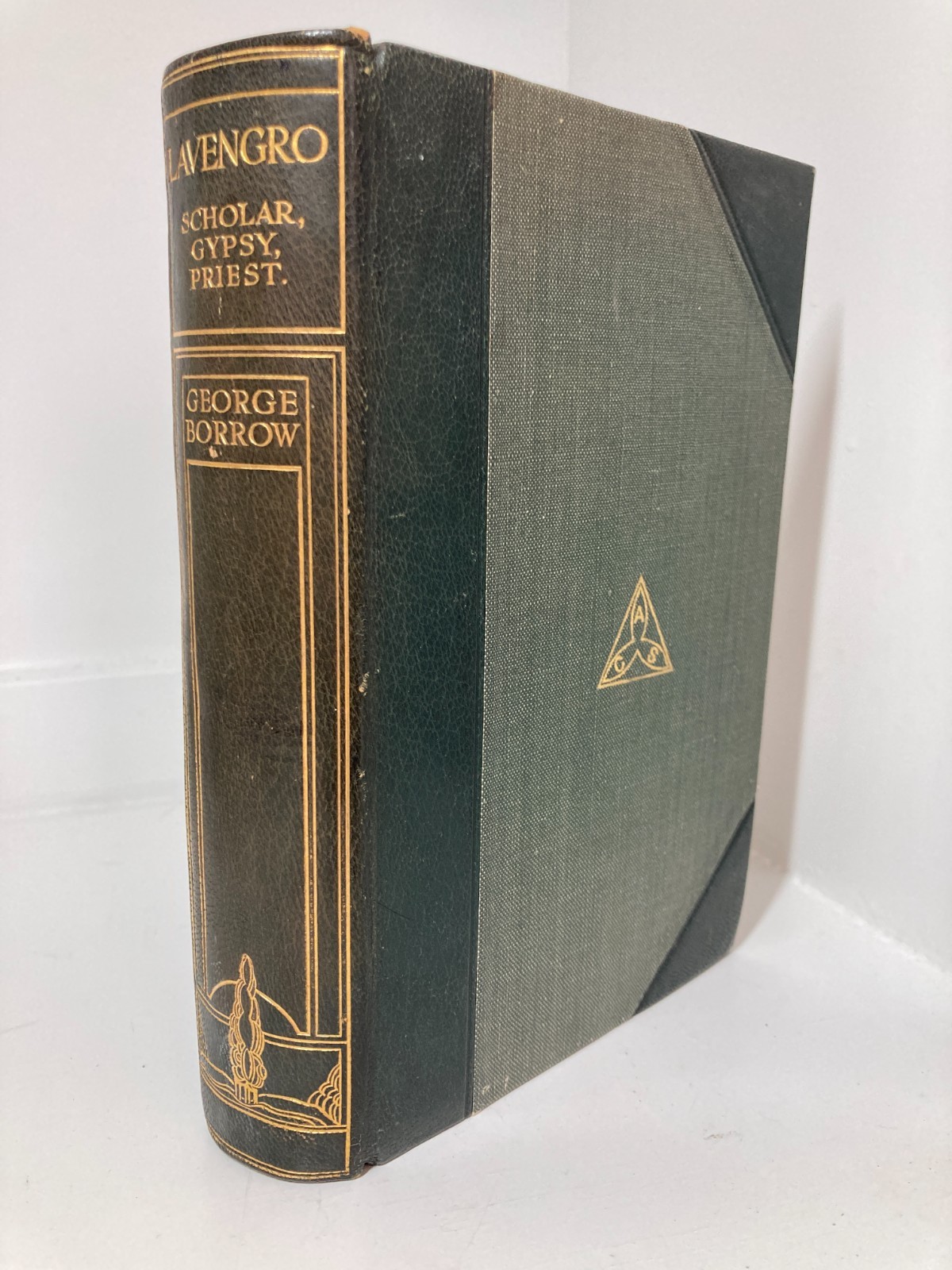
The ordinary edition is usually encountered in publisher’s cloth. This copy was specially bound for presentation in half dark green leather over cloth boards, with matching leather corners, a decorative gilt spine, top edge gilt, and the gilt crest of Aston Commercial School to the front board.
The result is a significantly more attractive and substantial copy than the standard cloth-bound issue.
THE 1914 ILLUSTRATED EDITION
This is the first edition of the T. N. Foulis production illustrated by Edmund J. Sullivan.
The volume contains twelve mounted color plates created especially for the book.
Sullivan’s original artwork for this edition is represented in the collection of the Morgan Library & Museum in New York. The Morgan owns his signed and dated 1914 watercolor “The blow which I struck the Tinker,” the original design published in this edition on page 544.
That surviving original provides a remarkable direct link between Sullivan’s working process and the finished illustrations in the present volume.
EDMUND J. SULLIVAN
Edmund J. Sullivan was one of the important British literary illustrators working across the late Victorian and early twentieth-century periods.
His work combined the traditions of nineteenth-century book illustration with the influence of Art Nouveau and the grotesque, and he illustrated works by authors including Thomas Carlyle, Omar Khayyam, Shakespeare, Keats, Izaak Walton, and George Borrow.
His twelve color designs for Lavengro are particularly well suited to Borrow’s strange and episodic world of roads, inns, scholars, horse dealers, fighters, wanderers, and outsiders.
The mounted plates give this substantial edition considerably greater visual appeal than ordinary unillustrated editions of Borrow’s novel.
THE PRIZE BINDING
Bound in half dark green leather over matching green cloth boards, with leather corners.
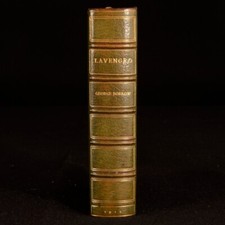
The spine is divided by raised or molded bands and decorated with gilt rules, bright gilt lettering, and a small ornamental gilt vignette toward the foot.
The upper board bears the gilt crest of Aston Commercial School in Birmingham.
Binding features include:
Half dark green leather binding
Matching leather corners
Green cloth-covered boards
Raised or molded spine bands
Gilt spine lettering and decoration
Decorative gilt vignette
Gilt school crest to upper board
Top edge gilt
Original dated prize bookplate
This is a classic English school prize binding: formal, handsome, and durable, with considerably greater shelf presence than the ordinary publisher’s cloth issue.
PROVENANCE: ASTON COMMERCIAL SCHOOL, BIRMINGHAM
The front pastedown bears the original presentation bookplate of Aston Commercial School.
The volume was awarded to:
N. Day
Form IV
Midsummer 1931
The plate is signed by headmaster Edgar C. Keey, M.A.
Aston Commercial School was a Birmingham educational institution with its own school magazine, The Axe. Edgar Keey is independently documented as the school’s headmaster.
The dated prize plate gives the volume an appealing interwar educational provenance and preserves the exact circumstances for which this specially bound copy was presented.
THE BOOK
First published in 1851, Lavengro remains George Borrow’s best-known and most unusual work.
Neither conventional novel nor straightforward autobiography, it combines memoir, fiction, travel, linguistic adventure, social observation, and encounters with outsiders on the margins of nineteenth-century British life.
Borrow’s narrator moves through a world dealers
Writers and printers
Fighters
Romani characters
Roadside encounters
Languages and linguistic puzzles
The title itself combines Borrow’s identities as the Scholar, the Gypsy, and the Priest.
The work has long attracted readers interested in Victorian literature, autobiographical fiction, travel and wandering narratives, language, unconventional social history, and nineteenth-century representations of Romani life.
WHY THIS COPY STANDS OUT
1914 T. N. Foulis edition
First edition thus
Twelve mounted color plates by Edmund J. Sullivan
Original artwork from this edition represented in the Morgan Library & Museum
Handsome half leather prize binding
Decorative gilt spine
Leather corners
Gilt Aston Commercial School crest
Top edge gilt
Original 1931 prize bookplate
Signed by headmaster Edgar C. Keey
Excellent condition
Much more attractive than the standard publisher’s cloth issue
Strong crossover appeal for collectors of George Borrow, British illustration, literary classics, prize bindings, Birmingham history, and decorative leather books
CONDITION
Near fine overall.
The binding is tight, square, and highly presentable.
The dark green leather remains clean and attractive, with only light expected wear at the edges and extremities.
The gilt spine lettering and decoration remain bright and well preserved.
The cloth-covered boards are clean overall, with minor handling wear.
Boards are secure and the binding is structurally sound.
The interior is clean and sound, with light even toning and minimal scattered foxing.
The twelve color plates are present.
Original Aston Commercial School prize bookplate to the front pastedown, dated Midsummer 1931.
Please review all photographs carefully, as they form an important part of the condition description.
A handsome and unusually well-preserved copy of George Borrow’s Lavengro: the first T. N. Foulis edition with twelve mounted color plates by Edmund J. Sullivan, specially presented in an attractive English leather prize binding.