When you click on links to various merchants on this site and make a purchase, this can result in this site earning a commission. Affiliate programs and affiliations include, but are not limited to, the eBay Partner Network.
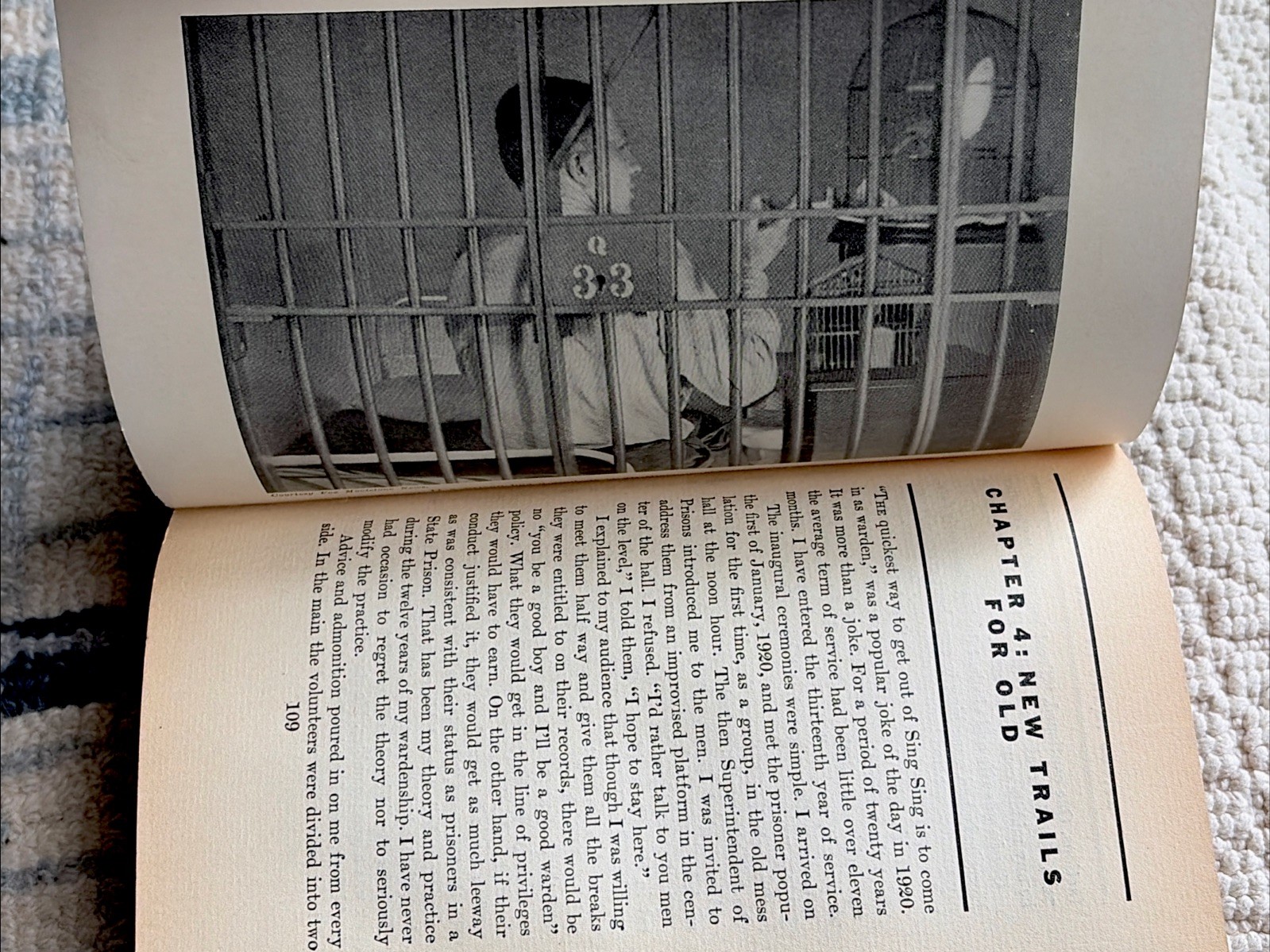
SIGNED —> PRESENTATION FIRST EDITION COPY, FIRST YEAR OF PUBLICATION by Lewis E. Lawes’s 1932 book, Twenty Thousand Years in Sing Sing. It is more significant than the rather stark black binding suggests, both because of what the book represented in American prison reform and because your copy appears to be personally inscribed and signed by Lawes in the year of publication. To —-> Joseph W. Moore, M.D. as First Assistant Physician at Matteawan State Hospital, at Beacon, New York. Matteawan was New York’s institution for mentally ill ( CRIMINALLY INSANE)) involved in the criminal justice system. An American Medico-Psychological Association record specifically lists:
The author — Lewis E. Lawes
Lewis Edward Lawes (1883–1947) was one of the best-known American prison administrators of his era. He became warden of Sing Sing in 1920 and remained there until 1941.
His career in corrections had begun much earlier, as a guard at Clinton Prison in Dannemora, New York. By the time this book appeared, he had accumulated roughly 27 years of experience in prisons. Contemporary reviewers recognized that the book wasn’t merely memoir: a 1932 review described it as a strong argument for a more enlightened treatment of convicted prisoners.
Lawes was unusually associated with rehabilitation rather than simple punishment. He believed prisoners remained individuals and that different people required different approaches to rehabilitation. He was also a prominent opponent of capital punishment—even though, as Sing Sing’s warden, he was responsible for overseeing executions required by law.
Sing Sing and the extraordinary title
The prison is Sing Sing, at Ossining on the Hudson River in New York. By Lawes’s time it was already one of America’s most famous—and notorious—prisons, particularly associated with its death house and electric chair - named OLD SPARKY.
The prison itself became a tourist attraction where they would sell postcards of old Sparky, the electric chair
One historical account explains the figure as roughly 2,000 inmates multiplied by an average ten-year sentence; another scholarly treatment describes it as the aggregate sentences of the roughly 2,500 prisoners there around the time Lawes wrote. Either way, the point is the same: Lawes asks the reader to contemplate the almost unimaginable cumulative amount of human life confined behind the walls.
That makes the starkness of the title quite intentional. Instead of presenting prisoners merely as a mass of “criminals,” Lawes makes the reader think in terms of thousands upon thousands of human years.
THE inscription:
“To Dr. Joseph W. Moore with
best wishes.
Lewis E. Lawes
May 5, 1932.”
Dr. Joseph W. Moore, M.D., was a senior New York parole official; one contemporary criminology source calls him Chairman of the Board of Parole of the State of New York, while another identifies him with the Division of Parole, State Executive Department,
Dr. Joseph W. Moore
Period medical records identify Joseph W. Moore, M.D. as First Assistant Physician at Matteawan State Hospital, at Beacon, New York. Matteawan was New York’s institution for mentally ill ( CRIMINALLY INSANE)) involved in the criminal justice system. An American Medico-Psychological Association record specifically lists:
“Joseph W. Moore, M.D., First Assistant Physician”
Matteawan State Hospital for the Criminally Insane
The Duchess County, NY hospital confined and treated individuals who were committed to it by criminal courts and who were declared insane while serving their sentences at state institutions. The Superintendent of State Prisons had control over the hospital.
Why the book matters
The book appeared at an important moment in the argument over what American prisons were supposed to accomplish. Lawes used his firsthand experience to advocate a more humane, rehabilitative philosophy. Google Books describes the work as an account of his prison career emphasizing progressive developments in penal administration; a contemporary review went further, calling it essentially a plea for enlightened treatment of prisoners.
Lawes opposed the death penalty while serving as warden of a prison where executions were part of his official responsibility. The book confronts capital punishment directly, rather than avoiding it. Lawes oversaw 303 executions in old sparky electric chair during his tenture at Sing Sing. 303! Let that sink in…
Reviews of the book , MAY2 1932 TIMES, The New Yorker in May 1932, which called Lawes’s career account “very interesting reading.” It then inspired the 1932/33 Warner Bros. film 20,000 Years in Sing Sing, directed by Michael Curtiz and starring Spencer Tracy and Bette Davis, and subsequently a long-running radio series narrated by Lawes himself.
This book represents an early modern American prison-reform books of the Depression era, inscribed by the man who actually ran Sing Sing at the time. Its title compresses the accumulated sentences of thousands of prisoners into one startling number, while the substance of the book argues that those enormous stretches of imprisoned human life should be approached with rehabilitation and individual responsibility rather than punishment alone.
Who were the most notorious prisonerS INCARCERATED IN SING SING PRISON UNDER LAWES’ TENURE? ((( check these inmates out!)))
Ruth Snyder and Henry Judd Gray — the great tabloid murder of the 1920s. Snyder and her lover Gray were convicted of murdering Snyder’s husband, Albert, for insurance money. Their 1927 trial became a national sensation. Both went to Sing Sing’s electric chair in January 1928. What made Snyder’s execution legendary was the secretly taken photograph of her strapped into the electric chair at the instant electricity was applied. Lawes later recalled that about 3,000 people gathered outside Sing Sing on the execution night.
* Albert Fish — perhaps the most horrifying prisoner of the Lawes era. Fish was the elderly serial murderer and sexual predator convicted of murdering 10-year-old Grace Budd. His trial produced grotesque revelations that made him one of the most notorious American murderers of the twentieth century. He was executed at Sing Sing in 1936. He is particularly significant in relation to your Lawes book because Lawes’s archival papers actually preserve photographs and material concerning condemned prisoners from this period.
* Charles “Lucky” Luciano — organized crime royalty. Luciano became one of the most powerful figures in American organized crime. After his spectacular 1936 prosecution and conviction on compulsory-prostitution charges, he was imprisoned at Sing Sing before being transferred to Clinton Prison. His presence demonstrates how Sing Sing under Lawes wasn’t merely a place for obscure criminals—it could contain people whose names dominated the national newspapers.
* Louis “Lepke” Buchalter — future boss of Murder, Inc. Buchalter was actually at Sing Sing near the very beginning of Lawes’s tenure: he returned there in January 1920 for attempted burglary and was released in March 1922. He subsequently rose spectacularly through organized crime and became the notorious head of Murder, Inc. He eventually returned to Sing Sing’s death house and was executed in 1944—but importantly, that execution occurred after Lawes retired.
* Owney “The Killer” Madden — gangster and underworld celebrity. Madden was a major New York gang figure associated with the violent Gopher Gang and later became deeply involved in Prohibition-era organized crime. The Sing Sing Prison Museum specifically places Madden among the notorious prisoners encountered during the period surrounding Lawes’s arrival.
* Charles E. Chapin — the “Rose Man of Sing Sing.” His case was sensational for completely different reasons. Chapin had been a powerful newspaper editor—the city editor of Pulitzer’s New York Evening World—before murdering his wife. At Sing Sing he became famous for creating elaborate gardens and was known as the Rose Man of Sing Sing. He is an especially revealing example of the kind of inmate who interested Lawes: an educated, accomplished man who had committed a terrible crime but was capable of meaningful work within prison. The Sing Sing Prison Museum specifically identifies him as the former newspaper editor convicted of murder who became famous for the prison gardens.
* Eva Coo — one of the era’s sensational female murder defendants. Coo, an innkeeper and brothel keeper, was convicted of murdering an employee and was executed at Sing Sing in 1935, squarely during Lawes’s tenure.
SHIPS BOXED MEDIA RATE OR PRIORITY
UP TO THE BUYER