When you click on links to various merchants on this site and make a purchase, this can result in this site earning a commission. Affiliate programs and affiliations include, but are not limited to, the eBay Partner Network.
RAY P. CHASE — ARE THEY COMMUNISTS OR CATSPAWS?1938 Minnesota Gubernatorial Campaign PropagandaExtensive Langston Hughes MaterialPhotographs, Newspaper Facsimiles & Government DocumentsDocumented Use of Manipulated PhotographsExceptionally Scarce — Only 13 Physical Institutional Holdings in WorldCat
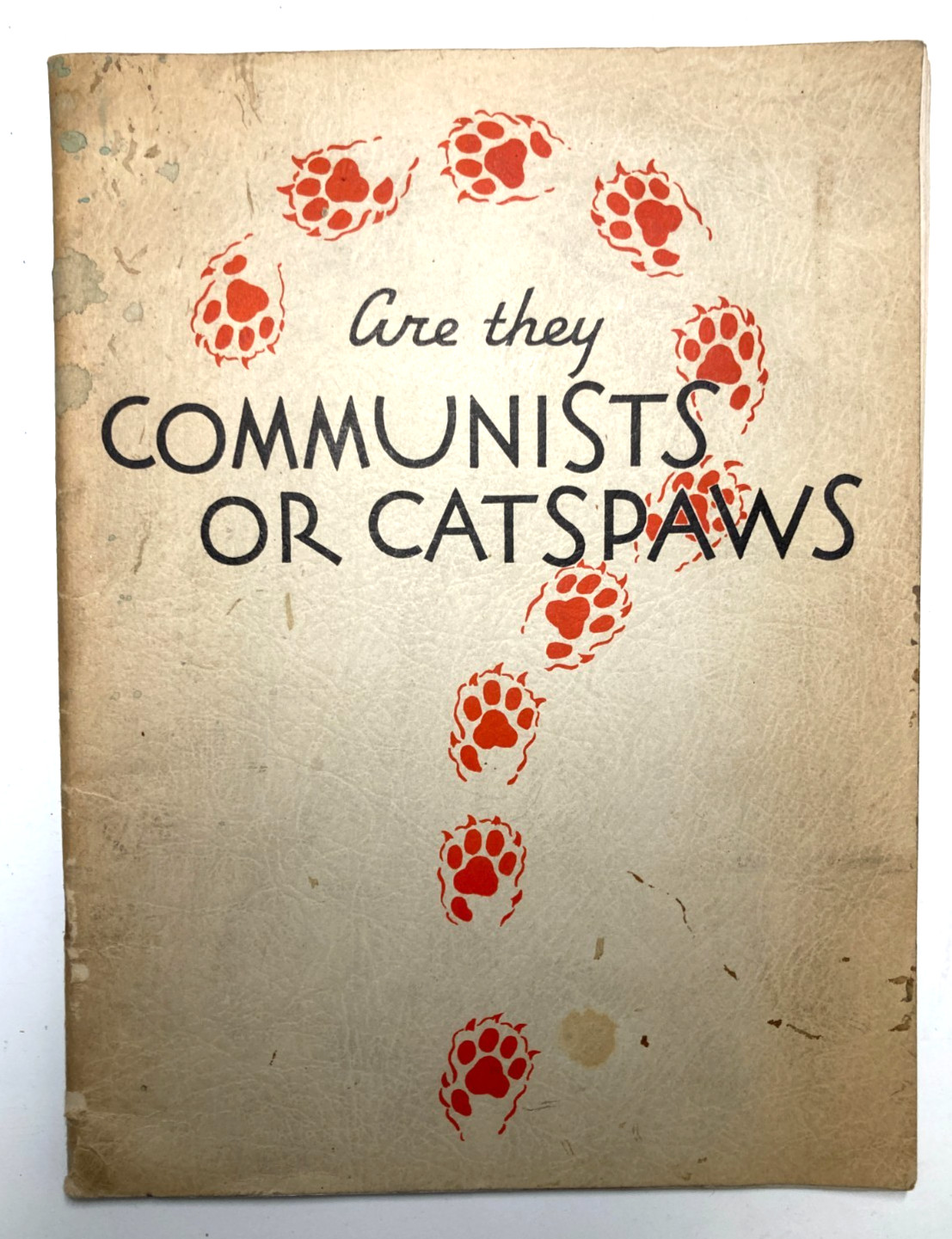
CHASE, Ray P. Are They Communists or Catspaws? A Red Baiting Article. Anoka, Minnesota: privately published by Ray P. Chase, 1938.
Original illustrated wrappers. Approximately 60 pages, extensively illustrated throughout with photographs, portraits, newspaper reproductions, political documents, checks, invoices, and other facsimiles, much of it printed on unusually substantial glossy stock.
An exceptionally scarce and historically significant piece of American political propaganda from the 1938 Minnesota gubernatorial campaign, produced by former U.S. Congressman and Minnesota State Auditor Ray P. Chase shortly before the election between incumbent Farmer-Labor Governor Elmer Benson and Republican challenger Harold Stassen.
Far more substantial than the term “pamphlet” might suggest, Are They Communists or Catspaws? is a large-format, highly produced illustrated publication. Its approximately sixty pages employ photographs, newspaper extracts, reproduced government records, payment documents and other purported documentary evidence in an attempt to portray Benson, members of his administration, the Farmer-Labor movement, and the University of Minnesota as connected with Communism.
Modern historians regard the publication as an important document in the history of political antisemitism, red-baiting, racial politics, and visual propaganda in Depression-era America.
THE 1938 MINNESOTA CAMPAIGN
Chase circulated the booklet shortly before the November 1938 gubernatorial election. It argued that a small group of advisers effectively controlled Governor Elmer Benson and presented four Jewish men associated with the administration as evidence of Communist influence.
A recent University of Minnesota historical investigation describes the booklet as an aggressive attack upon Benson and the Farmer-Labor Party and notes that Chase focused on four Jewish men whom he claimed controlled the governor while excluding other figures central to Benson\'s administration.
The University\'s A Campus Divided project similarly characterizes the publication as antisemitic campaign propaganda circulated shortly before the election and notes its attack upon Benson\'s advisers and the University of Minnesota.
Contemporary and later accounts show that the pamphlet became one of the most notorious pieces of literature produced during the campaign. Minnesota Lawyer, drawing heavily upon Minnesota Historical Society archival material, describes Chase\'s publication as a sixty-page mass-distributed work employing anti-Communist accusations, antisemitism and altered photography.
AN EXTRAORDINARY LANGSTON HUGHES SECTION
One of the most striking aspects of this copy, and something not apparent from a simple bibliographical description, is the extensive treatment of Langston Hughes.
The University of Minnesota\'s recent investigation states that the Hughes material occupies pages 46–61, an unusually large portion of a roughly sixty-page campaign publication.
The section includes:
- a full-page photographic portrait of Langston Hughes, captioned by Chase as a “Communist Poet Who Addressed University Students”;
- a full-page facsimile of the University of Minnesota invoice recording a $100 honorarium paid to Hughes for his October 10, 1935 convocation address;
- reproduction of a hostile 1931 Southern Textile Bulletin article concerning Hughes;
- discussion of Hughes\'s political activity and published poetry;
- reproduction and discussion of Hughes\'s “Christ in Alabama”;
- material concerning “Good Morning Revolution” and other writings;
- an attempt to use Hughes\'s University appearance as evidence for Chase\'s broader allegation of Communist influence on the campus.
The University report confirms that Chase specifically requested and obtained information concerning Hughes\'s University visit and payment, then used that material in Communists or Catspaws.
Minnesota Lawyer likewise notes that Chase attacked Benson by association with Hughes and reproduced material from Hughes\'s poetry as part of his campaign argument.
This makes the publication of particular interest not merely as Minnesota election ephemera but as an unusual 1930s artifact concerning the political reception of Langston Hughes and African American literature.
MANIPULATED PHOTOGRAPHS
The publication is also historically notable for its documented use of altered or misleading photographs.
The recent University of Minnesota investigation states explicitly that Chase included photographs that had been altered to mislead voters about Benson\'s associates and to make it appear that the governor had attended events he had not attended.
This was challenged during the 1938 campaign itself.
Benson\'s reelection organization issued a four-page rebuttal titled Forgery! Frame-Up, accusing the opposition of fabricating, compositing and superimposing photographic material. Minnesota Lawyer, using Minnesota Historical Society archival material, documents one particularly striking example: a photograph was altered so that Benson appeared to be dining alone with Roger Rutchick, one of the Jewish aides targeted by Chase. The contemporary response showed the original context of the photograph and accused Chase\'s publication of manipulating it.
The pamphlet therefore has unusual relevance to the history of photographic manipulation in American electoral propaganda.
ANTISEMITISM AND THE FIVE-MAN “INNER CIRCLE”
Chase\'s central argument presents Benson as either a Communist himself or a “catspaw,” meaning a person unknowingly or willingly used by others.
The opening pages identify a supposed group of men exercising extraordinary influence over the state administration. Modern scholarship has emphasized that Chase singled out Jewish advisers and presented Jewish identity and Communist politics as intertwined threats.
The University of Minnesota\'s recent historical review calls the pamphlet openly antisemitic and racist and describes it as one of the most consequential pieces of propaganda produced in the campaign.
A scholarly treatment in the Mitchell Hamline Law Review likewise identifies Are They Communists or Catspaws? as a notorious component of the 1938 campaign and notes its use of doctored photographs and attacks upon Benson\'s Jewish advisers.
The antisemitic character of Chase\'s publication is therefore not merely a modern seller\'s interpretation; it is a well-established subject of historical scholarship.
THE UNIVERSITY OF MINNESOTA
A substantial part of the booklet attempts to demonstrate that the University of Minnesota had been infiltrated by Communists.
The publication reproduces campus-related material and connects faculty, administrators, student politics and visiting speakers to its broader argument against Benson.
The Langston Hughes material is central to this section. Chase presents the University\'s decision to invite and pay Hughes as evidence of political radicalism, reproducing the University\'s own payment documentation as purported proof.
That aspect of the publication has received renewed scholarly attention in the University of Minnesota\'s institutional-history research into campus surveillance, antisemitism and political activity during the 1930s.
A HIGHLY VISUAL PIECE OF PROPAGANDA
The physical production deserves emphasis.
This is not a cheaply printed four- or eight-page campaign handbill. It is a substantial, approximately sixty-page publication, profusely illustrated and printed in significant part on glossy coated paper.
The pages contain:
- large photographic portraits;
- full-page and double-page photographic layouts;
- newspaper reproductions;
- facsimiles of checks and state documents;
- a University of Minnesota invoice;
- clipped and rearranged newspaper material;
- political commentary integrated directly with photographic evidence.
The result is visually closer to an illustrated magazine or investigative dossier than to ordinary election ephemera.
That elaborate production makes the object especially interesting as an example of prewar American mass-persuasion design.
RARITY
Exceptionally scarce in original physical form.
WorldCat presently records only 13 physical institutional holdings of the 1938 edition.
No ordinary unsigned copy was located in current commercial availability during our research, and no directly comparable public sale result has been identified.
The title is preserved institutionally by the Minnesota Historical Society and other research libraries because of its importance to the study of the 1938 election, Farmer-Labor politics, antisemitism, Communism and anti-Communism, Langston Hughes, and University of Minnesota history.
The U.S. House of Representatives\' biographical record for Chase itself lists Are They Communists or Catspaws? among his published works.
CONDITION
Original flexible wrappers printed in black and red with the memorable paw-print question-mark design.
A complete and unrestored copy, with the original stapled binding intact.
Wrappers toned and soiled from age and handling, with scattered spotting, stains and rubbing. Front wrapper shows a more noticeable area of staining/discoloration along the upper left edge and spine, together with a small circular stain toward the lower portion. Minor edge wear and creasing.
Old moisture staining affects portions of the lower inner gutter and lower margins, most noticeable in the opening leaves and appearing intermittently elsewhere. Some scattered foxing and spotting, including in portions of the Langston Hughes section.
Despite these faults, the interior remains quite attractive overall. The glossy illustrated stock is generally bright, the photographic reproductions retain strong contrast, and the extensive printed and documentary material remains completely legible.
No restoration observed.
Please review all photographs, which form an important part of the condition description.
SCARCE MATERIAL RELATING TO
Langston Hughes • Elmer Benson • Harold Stassen • Ray P. Chase • Farmer-Labor Party • Minnesota politics • University of Minnesota • African American literature • political antisemitism • anti-Communism • American propaganda • manipulated photography • labor history • Jewish American history • 1930s election ephemera