When you click on links to various merchants on this site and make a purchase, this can result in this site earning a commission. Affiliate programs and affiliations include, but are not limited to, the eBay Partner Network.
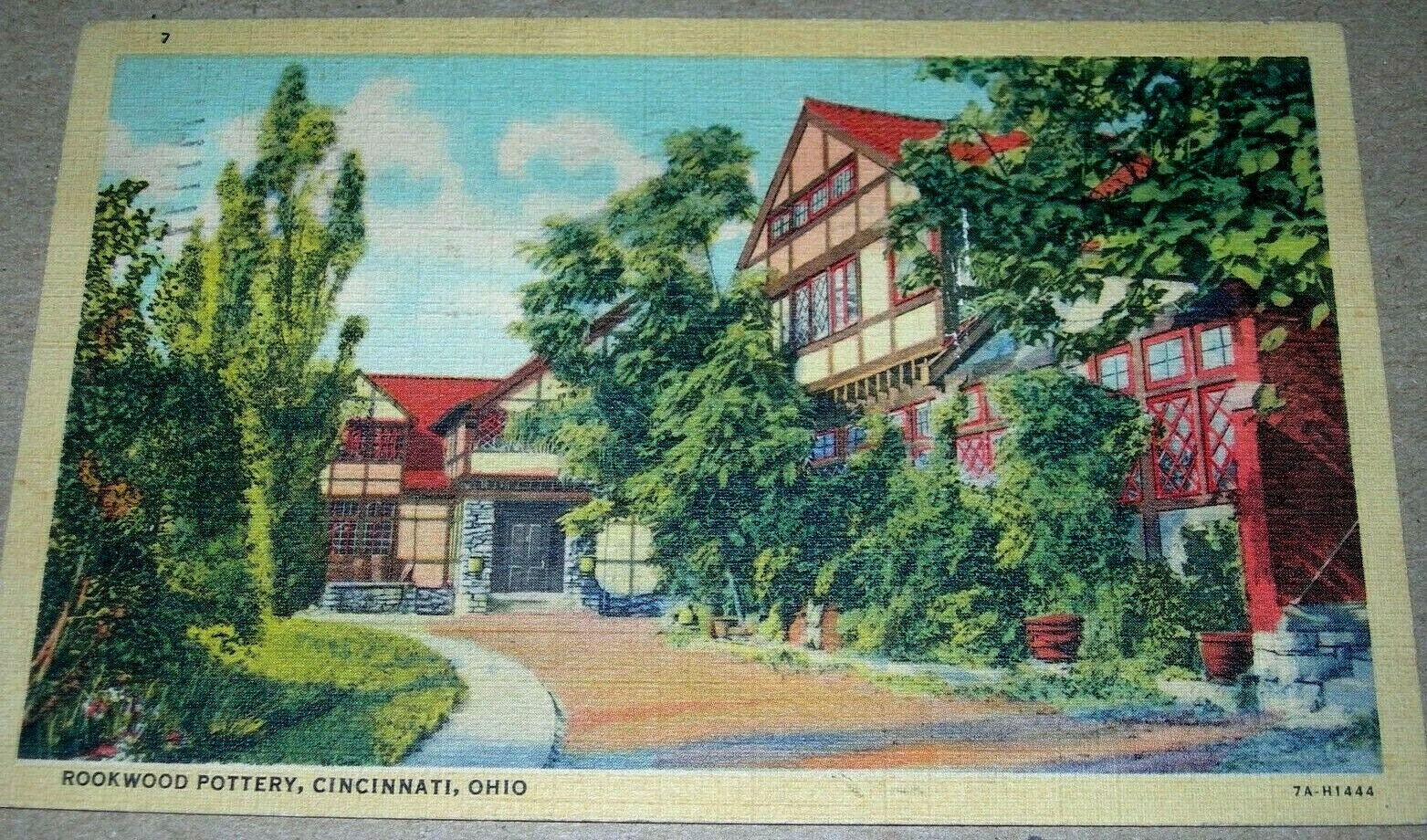
Here is a printed photo postal mailing card. It shows a main street view of the art pottery studio. It is a 1941 Cincinnati Ohio divided back post card. .The caption is \" ...... \".
Rookwood Pottery was initially based in a school building in the Over-the-Rhine neighborhood in Cincinnati that Longworth had bought in March of 1880. Storer would name the building Rookwood based on her father’s country estateoutside Cincinnati, Ohio. The early history of Rookwood Pottery consists of Storer purchasing a kiln and pulling the first wares from it on Thanksgiving Day of 1880.
Along with Mary Louise McLaughlin (1847-1939), a future competitor in the pottery market, both an under and overglaze kiln was built to improve the production process. These developments would cement her legacy as one of the first women-owned manufacturing companies in the United States. The company’s headquarters would later be moved to a hilltop in the Mounty Adams District along the riverfront of Cincinnati, Ohio. The building was designed by H. Neill Wilson (1855-1926), the son of a very prominent Cincinnati architect, James Keys Wilson (1828-1894).
Storer would eventually implement a foundational design for Rookwood pottery by developing the “Standard Glaze” to be used prominently in their pottery designs. The pottery glaze was mostly used on floral motifs and in the production of portraits. Storer would also develop the “Tiger Eye” glaze, which produced a highly collectible gold-tone deeper in the glaze. Rookwood was also well known over its history for the employment of women. Additionally, Rookwood has origins in making relief-type-colored ceramic clay in various tones. The ceramic would be painted by patrons of the pottery studio who would come in and paint the greenware for a price. Rookwood would eventually struggle through the Great Depression and shutter its doors permanently in 1941 because of losses incurred during the economic crisis. Rookwood would subsequently move to Starkville, Mississippi, after being acquired by Herschede, a famous clockmaking company, before closing permanently in 1967.
Shipping is $3.99 with cardboard protection.