When you click on links to various merchants on this site and make a purchase, this can result in this site earning a commission. Affiliate programs and affiliations include, but are not limited to, the eBay Partner Network.
A museum-quality masterwork and centerpiece for any accomplished Bob Dylan or 1960s folk-rock collector
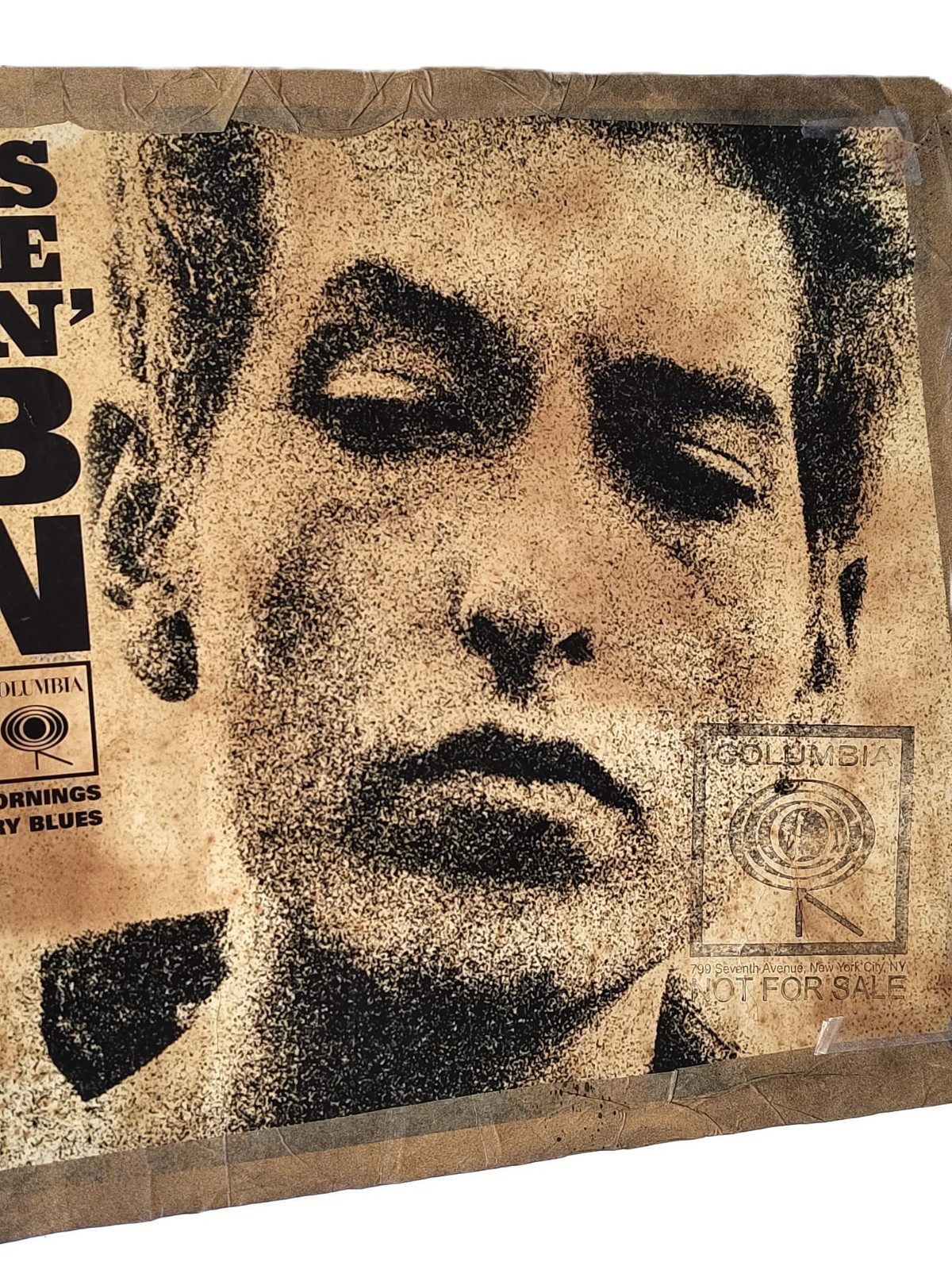
Bob DylanThe Times They Are A-Changin' 1964 Columbia Records (King Karol Records Mailer)
LOT DESCRIPTION, PLEASE READ
This unique rock art is a signed masterwork by the enigmatic British contemporary artist/conservator Aurelian (known online as @restorerofworlds).
The piece reanimates vanishing music history and features an antiqued, denatured paper substrate with active corrosion to make the piece behave as if it were still glued to a wall in 1960s New York.
1964 Columbia Records NOT FOR SALE period-correct promotional poster sent out to iconic King Karol Records, New York, ahead of the release of Dylan's landmark third studio album, The Times They Are A-Changin'.
Released February 10, 1964, The Times They Are a-Changin' stands as a landmark in American music history as Dylan's first album to consist entirely of original compositions, establishing him firmly as a premier global songwriter.
LOT DESCRIPTION, PLEASAE READ
Artist: Aurelian #restorerofworlds
Produced: 1970-2020 Contemporary
Edition: Signed variable edition #1 of 4
Substrate & Dimensions: 59cm x 38cm denatured paper substrate with active corrosion
Framed Dimensions: Unframed
Frame: Unframed
Process: See biography
Unpacked Weight: 53 grams
Condition: Original
Reference: DLG622
ARTIST BIOGRAPHY
Enigmatic yet anonymous.
The Restorer of Worlds #restorerofworlds his only online archive.
A reverent homage that borders on resurrection; reviving fading 19th and 20th century worlds for a 21st-century audience starved of beauty and stillness.
His unique invention of active corrosion is not street art, not conceptual, not ironic but a more sincere technical mastery and a statement in the service of wonder and nostalgia that ushers the outdoors and all the elements inside.
Your poster really thinks it is still on the wall at King Karol Records,111 West 42nd St, New York, and it still behaves like it is.
By subjecting hyper-faithful reproductions of canonical masterworks to chemical and mechanical trauma, Aurelian collapses the distance between historical idealism and modern existential reality.
A singular creative intelligence behind the content reveals an artist who re-contextualizes historical works for contemporary eyes.
His captions are scholarly and understated yet the recurring #aurelian #restorerofworlds and cryptic tags imply these are not mere reposts. They reveal uniquely restored editions: enhanced, upscaled and reinterpreted by Aurelian himself, reanimating rapidly vanishing master works and museum archives into living contemporary statement pieces.
His scholarly detail and multi-disciplinary mastery places Aurelian adjacent to the classical realism or academic revival movement of Jacob Collins atelier tradition or contemporary plein-air masters, but now with unique materials, historical curation, anonymity and a corrosive observation of society.
Aurelian is displayed by collectors in New York, Paris, London, Berlin, Shanghai and Madrid.
PROVENANCE
Signed by the artist Aurelian. This piece appears on the official Aurelian online catalogue @restorerofworlds reference number DLG622
PAYMENT, SHIPPING & INSURANCE
Payment at checkout with Buy It Now.
Securely consigned fully insured through Buyer Protection.
Bespoke packaging by Trans Art Box Company England, specialist fine art shipping.
All orders are packed with an industrial cardboard shipping box with polystyrene liners.
Please note any applicable import duty or VAT in your country is the buyers responsibility.
QUESTIONS - GET TO KNOW EXACTLY WHAT YOU ARE BUYINGPlease take a moment to ask any questions you might have prior to purchase.
responseAccording to , statistically 60-80% of users do not leave response so happy to reciprocate with response if or when I receive yours.
The Times They Are A-Changin' 1964 Columbia Records
1964 Columbia Records NOT FOR SALE promotional poster and music trade mailer for Bob Dylan's landmark third studio album, The Times They Are A-Changin'.
Period-correct promotional artifact sent out to music industry insiders and record shops ahead of the album's release.
Historical Context, Reception & Legacy:
Released on February 10, 1964, The Times They Are a-Changin' stands as a landmark in American music history as Bob Dylan's first album to consist entirely of original compositions, establishing him firmly as a premier songwriter.
Produced by Tom Wilson at Columbia's Studio A, the record ditched the playful humor of his previous work for a stark, unsparing, and deeply poetic focus on racism, poverty, and systemic social injustice.
While some initial critics and fans missed the musical variety of Freewheelin' the album was a major commercial triumph, peaking at #20 on the US Billboard charts and later reaching #4 in the UK.
The title track became the overarching anthem of 1960s counter-culture, the Civil Rights Movement and the generational divide rolling across the country following the assassination of JFK.
In terms of legacy, this record represents the pinnacle and culmination of Dylan's purely acoustic "protest song" era.
Immediately following this release he began moving away from the "voice of a generation" folk moniker toward the abstract, electric rock poetry that would redefine popular music forever.
Key Details & Features: Front Portrait:
Features the striking, iconic cover photo by legendary photographer Barry Feinstein, alongside the full album track list. Includes the critical "799 Seventh Avenue, New York City, NY - NOT FOR SALE" promo branding block at the bottom right, which directly addresses the historic studio location where Dylan tracked the album.
Reverse Side Provenance:
The reverse acts as the original self-mailer envelope, providing irrefutable provenance. It features the addressee stamp, being historic King Karol Records at 111 West 42nd St, New York—a legendary, defunct NYC music hub—alongside authentic 1964-era 5-cent US postage stamps and a partial New York post mark.
King Karol Records
King Karol Records was one of New York City’s most important independent music retailers during the golden era of vinyl.
Founded in 1952 by Ben Karol and Phil King, the chain eventually grew to seven locations across Manhattan and Queens. It became legendary among collectors, industry insiders, and international tourists for maintaining an unparalleled, exhaustive inventory across every conceivable musical genre.
The History of the 111 West 42nd Street Location: An Early Mainstay (1950s–1976):
Located near 6th Avenue in the bustling heart of Midtown Manhattan, 111 West 42nd Street was one of King Karol's earliest storefronts.
It served as a critical hub during the 1960s folk and rock revolutions - explaining why your 1964 promotional mailer bears this historic address stamp.
The Massive "Schwann Catalogue" Stock:
King Karol's ultimate claim to fame was its business philosophy: if a record was currently listed in the Schwann Catalogue (the definitive industry directory of in-print music), King Karol kept it physically on the shelves. This massive depth of stock attracted international music buyers and collectors who couldn't find rare pressings anywhere else.
The Famous Mail-Order Empire:
Beyond walk-in retail traffic, the 42nd Street operation was a powerhouse mail-order business. They distributed book-format print catalogues across the globe. Record labels (like Columbia) frequently partnered with them to ship promotional items and new releases directly to radio stations, reviewers and sub-distributors.
Pop Culture and Street Legacy:
In 1966, the storefront's exterior was immortalised on film in Francis Ford Coppola's comedy You're a Big Boy Now. By the 1970s, the block evolved into a gritty, neon-lit slice of classic "Old Times Square" culture, sitting directly alongside the famous adult venue Fun City at 113 West 42nd St.
Relocation and Closure:
In 1976, King Karol moved this specific branch just down the block to a larger space at 126 West 42nd Street. By the mid-1980s, the chain found it impossible to compete with the arrival of corporate mega-stores like Tower Records. King Karol gradually downsized and had officially closed its doors for good by 1993.Voice of a Generation
Dylan was the quintessential figure of the American counterculture during the 1960s, widely dubbed the "voice of a generation." His early 1960s acoustic anthems like "Blowin' in the Wind" and "The Times They Are a-Changin'" provided the literal soundtrack for both the Civil Rights Movement and the anti-Vietnam War protests.
Why Dylan Defined the Counterculture: Anthems of Dissent:
His songs captured the disillusionment of American youth toward the establishment, political corruption and systemic racism.
Movements adopted his music because it articulated their anger and hope better than any traditional political speeches.
The 1965 Electric Pivot:
When Dylan "went electric" at the Newport Folk Festival in 1965, he fractured the traditional folk scene but further solidified his countercultural status. He transitioned from writing literal protest songs to unleashing surreal, cynical, and revolutionary rock poetry (such as "Like a Rolling Stone") that completely redefined what popular music could express.
Rejecting the Label:
Ironically, Dylan himself fiercely resisted being a leader. He grew to despise the "voice of a generation" label, viewing himself as a musician rather than a political prophet and famously retreated from the spotlight following a 1966 motorcycle crash to escape the immense pressure of the movement.
Aurelian #restorerofworlds Process
Typically 8-10 months time to completion. The waiting list varies from one to two years.
Based on Aurelians previous work over the last forty years scholars have identified signature processes embracing the volatile physics of organic decay in some cases blending botanical matter with mineral pigment.
Following is part of an art industry extract which reveals some of the multi-disciplinary processes in Aurelian’s hyper-craft.
The Component Philosophy: Aurelian constructs a highly volatile compound that functions as both a chemical stain and an interactive element:
The Living Core: Highly concentrated infusions, most unknown origin but some harvested from the red calyx of Hibiscus Sabdariffa. This botanical liquid is naturally saturated with powerful, unstable anthocyanin pigments and strong organic acids.
The Metallic Binding: Fine iron oxide pigments (reminiscent of raw ochre or rust).
The Canvas: Heavy, porous paper substrates that readily absorb and react to liquid infusion.
The Chemical & Metaphorical Symphony: Rather than simply painting an image onto paper, Aurelian sets off a chain reaction that transforms the artwork across three distinct phases:
The Instant Color Shift (The Iron Gall Effect): When the acidic hibiscus calyx extract meets the iron oxide pigment, a process of acid dissolution occurs or “active corrosion”. The organic acids complex with the iron ions, causing the vibrant crimson hibiscus shades to immediately deepen into dark, gothic purples, deep blues or near-blacks. This mimics the formulation of ancient iron gall ink.
Substrate Alteration ("Denaturing"): As the highly acidic mixture sits on the paper, it attacks the cellulose fibers so is painstakingly managed and controlled through its first weeks. The acid breaks the hydrogen bonds within the paper's matrix. This localized degradation physically changes the structure of the substrate, eventually giving the paper a heavily weathered, aged and physically transformed character.
Atmospheric Responsiveness: Once dry, the artwork remains sensitive to the surrounding environment. Changes in room temperature and spikes in humidity reintroduce micro-moisture to the paper, briefly reactivating the residual organic acids. Over time, the anthocyanins continue to gently oxidize, causing the visual image to subtly morph and color shift in tandem with the climate of the room it is displayed in.
Through this specific process, the artwork is never truly "finished."
It acts as a ticking chemical clock, transforming the artist from a traditional painter into a curator of active, visual decay.
By subjecting hyper-faithful reproductions of canonical masterworks to chemical, mechanical, and digital trauma, scholars suggest Aurelian collapses the distance between historical idealism and modern existential reality.
Hyper-CraftMonths of work and often more than thirty separate disciplines can go into the creation of a single Aurelian artwork, particularly when the piece also includes conjoined historical artifacts.
The following technical summary is relevant to the work featured:
Section 1: Procurement & Curation
Philatelic Forensic Validation (Stamps and cancellations)
Chromatographic Sourcing & Alignment (Color-matching materials)
Archival Ephemera Preservation (Document conservation and preparation)
Historical Material Sourcing & Provenance Authentication: Locating period-correct, age-authentic 19th and 20th-century documentation.
Anachronistic Ephemera Conjunction: Integrating authentic historical documents and philatelic assets directly into the composition to anchor the artwork in a specific period aesthetic.
Section 2: Substrate Preparation
Mechanical Substrate Abrasion (Manual and electronic surface profiling with abrasives)
Vintage Adhesive Materialization: Sourcing, weathering and manually painting period-correct adhesive tapes before physical affixation to mimic long-term structural repairs.
Chemical Substrate Denaturing: Artificially distressing raw paper fiber matrices using botanical compounds like acidic infusions to force rapid fiber breakdown.
Substrate Delamination & Grafting: Deliberately splitting paper plies and grafting disparate ephemera types into a singular structural sheet.
Section 3: Environmental Degradation
Paper Science & Applied Chemistry (Active chemical corrosion)
Pyrometric Degradation (Precision fire forging)
Pyrogenic Smoke Patination (Carbon soot layering)
Microbiological Acceleration Simulation: Creating accelerated foxing, mold-mimicking blooms, and moisture-stain mapping to simulate decades of damp storage.
Organic Botanical Cultivation: Curating open-air botanical infusions over multi-week cycles to cultivate active surface mold, harvesting natural organic materials for structural application.
Enzymatic Biodegradation Control: Utilizing isolated organic enzymes to selectively weaken cellulose structures without completely destroying the surrounding substrate.
Atmospheric Oxidation Chambering: Subjecting materials to altered, high-humidity environments to rapidly accelerate natural airborne decay and yellowing.
Particulate Infiltration & Embedding: Forcing microscopic environmental dust into the paper pores to simulate a century of exposure to open air.
Cryogenic Thermal Shocking: Alternating extreme cold and intense dry heat cycles to induce micro-fractures in old varnishes, coatings and ink layers.
UV Photolytic Fading: Exposing targeted areas to intense ultraviolet radiation spectrums to mimic decades of direct solar bleaching and pigment shifting. (New Expansion)
Section 4: Typography & Printing
Graphic Design & Historical Typography (Logo and layout reconstruction)
Archival Seal & Cachet Replication (Recreating period ink stamps)
Commercial Printing Techniques (Textured ink stenciling)
Intaglio & Relief Impressioning: Utilizing historical heavy-pressure plate indentation to give printed elements an authentic, embedded physical footprint.
Section 5: Sensory & Finishing
Chromatic Color Grading (Atmospheric tonal balancing)
Olfactory Engineering (Compounding scents of paper decay)
Preservation Polymer Chemistry (Professional German made fixatives)
Isolating Resin Chemistry: Applying individual micro-thin conservation barrier layers throughout the build to freeze and isolate volatile, actively corroding chemical reactions from later completely destroying the piece over time.
Section 6: Museum View Framing
Framing & Preservation
Aurelian frames are engineered using their"Museum View" dual-glazing system.
This dual-glass construction provides full visual transparency through the artwork while serving a critical archival function to help precision-seal the envelope and strictly manage air exchange. By regulating atmospheric influx the design helps control ongoing chemical reactions and preserves the delicate balance of the work.