When you click on links to various merchants on this site and make a purchase, this can result in this site earning a commission. Affiliate programs and affiliations include, but are not limited to, the eBay Partner Network.
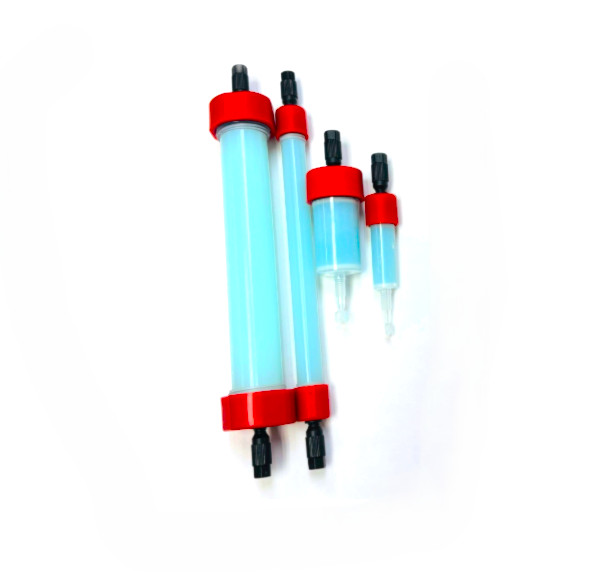
20 ml Ni-NTAFast Flow Column MBC01-FF20
The 20 ml MBC01-FF20 column is a prepacked nickel affinity column specifically engineered for high-efficiency purification of His-tagged proteins. Packed with nickel-charged resin, the column selectively binds histidine-tagged proteins, enabling precise and consistent separation from complex biological lysates.
Built for durability, the MBC01-FF20 offers excellent chemical stability and minimal metal ion leakage, making it suitable for harsh conditions, including exposure to acids, bases, and various chemical agents. It is compatible with standard aqueous buffers and a broad range of additives, offering flexibility across diverse purification workflows.
Both ends of the column are configured for 1/16" Fingertight male connectors, ensuring easy integration with a wide range of chromatography systems. It is fully compatible with legacy GE systems such as ÄKTA Prime and Explorer, as well as newer platforms including ÄKTA Start, Go, Pure, and Avant.
Ideal for academic research and pharmaceutical manufacturing, the MBC01-FF20 offers a reliable, small-scale solution for high-purity protein purification with reproducible performance.
Specifications:
Matrix Highly cross-linked 6% agarose
Bead size 45-165 µm
Ligand Chelating group pre-charged with Ni²⁺
Pressure Limit 0.3 MPa
Ideal Binding pH 7.5 – 8.0 for histidine-tagged protein
Max Binding Capacity 20~30~40 mg (differs by protein)
Ni Column Purification Protocol
Flow rates
- Loading: 2 mL/min
- Washing: 2–3 mL/min
- Washing:2–3 mL/min
- Elution: 2-4 ml/minGradient from 150–190 CV (Buffer A → Buffer B)
Buffers
- Loading buffer:
25 mM Tris or 25 mM phosphate, pH 7.5
300 mM NaCl
Optional: up to 20 mM imidazole (do not exceed) - Washing buffer:
20 mM Tris or 20 mM phosphate, pH 7.5
300 mM NaCl
20 mM imidazole (can increase slightly if needed, but use caution) - Elution buffer:
20 mM Tris or 20 mM phosphate, pH 7.5
300 mM NaCl
0.2–0.3 M imidazole
We’ve received some great questions from customers since listing this column. We’re sharing them here in a Q&A section to help others as well. Please feel free to ask your own questions—we’ll continue adding more over time!
Questions and Answers:
1.What is the max pressure and recommended flow rate?
Max pressure / flow rate: The columns are designed to operate up to 0.3 MPa. They can be run at up to 20–30 mL/min; however, we typically recommend 2–10 mL/min depending on your application and system setup. For this smaller size column, we suggest ~2–3 mL/min for loading and 2–5 mL/min for elution, while washing steps can go up to ~10 mL/min. Of course, optimal loading flow rate may vary depending on the specific protein.
2.Flow direction:Both ends are identical, so there is no required flow direction.
3.Cleaning & storage: For cleaning, flush with 0.1 M EDTA and 0.3–0.5 M NaCl in the Tris or Phosphate buffer at pH 7.5 (make sure all Ni2+ removed and no color anymore), followed by 0.5 M NaOH. Then wash with deionized water to remove NaOH residue and prevent precipitation of Ni²⁺. Recharge the column with 0.5 -1 CV volume of 0.1 M NiSO₄, then wash with deionized water and your elution buffer containing imidazole to remove excess Ni²⁺. For storage, keep the column in 20% ethanol or deionized water with 0.03% sodium azide, and ensure it is properly sealed to prevent drying.
4.When monitoring protein via A280, should I expect to see peaks rise above the baseline created by imidazole?
Generally speaking, if you have a good amount of protein, there’s no need to worry — absorbance at 280 nm will be dominated by the protein signal. Your protein (especially if it contains aromatic residues like tryptophan or tyrosine) will typically produce clear peaks above the background.Imidazole does contribute to the absorbance at 280 nm, and as its concentration increases during elution (Max Imidazole concentration for elution ~0.2–0.3 M), you may see a gradual rise in the baseline. However, this usually only becomes noticeable when protein levels are low or absent.5.For small proteins lacking tryptophan or tyrosine, what detection method should I use?
For small proteins lacking tryptophan or tyrosine, A280 detection may be insufficient. In such cases, consider monitoring at 254 nm instead, where peptide bonds provide stronger absorbance.
6.What buffer should I use with this Ni resin column, and how should the buffer be prepared and handled?
Optimal binding typically occurs at a pH of 7,0 – 8.0. Buffers within this range—such as Tris or phosphate—are suitable for loading, commonly supplemented with 250–300 mM NaCl as a basic component.You may include additional components depending on your protein, but avoid EDTA, as it can strip the nickel from the resin.
For the elution buffer, add 0.2–0.3 M imidazole, and be sure to adjust the pH to match that of the loading buffer.Finally, filter all buffers through a 0.45 µm filter before use.