When you click on links to various merchants on this site and make a purchase, this can result in this site earning a commission. Affiliate programs and affiliations include, but are not limited to, the eBay Partner Network.
EMPTY Antique Dr. Freeman’s C.D.Q. Opium Tablets Bottle – Portland, Maine – c. 1915
PLEASE NOTE: THIS BOTTLE IS COMPLETELY EMPTY. IT CONTAINS NO TABLETS, MEDICINE, OPIUM, OR OTHER CONTENTS.
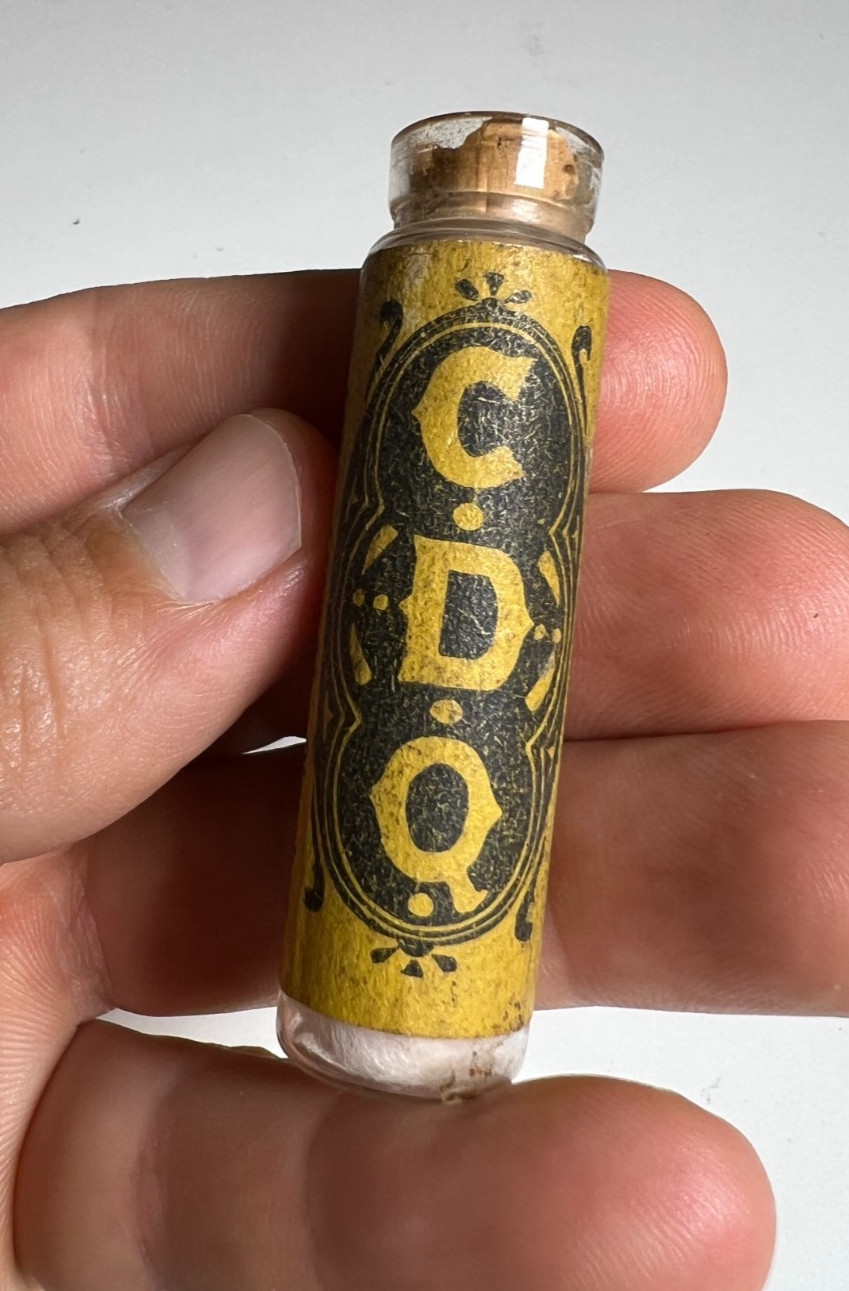
This is a scarce, wonderfully graphic empty Dr. Freeman’s C.D.Q. patent-medicine vial, retaining its original yellow-and-black paper label and partial cork. An almost identical example is preserved in The Henry Ford museum collection.
This listing is for the antique empty glass bottle and its historic paper label only.
Identification
The large central initials read:
C.D.Q.
The surrounding label identifies the original preparation as:
For Colic, Cramps, Diarrhea, and All Summer Complaints
It was manufactured by:
Freeman Pharmacal Co.Portland, Maine
The vial measures approximately 2¼ inches tall and originally sold for only 10 cents.
Again, although the label describes the bottle’s original medicinal contents, the bottle is now completely empty.
Precise Date: Circa 1910–1918
I would date this particular vial to approximately:
c. 1915
That date is unusually well supported. The label states:
Guaranteed under Food and Drugs Act, June 30, 1906 — Serial No. 455
Therefore, it cannot predate 1906. More importantly, The Henry Ford dates its virtually identical Dr. Freeman’s C.D.Q. vial to circa 1915. Its museum example has the same dimensions, yellow label, dosage language, manufacturer and federal guarantee number. See The Henry Ford museum record.
That makes circa 1915 the strongest and most defensible date—not merely a general “early 1900s” estimate.
What Did the Bottle Originally Contain?
The fine print on the historic label states:
Each tablet contains 3 minims Tinct. Opium
“Tinct. Opium” meant tincture of opium, commonly known as laudanum. The tablets originally packaged in bottles like this were intended to slow intestinal action and relieve pain and cramping associated with diarrhea.
The directions instructed customers to take:
One or two tablets; repeat in half an hour.
The label simultaneously promised “No Harmful Effect,” a striking reminder of how casually powerful narcotics were once marketed to American households. Early federal law required disclosure of certain narcotic ingredients but did not immediately eliminate them from over-the-counter remedies.
No tablets or medicinal contents remain in this example. The bottle is empty and is being offered solely as an antique collectible.The Maker—Edgar S. Fossett
The Freeman Pharmacal Company was operated by Edgar S. Fossett of Portland. Fossett helped establish the earlier Freeman-Rice Medicine Company in 1892, assumed full control around 1894 and renamed it the Freeman Pharmacal Company.
The firm operated from 40 Preble Street in Portland, Maine, and sold patent remedies throughout northern New England. Its other preparations included:
- Dr. Freeman’s Balsam of Fir Wafers
- Headache capsules
- Toothache wax
- Cold tablets
- Various digestive and pain preparations
Fossett was not actually “Dr. Freeman.” The medical-sounding Freeman name functioned as the brand—a common marketing practice within the patent-medicine trade.
Museum Connection
A matching Dr. Freeman’s C.D.Q. vial belongs to The Henry Ford in Dearborn, Michigan, under artifact number 00.4.6116.
The museum attributes the product to the Freeman Pharmacal Company and Edgar S. Fossett, dates it to circa 1915, and records the same claims, dosage, opium disclosure, Portland location and 10-cent price.
That institutional match provides particularly strong identification and dating—always a lovely thing when the research gods cooperate.
Condition
Approximately 2¼ inches tall.
- Bottle is completely empty
- No tablets, medicine, opium or other contents are included
- Original yellow-and-black paper label
- Original partial cork remains in the mouth
- Label remains remarkably complete and readable
- Strong central C.D.Q. graphics
- Expected age toning, scattered surface wear and small areas of paper loss
- Glass appears bright and clean
Please examine all photographs carefully, particularly the mouth, partial cork and paper label, as they form an important part of the condition description.
This listing is for an empty antique bottle and its original historic label only.