When you click on links to various merchants on this site and make a purchase, this can result in this site earning a commission. Affiliate programs and affiliations include, but are not limited to, the eBay Partner Network.
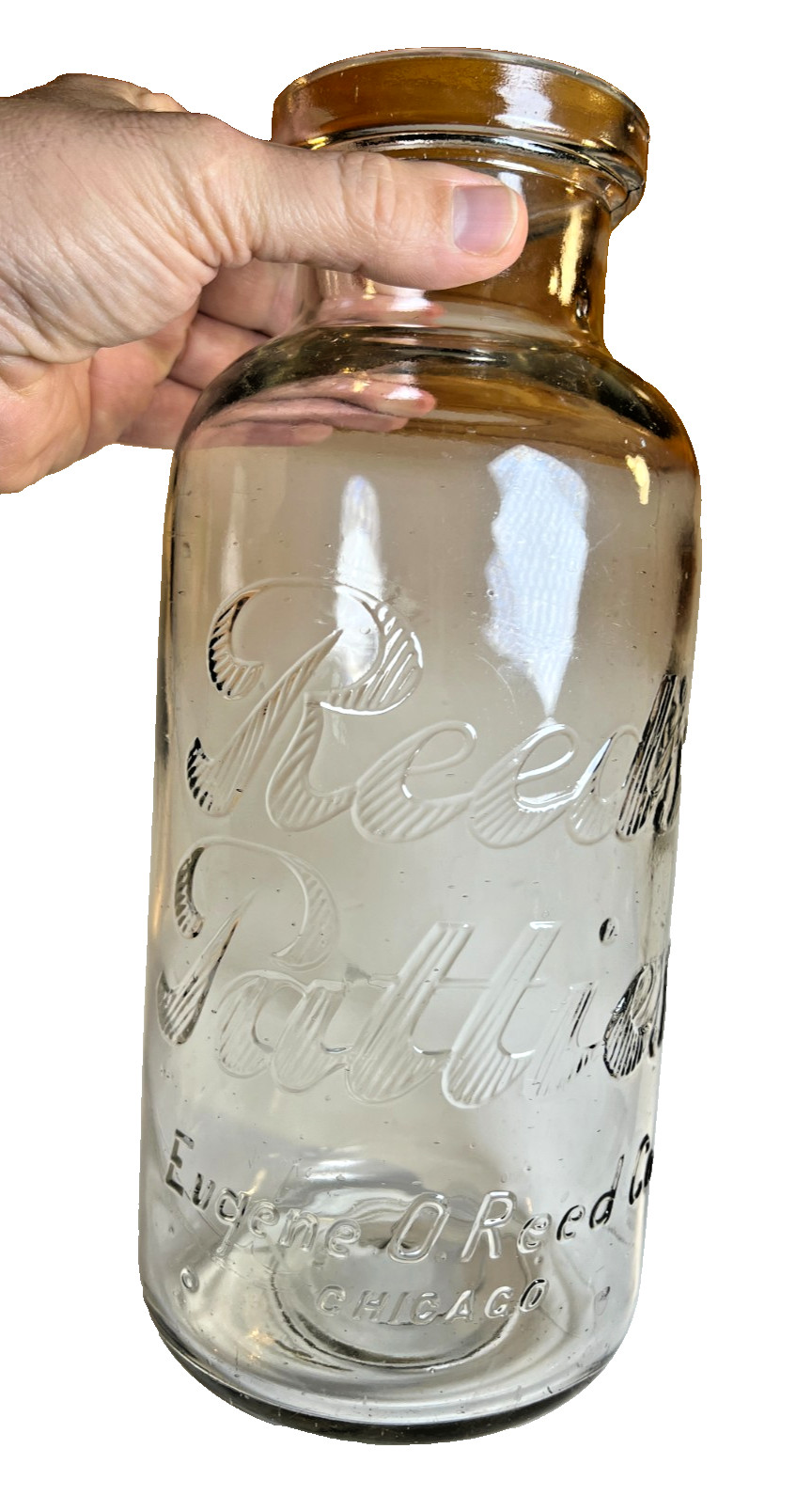
A Reed’s Patties jar from Eugene O. Reed Co., Chicago, a premium confectionery manufacturer active from the 1910s through the 1930s, best known for its “Reed’s Butterscotch Patties” and later “Reed’s Rolls” candies.
Identification
This large embossed jar — measuring 11.25" tall x 5" wide — is an original counter or store display jar, used to hold wrapped candy patties at soda fountains and general stores. The Eugene O. Reed Co. logo is deeply embossed in script lettering with hatched fill lines, a signature Reed design feature from the 1920s advertising era. The wide-lip top would have held a glass lid or tin cap, depending on store use.
These jars were made in small batches for commercial display, so while not technically rare, pristine examples are unusually well-preserved — especially with such brilliant clarity and shine.
Condition
This one’s a standout:
Minty clean – no chips, cracks, or stains
Crystal-clear glass – no interior haze or ghosting
Crisp, deeply struck lettering with stylized hatched script
Bright, glossy finish with early machine-made character and tiny seed bubbles visible
Historical Context
Eugene O. Reed Co. of Chicago was among the first to mass-produce individually wrapped hard candies in America. Their butterscotch patties and later “Reed’s Rolls” became a national sensation — a fixture in drugstores and rail depots alike. These jars once stood proudly on polished marble counters, the sunlight catching the script and candy within. The Reed name was so enduring that the brand survived multiple buyouts (including Life Savers, Inc.) well into the 20th century.
Let’s go back — to Chicago, around 1920, when your “Reed’s Patties” jar would’ve stood proudly on a marble soda fountain counter, catching sunlight through the front windows of a corner drugstore.
The Candy Capital of America
By the early 1900s, Chicago was the undisputed candy capital of the United States — home to more confectionery giants than anywhere else in the world. The city’s bustling rail lines, access to sugar imports, and innovative machinery made it a haven for sweet-makers.
Eugene O. Reed Co. joined a glittering roster that included Curtiss Candy Co. (Baby Ruth, Butterfinger), Bunte Brothers, Fannie May, and Wrigley (then still a gum company).
Between 1915 and 1930, Chicago produced nearly one-third of all candy sold in America.
Factories belched sugar steam and peppermint vapor into the cold Midwestern air, and kids walking to school could literally smell which candies were being made that day.
Eugene O. Reed & the Birth of Reed’s Patties
Eugene O. Reed, a Chicago confectioner with a flair for branding, founded his namesake company around 1893–1895. Reed focused on small, high-quality hard candies rather than bulk chocolates — what grocers called “penny sweets.”
His Reed’s Patties were a marvel of the era: perfectly round, buttery-smooth disks of hard candy with a slow-dissolving texture and a rich butterscotch flavor. Each was individually wrapped in wax paper — a technological innovation at the time that kept candies clean, portable, and fresh.
A glass jar like yours — hand-filled and displayed at the counter — would’ve been the centerpiece of the shop. The shopkeeper scooped patties out with a small tin scoop, wrapping them in paper or dropping them into a child’s waiting hand for a few copper cents.
By the 1930s, the company had expanded into a full line of flavors — Butterscotch, Root Beer, Cinnamon, Peppermint, and Lemon — leading to the later “Reed’s Roll” packaging familiar to mid-century kids. But the “Patties” were the original — and the jar in your hands dates to that golden first era.
A Day in the Life — Chicago, circa 1925
Imagine you’re ten years old, a city kid in 1925, walking home from school. The streets are lined with clanging streetcars, Model T Fords coughing in the cold air, and the smell of coal smoke mingling with baking bread from the corner bakery. Your allowance — maybe three pennies — jingles in your pocket.
You stop by Mr. Brenner’s Drugstore, where the marble soda fountain gleams and the shelves are filled with candy jars stacked in rows like jewels. The Reed’s Patties jar sits front and center, thick glass embossed with fancy script that catches the light like crystal.
You point at it — “Butterscotch, please.” Mr. Brenner slides open the lid, scoops three patties into a crisp paper twist, and hands it over. The candies clink together with a sound every kid in Chicago knows by heart.
You walk home, kicking through slushy snow, unwrapping one as you go. The sugar hits first — sharp and sweet — then the warmth of real butter, melting slow enough to last the entire walk home. When you get there, you tuck the remaining two patties into your coat pocket, sticky paper and all. They’ll be your treat after supper, when the family gathers around the new Atwater Kent radio, listening to Amos ‘n’ Andy or the latest baseball scores.
The Technology & Culture of the Era
When this jar was new:
Electric blenders and toasters were just entering middle-class kitchens.
Radio was transforming the home from a quiet place to a portal of national culture.
Movies had sound for the first time — The Jazz Singer (1927) had people lining up around the block.
Candy wasn’t just a snack — it was a symbol of affordable luxury during an age when even a dime had weight.
Chicagoans could visit the grand Woolworth’s soda fountains, sip a cherry phosphate, and pick out a few Reed’s Patties on the way home — the same way we might grab a chocolate bar at checkout today.