When you click on links to various merchants on this site and make a purchase, this can result in this site earning a commission. Affiliate programs and affiliations include, but are not limited to, the eBay Partner Network.
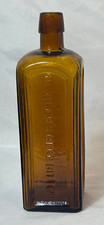
c.1870–1875 Mishler’s Herb Bitters – Dr. S. B. Hartman & Co. – Lancaster, Pennsylvania – Yellow-Apricot / Golden Yellow Amber – Applied Top – Patented Tablespoon Graduation
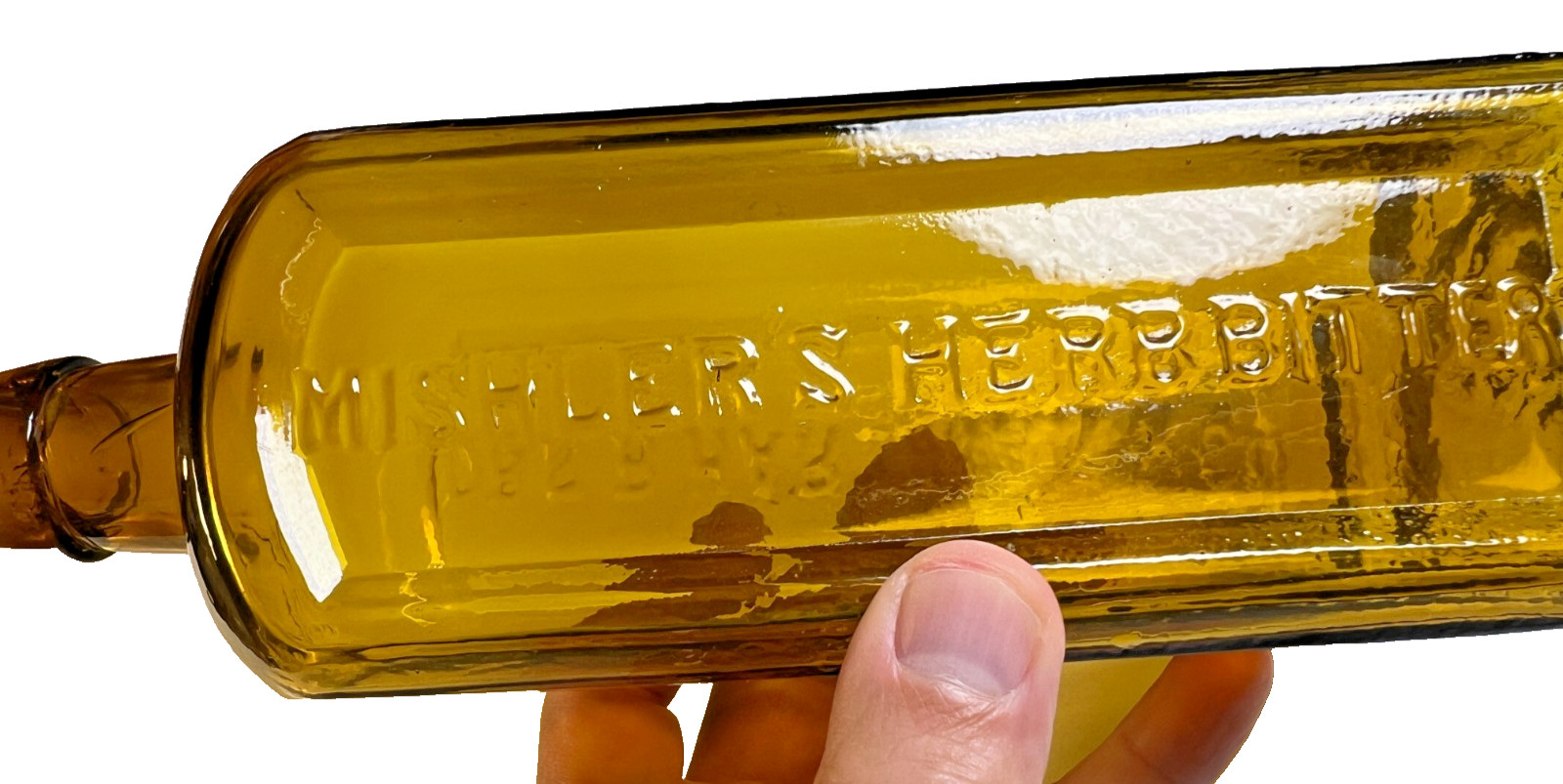
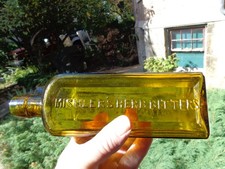
A spectacular early Mishler’s Herb Bitters bottle in an exceptionally desirable yellow-apricot / golden-yellow amber color! This is not the ordinary dark amber commonly encountered in Mishler’s bottles—the beautiful light yellow/apricot coloration is one of the standout features of this example and absolutely glows when illuminated.
Bottle measures approximately 8 3/4" tall × 2 1/2" wide.
This handsome square bitters bottle has recessed embossed panels, beveled corners, an applied sloping/collared top, and wonderful bold period embossing.
Embossing includes:
MISHLER’S HERB BITTERS
DR. S. B. HARTMAN & CO.
and the especially fascinating:
TABLE SPOON GRADUATION
with a molded measuring scale running vertically along the bottle.
The base is embossed:
STOECKEL’S GRAD. / PAT FEB 6 66
with:
W McC & Co / No 1
in the center.
The base markings tell an especially interesting piece of American bottle-making history.
George W. Stoeckel received U.S. Patent No. 52,461 on February 6, 1866 for an improved graduated bottle—a system that allowed measurement graduations to be molded directly into the glass. Dr. S. B. Hartman & Co. used this patented design for Mishler’s Herb Bitters, creating the wonderful built-in TABLE SPOON GRADUATION seen on this bottle.
The W McC & Co. marking identifies William McCully & Co., the important Pittsburgh-area glass manufacturer known for producing a variety of 19th-century bottles, including bitters bottles. The No. 1 is a mold/base variant; No. 2 examples of the Hartman Mishler bottle are also documented.
A Lancaster, Pennsylvania Patent-Medicine Classic
Mishler’s Herb Bitters originated with Benjamin Mishler of Lancaster, Pennsylvania, who was involved in the liquor and distilling business with his brother Isaac during the 1850s. Mishler's Herb Bitters developed into his signature proprietary preparation and was manufactured in Lancaster.
In 1867, Dr. Samuel B. Hartman purchased Benjamin Mishler’s business, becoming his successor and continuing production of Mishler’s Herb Bitters under the name Dr. S. B. Hartman & Co.
The Mishler’s Herb Bitters / Dr. S. B. Hartman & Co. trademark was recorded in April 1871, placing this wonderful bottle squarely in the early Hartman era.
Based upon the Hartman company history, applied mouth, William McCully glasshouse marking, Stoeckel patented graduation and known examples of this form, I would date this bottle to approximately 1870–1875.
Medicine, Bitters & Victorian Marketing
Patent medicines occupied a fascinating place in 19th-century American life. The boundary between medicine, tonic and alcoholic bitters was often remarkably blurry.
Mishler’s Herb Bitters was aggressively promoted as a medicinal tonic rather than simply an alcoholic beverage. Period advertising credited bitters preparations with an extraordinary range of restorative properties.
The patented tablespoon scale molded directly into this bottle was therefore particularly clever. A purchaser wasn't merely buying a bottle of bitters—the packaging itself looked scientific and medicinal, allowing a dose to be measured directly from the container.
It is a fantastic surviving example of the intersection between Victorian medicine, glassmaking technology, advertising and the American liquor trade.
The Color
The color is one of the strongest features of this particular example.
Mishler’s bottles occur in numerous shades of amber, but collectors particularly prize the lighter and unusual colors, including yellow, golden yellow, apricot and olive-toned amber.
This bottle displays a gorgeous yellow-apricot / golden-yellow amber coloration that becomes absolutely brilliant when backlit. It is considerably more visually striking than the typical dark amber Mishler’s example.
Condition
Exceptional attic-mint condition.
The glass is bright, clean and shiny with tremendous clarity and color.
No chips.
No cracks.
No stain.
No haze.
No scratches.
There is a small interior lip flash from the original manufacture of the bottle. This is a period manufacturing characteristic and NOT later damage.
The bottle retains the wonderful slight irregularities and character expected of an early mouth-blown bottle, along with its handsome applied top and strong embossing.
Life When This Bottle Was Made – c.1870–1875
This bottle was made during an extraordinary period of American history, only a few years after the Civil War.
Ulysses S. Grant occupied the White House through most of this period as the United States struggled through Reconstruction and the enormous political and social consequences of the Civil War.
Railroads were rapidly knitting the country together. Telegraph lines had revolutionized long-distance communication, yet the telephone was still in the future—Alexander Graham Bell would not receive his famous telephone patent until 1876.
Electric lighting had not yet entered ordinary American homes. Most households were illuminated by oil lamps or gas. Horses still dominated local transportation, while steam locomotives represented the high technology of long-distance travel.
Medicine was also undergoing enormous change. Germ theory was only gradually gaining acceptance, antibiotics were generations away, and proprietary medicines such as Mishler’s Herb Bitters flourished. Elaborately advertised tonics, bitters, syrups, pills and extracts filled drugstore shelves.
Against that backdrop, the patented measuring graduations molded into this bottle must have looked remarkably modern and scientific.
In Lancaster, Pennsylvania, Dr. S. B. Hartman & Co. was turning Benjamin Mishler’s already-established bitters into a nationally marketed proprietary medicine—and this beautiful yellow-apricot bottle was part of that story.
A fantastic piece for the serious bitters, patent medicine, Pennsylvania, Lancaster, applied-top or colored antique bottle collection.
The combination of beautiful yellow-apricot color, applied top, patented tablespoon graduation, Stoeckel patent embossing, W McC & Co. No. 1 base marking and exceptional attic-mint condition makes this a particularly desirable example.
A beautiful 150+ year-old American bitters bottle that looks like it was put away yesterday.