When you click on links to various merchants on this site and make a purchase, this can result in this site earning a commission. Affiliate programs and affiliations include, but are not limited to, the eBay Partner Network.
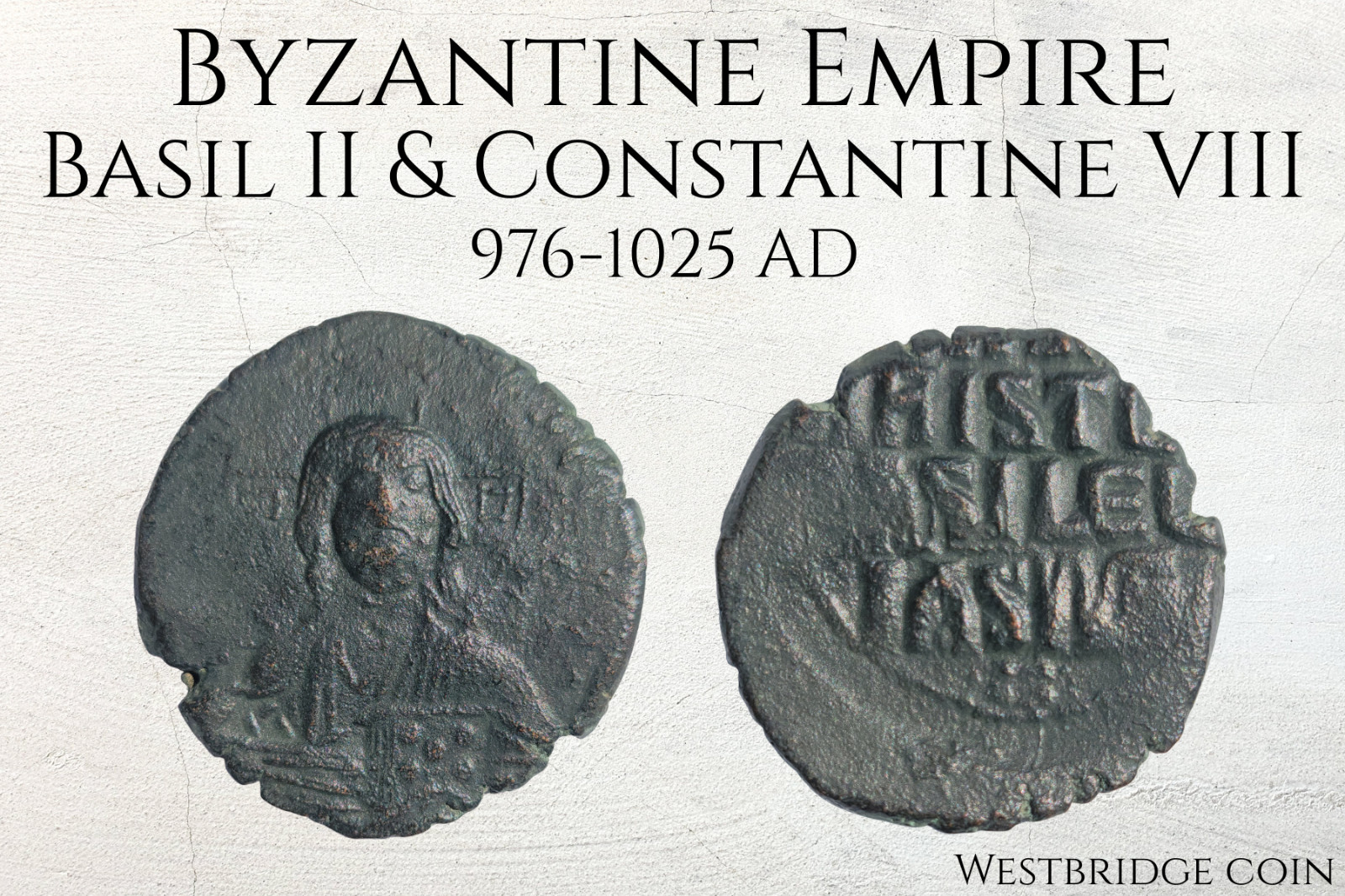
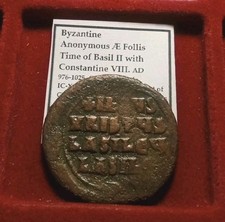
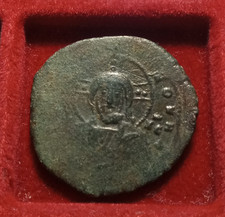
✦ BYZANTINE EMPIRE ✦ BASIL II & CONSTANTINE VIII Anonymous Class A2 Follis c. 976–1028 AD | Constantinople Basil II and Constantine VIII depicted in the Bari Exultet Roll. The identification as portraits has been discussed by scholars. A Byzantine bronze from the age of Basil II, one of the most powerful emperors of the medieval Roman world. ✦ ✦ ✦ ✦ Coin Details Empire Byzantine Empire Attributed Emperors Basil II & Constantine VIII Date c. 976–1028 AD Mint Constantinople Type Anonymous Class A2 Denomination Follis Metal Bronze Diameter Approximately 28 mm Weight 8.75 g Reference Sear Byzantine 1813 The Design Obverse Facing bust of Christ, wearing a cross-shaped nimbus and holding the Book of Gospels with both hands. The inscription includes EMMANOVHΛ — Emmanuel, “God with us” — together with IC XC, the abbreviated name of Jesus Christ. Reverse + IhSUS
XRISTUS
bASILEU
bASILE The four-line inscription translates to: “Jesus Christ, King of Kings.” ✦ Why Is It Called “Anonymous”?
Earlier Byzantine bronze coins commonly displayed the reigning emperor and his titles. The anonymous follis series departed dramatically from that tradition.
On these coins, the emperor\'s portrait and name disappear entirely. Christ becomes the central figure, while the reverse proclaims Him “King of Kings.”
The result is one of the most distinctive expressions of Christian imperial ideology found on Byzantine bronze coinage.
Basil II Emperor 976–1025 AD
Basil II became the senior emperor in 976 AD. His early rule was threatened by major rebellions from powerful military aristocrats, including Bardas Skleros and Bardas Phokas.
After overcoming those challenges, Basil devoted much of his reign to strengthening the empire\'s frontiers and limiting the political power of the great land-owning families.
His reign became one of the longest and most militarily successful in Byzantine history, leaving the empire stronger and territorially larger than it had been for centuries.
✦ The Long War with Bulgaria
Basil\'s most famous struggle was his decades-long war against the First Bulgarian Empire and its ruler Samuel.
After years of campaigning, the Byzantines achieved a major victory at the Battle of Kleidion in 1014. Medieval sources report that large numbers of Bulgarian prisoners were blinded after the battle, although the scale of the episode may have been exaggerated.
Bulgarian resistance continued until 1018, when the First Bulgarian Empire finally submitted. Later generations attached the epithet “Bulgar Slayer” to Basil, although that title became common only well after his lifetime.
Constantine VIII
Basil\'s younger brother Constantine VIII was formally co-emperor throughout Basil\'s reign, but he took little active part in the government while Basil was alive.
When Basil died without children on 15 December 1025, Constantine became sole emperor. He ruled until his own death in 1028, which is why this anonymous Class A2 type is often cataloged through that year.
✦ The Empire in 1025 Byzantine territory at the death of Basil II The Byzantine Empire at the death of Basil II in 1025, following decades of military expansion and consolidation. ✦ Condition Condition: About G/VG.
This coin has not been graded by a third-party grading service. Any grade, condition, or descriptive wording is the seller’s opinion only and is not a professional grade, guarantee, or prediction of how NGC, PCGS, ANACS, ICG, CAC, or any other grading service may evaluate the coin. Grading is subjective. Please review the photos and video, where available, and make your own judgment regarding condition and overall appearance before purchasing.
Ancient coins were individually struck by hand. Differences in centering, flan shape, patina, deposits, wear, and surface characteristics are normal features of ancient coinage. Please examine every listing photograph carefully when evaluating condition and appearance.
✦ Christ, King of Kings
This follis comes from a period when Byzantine imperial power was reaching one of its medieval high points. Yet the coin does not show Basil II or Constantine VIII at all. Instead, the emperor disappears from the bronze coinage and Christ occupies the center of authority, while the reverse declares Him simply and directly: “Jesus Christ, King of Kings.”
WESTBRIDGE COIN ✦ ✦ ✦ Historical imagery is included for educational and historical context and is not part of the item offered. Basil II & Constantine VIII image: Bari Exultet Roll, public domain.
Byzantine Empire 1025 map: Nécropotame / Cplakidas, CC BY-SA.