Heat.net Store Home
|
Butiagrus Seedlings - F1 Hybrid Mule Palms - Cold Hardy Butia x Syagrus Palms For Sale

When you click on links to various merchants on this site and make a purchase, this can result in this site earning a commission. Affiliate programs and affiliations include, but are not limited to, the eBay Partner Network.

Butiagrus Seedlings - F1 Hybrid Mule Palms - Cold Hardy Butia x Syagrus Palms:
$27.99
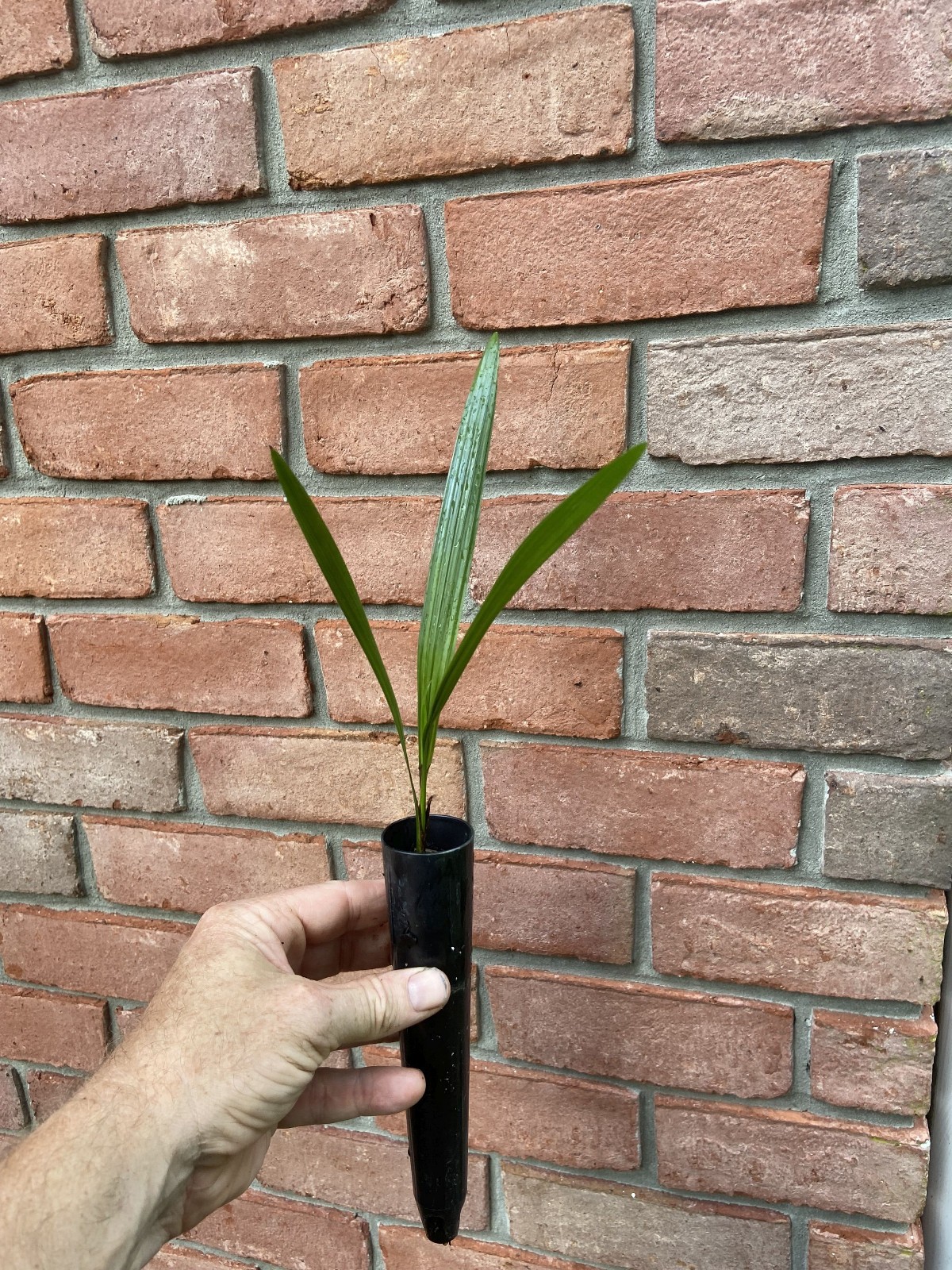
I am finally offering LIVE SEEDLING PALMS of my hybrid Butiagrus! It occurs to me that a lot of you don't want to bother trying to germinate some very difficult-to-germinate seeds, and I heard you. I have become somewhat of an expert on germinating these seeds though, so now I am offering the actual plants for sale.The Queen Palm in my last 2 pictures is the pollen parent of this batch of Butiagrus seedlings! It's a very large, thick-trunked, massive Queen Palm growing here in Gainesville, FL. I make no promises about it being any more cold-hardy than a normal Queen, only that it's been living in that spot for well over a decade and has been through some pretty cold winters here in Gainesville. This past winter, it endured two consecutive mornings of 20F and 22F in early February, and kept some green leaves!The palms in the cones are the ones being offered for sale, and are working on their 3rd leaf, more or less. Maybe some will only have 2 leaves, and it's possible that one or 2 might have 4 leaves. But they are all about the same age and size. The small palms towards the end of the pictures are 1 1/3 years old as of August 15, 2025, and badly need to be repotted into 5 gallon or higher pots, or planted in the ground! Those aren't for sale, only representations of what the palms look like as they grow.I produced the seeds that created these palms with my Butia odorata palms and pollen from the Queen Palm pictured. There's a LOT of work that goes into doing a controlled cross, and these seedlings are the result of all of my work. I hand-pollinate all flowers myself.Butiagrus, or more accurately written as x Butiagrus nabonnandii, is commonly called the Mule Palm. Terrible name, but it refers to the fact that most of the palms created with this intergeneric cross are sterile (there are very few exceptions). It is a hybrid cross between Butia odorata and Syagrus romanzoffiana (written as Butia odorata x Syagrus romanzoffiana. The seed parent is always written first, which is the Butia odorata. Syagrus is the pollen parent). Both of these palms are native to Brazil and Argentina in South America, and sometimes their ranges overlap. Occasionally there are instances of natural hybridization occurring.The French horticulturist Paul Nabonnand was the first to create this hybrid by hand in the early 1900s in France. Forgotten about after his death and unknown in the USA, it was "rediscovered" in the early 1970s in Florida. Around this time, a professor at The University of Florida by the name of Dr. Merrill Wilcox became interested in creating this hybrid, and much of the popularity of this palm today is owed to his work in the field. Today, there are several hybridizers and nurseries in the state of Florida and elsewhere who specialize in creating this hybrid.Creating this hybrid palm, and really creating any hybrid palm, is a tedious task that involves many hours of painstaking, obsessive-compulsive work. It's not as simple as dusting pollen from one palm to another. If it was that easy, Butiagrus would probably be a lot more plentiful!A little about me...I have a degree in horticulture and have been producing these hybrids for several years now. I have experience with hybridization with other genera of plants as well, but have decided to focus on palms mainly. I'm a member of The International Palm Society (Bigfish). I am confident in my processes and procedures and methods, and these should all be nice Butiagrus palms. That's not to say that I'm perfect, because I am far from it. There are many things that could go wrong in the process, and the most obvious one is that the wrong pollen gets on the female flower and you end up with a regular Jelly Palm. This is called an outcross. It can happen if you get a tear in whatever material you are using to cover your receptive female flowers, or if you somehow miss a male flower during emasculation. Extra precautions need to be taken to ensure that any nearby male Butia flowers are covered up BEFORE you start pollinating. If I have to cover up a newly emerged inflorescence, before pollinating one that is ready for Syagrus pollen, I will take a shower and change into new clothes before pollinating! You will have pollen on your clothes, hair, etc from the male flowers on the new inflorescence that just emerged. That's in addition to hosing everything down. So that's a little of the OCD that is required to make good hybrid seeds! I will say that I have not noticed a single plain Butia sprout from my seeds yet. All of them have been Butiagrus.I have included in the pictures a couple of my Butia odorata palms that I use as seed parents, and of the Queen palm parent.One of the reasons for producing Butiagrus is because it's faster-growing than a Butia, but more cold-hardy than a Syagrus. It resembles a Coconut Palm, and is the closest-looking palm to a Coconut that we can grow north of zone 10a. Mule Palms are cold-hardy down into the mid teens Fahrenheit, although you should expect damage at those temperatures. There are some in Gainesville, FL that took 10F and survived. Really, it should be considered a zone 9a palm that will do fine down to 20F or a little less, and possibly down into zone 8b with some protection on occasion.I have 4 different options to buy: a single palm in a cone pot, double palm (2 palms from the same seed) in a cone, single palm in a square pot, and double palms in a square pot. Sometimes, you can get 2 or even 3 sprouts coming from the same "nut" (actually the endocarp), because there are 1-3 kernels (seeds) inside each endocarp. And occasionally, more than one will sprout. When this happens, it's not advisable to separate them before they have formed at least 2 leaves. You want to make absolutely sure that they aren't still relying on the endosperm for nutrients. All of the doubles that I am selling are fully capable of being separated, but I thought it would be cool to just leave them like that and sell them as-is. You can grow them just like they are and leave them as twins, or you can separate them carefully and grow them individually. It's up to you.If you have any questions, don't hesitate to send me a message. I try and respond right away to all of my messages!A note to friends not in the USA: I can't ship these internationally, sorry!Also, no shipping to CA. I am going to work on getting certified to ship to you guys, but your regulations are a bit much at the moment.No shipping to HI either.Plants sometimes get damaged during shipping. A leaf might get bent or broken, but the palm will most likely be fine. They grow quite fast! If a leaf gets bent but is still attached to the palm, DON'T CUT IT OFF! No matter how small the connection is, the palm is still able to photosynthesize with that leaf and make food for itself. It might look kind of ugly for a few weeks, but it will be fine eventually and recover much faster if you don't remove anything. Sometimes the shipper can have delays, causing the palm to dry out. That can be remedied, but you must let me know ASAP! Also, please do an unboxing video for your sake and mine. It's just easier this way.Florida nursery registration no.: 484044357
|
|
Other Related Items:
Related Items: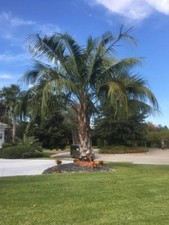
Butiagrus Seedlings - F1 Hybrid Mule Palms - Cold Hardy Butia x Syagrus Palms $27.99
Butiagrus Seeds F1 Hybrid Mule Palm Seeds. Rarely Ever Offered Cold Hardy $14.99
|