When you click on links to various merchants on this site and make a purchase, this can result in this site earning a commission. Affiliate programs and affiliations include, but are not limited to, the eBay Partner Network.
100 Seeds
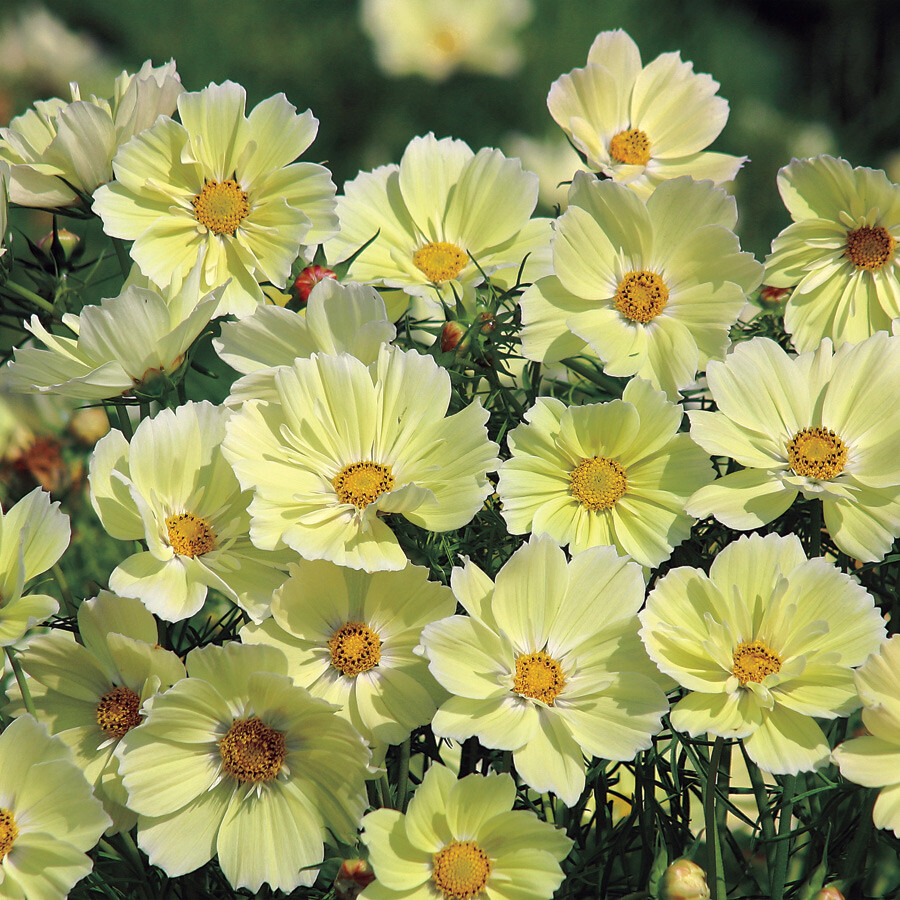
Cosmos SUNSET YELLOW 3\' Tall
Medium Dwarf Non-GMO
Great for Cut Flowers and Containers
100% Pure Seed – No Filler – Non GMO
PRODUCT INFORMATION
- Elegant, light yellow petals surround a pureyellow center, making this variety a must-have in any summer garden or meadow.
- The gorgeous blooms make a grand statementplanted with pink and white Cosmos varieties, or on its own.
- Pollinators love Sunset Yellow and will becoming to and from the garden from summer into the fall.
- The light-colored blooms also make for gorgeoussummer bouquets.
- This is a gorgeous Cosmos with pretty pale buff yellow flowers with lovely accents of white. Cosmos are such graceful Summer flowers for the garden. Planted en masse they are beautifully hypnotic as they sway in the breeze. They also look magnificent in floral bouquets.
FAST FACTS
- Common Name: Cosmos
- Botanical Name: Cosmos bipinnatus
- Seed Life Cycle :Annual
- Light Requirements: Full Sun, Half Sun / HalfShade
- Flower Color :Yellow
- Bloom Time: Summer to fall
- Mature Height: 30-36\" tall
- Wildflower Mix or Specie: Species
- Ships As: Seed
- Ideal Region :Northeast, Southeast, Midwest, West, Southwest, Pacific Northwest
- Zones : 2,3, 4, 5, 6, 7, 8, 9, 10
- Non-GMO :Yes
- Native To: American southwest and Mexico
- Soil Type: Sandy Soil, Loamy Soil, Drought/DrySoil
- Soil Moisture: Dry, Average, Well Draining
- Advantages: Easy To Grow, Attract Butterflies,Bee Friendly, Pest / Disease Resistant, Low Maintenance, Good For Cut Flowers,Good For Containers, Extended Bloom Time (more than 4 weeks), Great For MassPlantings
THE COSMOS CRAZE
The Cosmos Craze: New rage for an old favorite.When it comes to annuals, probably no plant adds more color than cosmos. Yourgrandmother grew it, today states plant masses along roadsides, and everybodyloves it. (Birds love it too, especially goldfinches.) But there\'s always beenone big problem--it\'s tall, sometimes very tall--up to 6 or 7 feet.
In the right setting, say a wildflower meadow inlate summer, nothing\'s more beautiful than a sea of these big ferny plantswaving in the wind, loaded with big blooms in pink, white and maroon. But ingardens, most people prefer shorter flowers. So for awhile, some relegated the\"tall\" cosmos to the group that\'s usually called \"old fashionedflowers\"--beautiful, surely, but a bit tall and rangy for our more sophisticatedflower borders today.
Enter the hybridizers. With all that color andsuch ease of care to work with, they have had a heyday with cosmos. Today,there are all sorts of variations on the originals, some with new-styleflowers, and others with simply the classic blooms on shorter plants. Allrequire full sun, and are among the simplest plants on the planet to grow fromseed. By the way, even the seeds of cosmos are distinctive; they look likeminiature pine needles.
The originals are wildflowers, of course, andare native to our own southwest and more commonly, Mexico. This tells youcosmos don\'t mind hot dry, conditions. In fact, some consider cosmos desertplants. But they\'re incredibly adaptable. And ever since some plant explorergathered seeds from the rocky wilds of Mexico and transplanted them into\"good garden soil,\" the world has known that they not only thrive,but enjoy our loamy, well-watered gardens. And if they\'re not fertilized toomuch, they rapidly develop into large branching plants with deep green fern-likeleaves. If you have a dry season, cosmos plants don\'t care, and revert to theirdrought-tolerant roots. Best of all, no matter where they\'re growing, theycover themselves with more and more wide (up to 4\") daisy-like blooms frommidsummer on. Only a hard frost stops the cosmos parade. They\'re fantastic as ablooming screen, or a background for shorter plants. And the big bonus: a grandstandof this garden classic in late summer can provide months of long-stemmed cutflowers for a whole neighborhood.
The Originals. There are scores of native cosmosspecies, most all native to the Americas, but there are only two that haveentered our gardens in a big way:
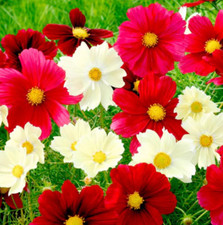
1. Cosmos bipinnatus, the big one. This is thegranddaddy of them all. Hailing from Mexico, it\'s one of the few wildflowersthat is so beautiful it was taken into gardens long ago just as it is in thewild. The old name for this garden classic is simply \"Wild Cosmos\",\"Cosmos Sensation,\" or \"Sensation Mix,\" since the seedsalways produce plants blooming in pastel pink, white, and deep red or maroon,all with bright yellow centers. These are the tall, (to 6 or 7 ft.) gracefulcosmos plants of your grandmother\'s garden.
2. Cosmos sulphureus, the other cosmos. Thisone\'s shorter, with more bushy plants and somewhat smaller yellow (to orange)semi-double flowers. It\'s often called \"Sulphur Cosmos\" or\"Orange Cosmos,\" and an old variety with particularly glowing orangeblooms is called \"Bright Lights.\" The flowers of these often remindme of open-style marigolds on larger plants.
The New Cosmos. Today, the old standard\"mixture\" flowers of C. bipinnatus have been segregated, and theplants grow from only 3 to 5 feet. So if you particularly like the old pastelpinks, there\'s \"Pinkie,\" for the pure white, \"Purity,\" andfor the old deep rose or maroon, \"Radiance.\" Even though the plantsare shorter, all the flowers are still big and beautiful with the familiarbright yellow centers. And this new group doesn\'t stop with the old basiccolors. \"Gloria\" is a beauty in pink with red-flared centers. And\"Daydream\" gives you the old pastel pink, but with a darker centerflare and darker pink veins all through the petals.
If 3-5 feet is still too tall for you, choosethe \"Dwarf Cosmos Mix\" which gives you all three of the old mixturecolors at just 2 to 4 ft. And yes, the flowers are still full size.
Want more variety? Pick \"Dazzler\" andenjoy unique blunt-tipped daisies in true red, still with the dazzling yellowcenter, on plants to 5 ft. Then there\'s the most unusual of all,\"Seashells,\" a big hit with cosmos lovers--its hot pink petals arecurled upward at the edges, giving the blooms a frilly look.
And here\'s my favorite: \"Picotee.\" Itgives you full-size daisy blooms in white with the end of each petal looking asthough it\'s been dipped into a rich red paint--and all that jazz is on plantsnever over 4 feet. This one, like all the others, creates spectacular color inthe garden, and even more in a vase.
How to Plant & Grow Cosmos Flowers fromSeeds
This Mexico native is one of the simplestflowers to grow, and they are suitable for all zones. Since they reseedthemselves easily, they make perfect additions to wildflower meadows ornaturalized areas. Children will love planting their cosmos seeds and watchingthem grow taller than they are!
Sow your Cosmos seeds in the full sun to partialshade. As cosmos flowers are very adaptable, they can thrive in average to poorsoil quality, and they are tolerant to dry conditions. Scatter cosmos seedsoutdoors after there is no longer a danger for frost. Seeds can be covered ¼inch since they do not need light to germinate. Germination will usually occurin just 3 to 5 days, but it can take up to 2 weeks.
Once started, cosmoses require virtually noattention. You can add a general purpose fertilizer once or twice a season. Ifa plant grows very tall and is not planted in a wind protected area, it mayrequire staking. If you want blooms all summer long, dead head the old blooms.
SEED STORING
- Store your seeds in a cool, dry and dark location.
- Most seeds have a long shelf life, but heat and moisture will cut that life short.
- Dedicate a drawer or cabinet to storing your seeds where you can also house your gardening journal close at hand for dreaming, planning and preparing.