When you click on links to various merchants on this site and make a purchase, this can result in this site earning a commission. Affiliate programs and affiliations include, but are not limited to, the eBay Partner Network.
Native Gold
16 to 1 Mine, Alleghany, Alleghany Mining District, Sierra County, California, USA
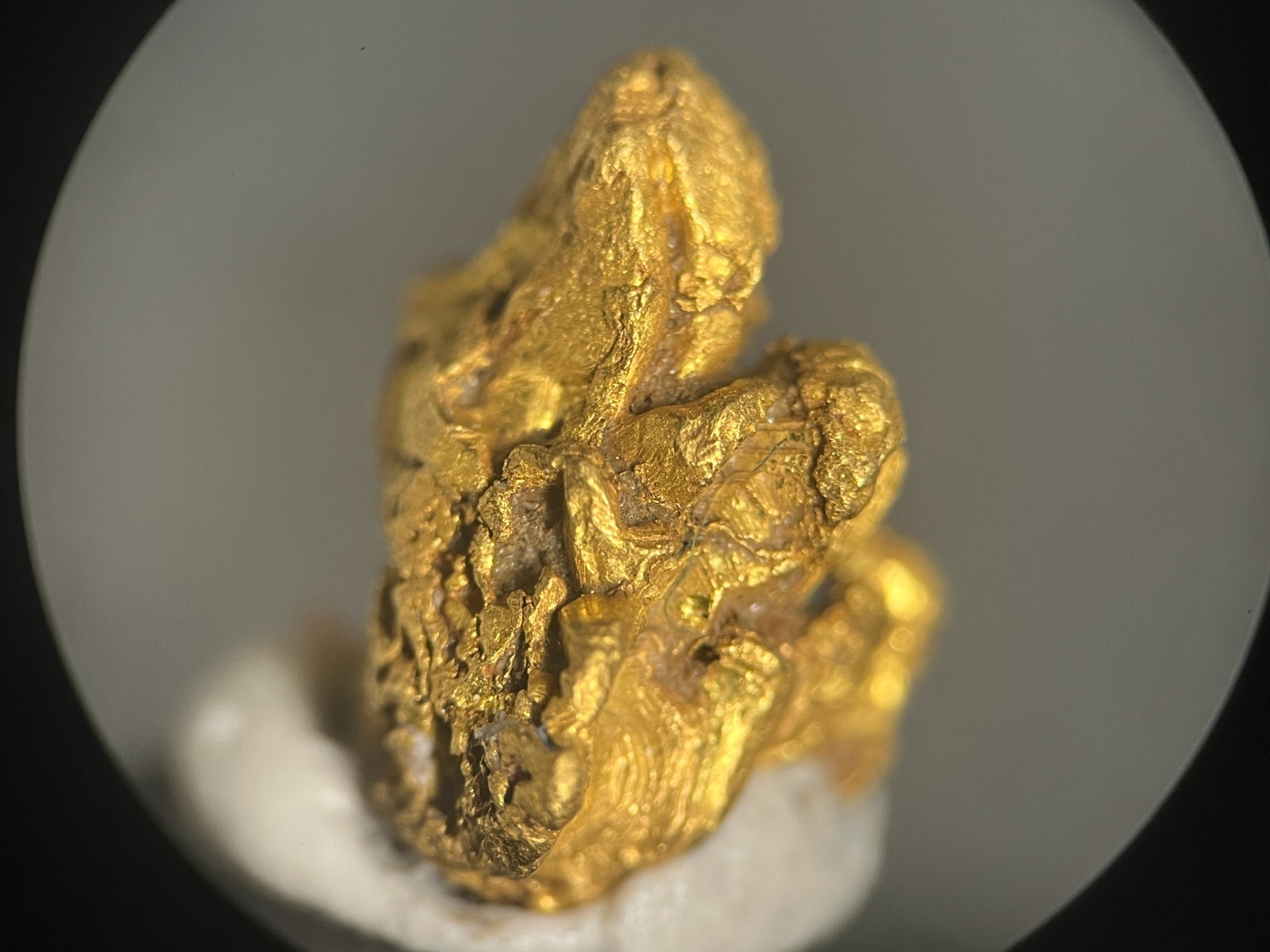
0.6457 gramsThis is a nice thumbnail (or micromount?) of chunky native gold crystals exhibiting some good geometric growth structures. It will come mounted on a custom 3D printed perky base (pictured) in a perky box.Ex: A.R.C. Fine MineralsAbout the deposit:The Sixteen-to-One Mine is the most prolific and famous mine in the Alleghany District. The mine has been in nearly continuous operation since its discovery in 1896. The gold deposits occur in fissure-filling hydrothermal quartz veins that cut amphibolite, chlorite schist, metaconglomerate, and, to a lesser extent, serpentinite. Saucedo & Wagner (1992) have placed these metamorphic rocks in a category (PzMz) of uncertain age (Paleozoic-Mesozoic) associated with the Feather River Peridotite Belt. The main vein is the “Sixteen-to-One,” which occupies an easterly dipping reverse fault within the Alleghany fracture system of the Melones Fault Zone. The vein is typically milky white quartz. Gold occurs as erratic, but extremely rich ore shoots and pockets hydrothermally introduced into an earlier barren quartz vein during the later stages of mineralization. Ore shoots are localized by discontinuities in the vein where fracturing and shearing provided conduits and sites for later gold mineralization. During the late Jurassic Nevadan Orogeny, much of the Sierra Nevada was metamorphosed and folded into a complex series of parallel northwest-trending folds and reverse fault complexes. After this upheaval, low-sulfide, native-gold-bearing hydrothermal veins were emplaced throughout much of the western Sierra Nevada, about 140 to 110 mya (Bohlke & Kistler, 1986). Fluid inclusion and paragenetic mineral assemblage studies from the neighboring Oriental Mine indicate the main veins are mesothermal deposits formed at temperatures between 200°- 300°C and at pressures up to 2.5 kilobars (Coveney, 1981).ShippingDomestic shipping via USPS, international shipping is available at cost. For smaller items, I can usually get economy shipping if you ask.EMF5About me
My name is Jason Utas and I have been collecting and hunting for meteorites since 1998. I am currently a graduate student studying geochemistry at UCLA.Thanks for looking!
Click here to view my other items.