When you click on links to various merchants on this site and make a purchase, this can result in this site earning a commission. Affiliate programs and affiliations include, but are not limited to, the eBay Partner Network.
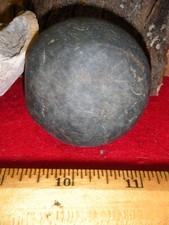
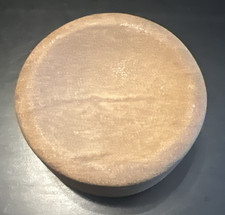
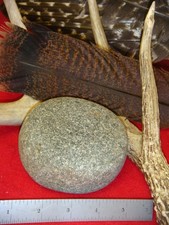
Type: Discoidal (Chunkey Stone)Age: Late Woodland to Middle Mississippian (approximately 900 - 1500 AD)Location: Found near Marysville MODiameter: 3 3/4\"Thickness: 1 5/8\"Material: Metamorphic SandstoneProvenance:I purchased this Discoidal from Alyssa Ervin (David Ervin Collection) and it comes with a CoA from Bill Breckinridge. Ex C. Parks & Dr. H. E. BrooksThis beautiful very well made 3 3/4\" x 1 5/8\" Discoidal is made from a very nice metamorphic sandstone material and displays very well. Discoidal\'s were used by the Mississippian Native American cultures to play a game called Chunkey, where they would roll the stone then throw spears at it and bet on who could get closest. This was a type of sporting event in the Native American villages. Please take a close look at the pictures.I took several close up photos using my microscope of the surface for your reference.This discoidalcomes with aBill BreckinridgeCoA with an IR Raman spectrograph scan. I will accept returns for any reason up to 30 days after purchase for the entire purchase price including shipping if you pay to ship it back in the same condition it was sent.
My wife has me doing \"Swedish Death Cleaning\"...look it up, it is a real thing...otherwise I would not be parting with this very nice artifact.
Flat rate shipping for $7.95 to US address.I will always combine shipping for one flat fee to the US for all sales shipped in the same package.
Please keep watching as I will be adding several new knives over the next few days and weeks.
AI Description:
A discoidal, or chunkey stone, isa circular, ground stone artifact used by Mississippian and Southeastern Native American cultures (c. 1000–1500 A.D.) in the competitive, often high-stakes game of \"Chunkey.\"These palm-sized stones were rolled across a dirt arena while players threw spears to land near the stopped stone.
Key Features and Details:
Game Function:The game involved rolling the stone (often at high speeds) and throwing lances to see whose spear landed closest to where the stone stopped, requiring high skill and accuracy.
Shape and Material:Ranging from 2 to 6 inches in diameter, these stones were crafted from hard materials like quartz, granite, or hematite. They are generally concave or convex, with some featuring central dimples or perforations.
Significance:These artifacts symbolize the intense social and cultural interaction of the Mississippian culture, often played in large public arenas as a form of social bonding or high-stakes gambling.
Regional Variation:They are commonly found in the Southeastern and Midwestern United States, particularly around major centers like Cahokia.
Discoidals varied in quality, with finely crafted examples often being prized possessions of clans or individuals.