When you click on links to various merchants on this site and make a purchase, this can result in this site earning a commission. Affiliate programs and affiliations include, but are not limited to, the eBay Partner Network.
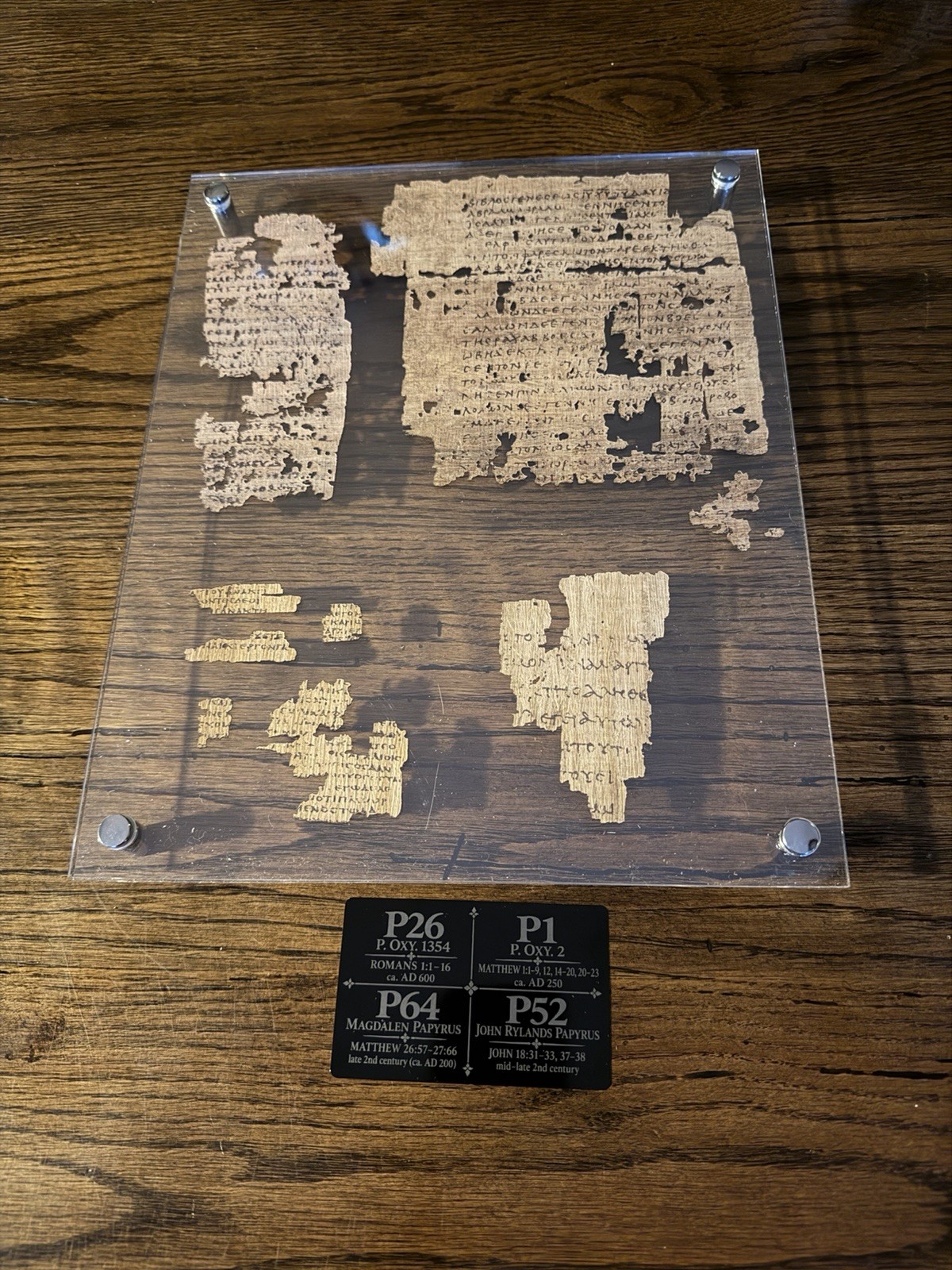
A handcrafted display bringing together replicas of four extraordinary early witnesses to the text of the New Testament: P1, P26, P52, and P64.Each fragment has been individually reproduced on real papyrus, carefully cut, distressed, aged, and arranged to evoke the appearance and character of the surviving ancient manuscripts. The surviving shapes, losses, holes, and individual fragments have been recreated to produce a display with genuine depth and texture.The collection includes:P1 — P.Oxy. 2
Gospel of Matthew
Matthew 1:1–9, 12, 14–20; 1:20–23
Early Christian papyrus codex, traditionally dated around the 3rd century.
P26 — P.Oxy. 1354
Epistle to the Romans
Romans 1:1–16
An important early Greek witness to Paul’s letter to the Romans.
P52 — John Rylands Papyrus, Greek P 457
Gospel of John
John 18:31–33, 37–38
The famous tiny fragment containing part of Jesus’ trial before Pontius Pilate. The John Rylands Library currently dates the manuscript to the mid-to-late 2nd century, while noting that earlier dates have also been proposed.
P64 — Magdalen Papyrus
Gospel of Matthew
Portions of Matthew 26
Preserved today between Oxford and Barcelona and generally considered part of the same manuscript as P67. CSNTM currently dates the manuscript to the 3rd century. Together, these fragments preserve portions of Matthew, John, Romans, and the genealogy, ministry, passion, and trial traditions of the New Testament—a remarkable window into the physical transmission of the Christian Scriptures.The replicas are mounted between clear acrylic panels with metal standoffs, allowing the papyrus itself to remain the visual focus. A custom engraved identification plaque accompanies the display.This is a modern handcrafted educational replica. It is NOT an ancient manuscript or antiquity.Because every piece is individually cut, distressed, and aged by hand, no two displays will be exactly alike. Variations in papyrus fiber, coloration, edge wear, holes, and distressing are intentional and part of the character of the piece.Designed for manuscript collectors, Bible students, pastors, teachers, textual-criticism enthusiasts, church libraries, offices, and anyone fascinated by the history of the New Testament text.