When you click on links to various merchants on this site and make a purchase, this can result in this site earning a commission. Affiliate programs and affiliations include, but are not limited to, the eBay Partner Network.

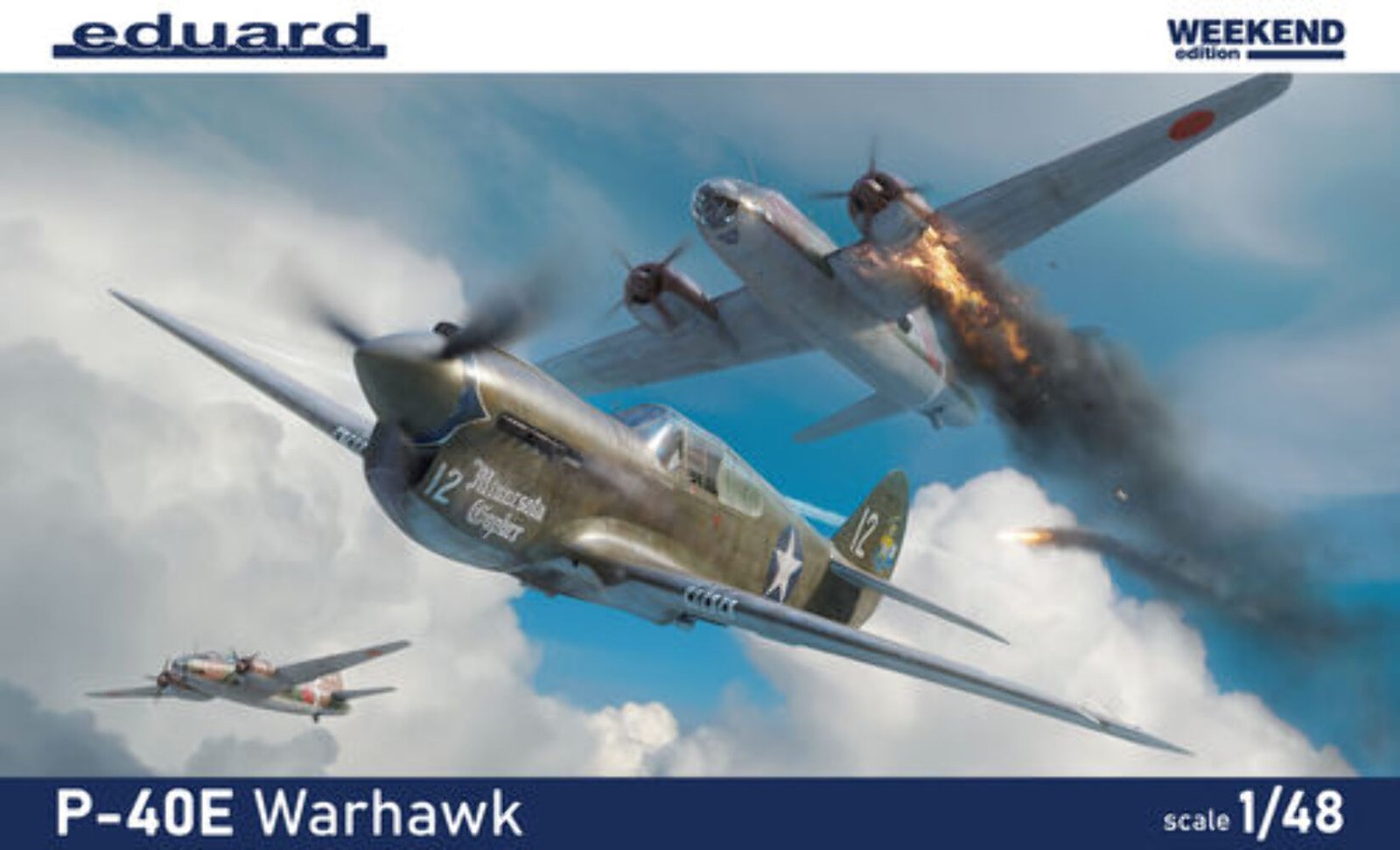
Eduard 84207 1/48 P-40E Warhawk The Weekend Edition:
$43.99
Weekend edition kit of US WWII fighter aircraft P-40E Warhawk in 1/48 mask: No Marking Harold J. Martin, 7th FS, 49th FG, Horn Island, Australia, spring 1942 Lt. John E Petach Jr, 75th FS, 23rd FG, 14th AF, Hengyang, China, July 194241-36243, 1/Lt. John Landers, 9th FS, 49th FG, Port Moresby, New Guinea, 1942 COL D AK653, F/O Neville Duke, No. 112 Squadron (RAF), El Adem, Libya, January 1942The Curtiss P-40 Warhawk is an American, single-engine, metal fighter-attack aircraft in a low wing configuration with a classic tail. The flight of the prototype took place in 1938, and serial production was carried out in the years 1938-1944. The last of the Hawk family of planes - the Curtiss P-40 Warhawk was, apart from the Republic P-47 and the North American P-51 Mustang, the most widely built American fighter. At the end of production in December 1944, the number of machines exceeded 15,000. The development of the design began in 1937, when the prototype airframe of version 75 was adapted to the installation of the 1167HP Allison V-1710-11 in-line engine. The plane became the first American construction capable of flying at speeds over 483 km / h. The version for the RAF was called the Tomahawk Mk IIA. The planes had self-sealing fuel tanks and two wing-mounted 7.7mm machine guns. The Tomahawk MkIIB were equipped with American radio hardware and armed with six 7.7mm machine guns. Some American P-40s were modernized in 1941 for reconnaissance tasks. They received the designation RP-40. Meanwhile, work on the Hawk 81-A was underway at the Curtiss facility. The changes included the installation of the Allison V-1710-39 engine with a capacity of 1167KM, providing constant power up to a height of 3563 meters, adaptation for installation in the wing of four 12.7mm machine guns and the installation of a fuselage node that could carry one bomb weighing 227 kg or thrown back additional fuel tank. The US Army placed an order for these machines in September 1940, awarding them the designation P-40D. Over the next three years, Curtiss made every effort to expand the application possibilities of the P-40, creating numerous new versions of the aircraft. Despite these efforts, Warhawk\'s performance was lower than that of contemporary Allied and Axis fighters. Technical data (P-40E version): length: 9.66m, wingspan: 11.38m, height: 3.76m, maximum speed: 580km / h, rate of climb: 11m / s, maximum range: 1100km, practical ceiling: 8800m, armament: fixed - 6 M2 machine guns, caliber 12.7 mm, suspended - up to 900 kg of cargo.
|