Heat.net Store Home
|
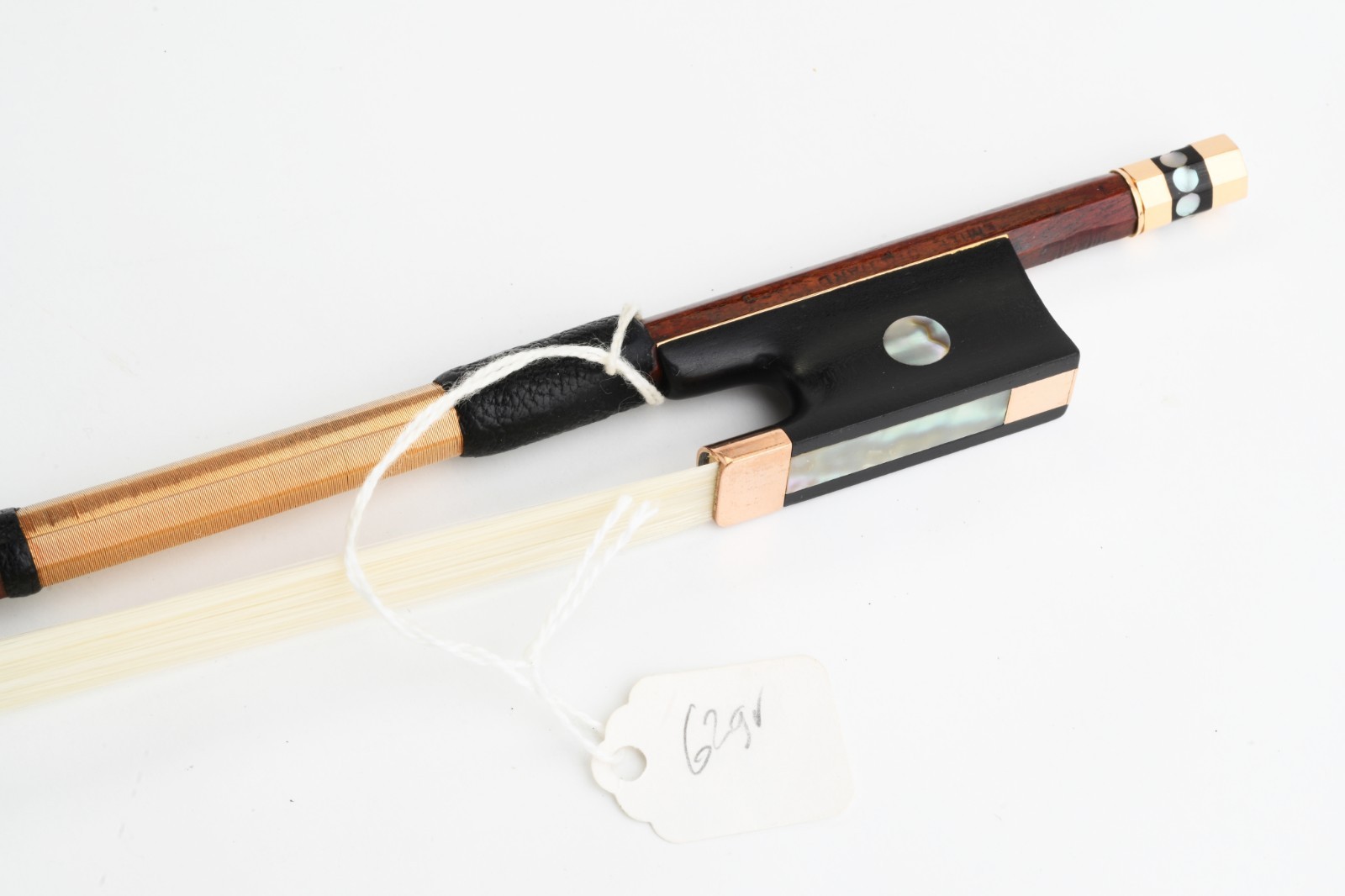
Emile Ouchard Stamped Violin Bow, Superb For Sale

When you click on links to various merchants on this site and make a purchase, this can result in this site earning a commission. Affiliate programs and affiliations include, but are not limited to, the eBay Partner Network.

Emile Ouchard Stamped Violin Bow, Superb:
$6500.00
- Gold mounts and fancy adjuster: Gold-mounted bows (with ebony inserts and decorated/eng elliptic designs on the button) are predominantly from his Paris era. Earlier Mirecourt work (1937–1938, stamped \"E.A. Ouchard Fils\") was more basic, often silver or nickel, with less ornate buttons. New York bows (1946–1960, stamped \"Emile A. Ouchard New York\") can have gold mounts but show a slight decline in refinement due to his later health issues (stroke in 1960). The fancy gold adjuster with ebony/decoration is a hallmark of his Paris peak—elegant and precise, influenced by Sartory/Voirin.
- Two gold pins on underslide: Ouchard fils adopted pins (and sometimes screws) for underslide attachment post-1935, but gold pins on a gold underslide are typical of his luxury Paris gold-mounted bows (for stability and aesthetics). This fits 1940s refinements, not earlier collaboration with his father (1923–1937, more traditional pins in silver/nickel).
- Joint mitered talons: Standard French construction throughout his career, but in Paris gold bows, mitered talons (two pieces joined at the corner for sharp edges) are common for precise fit—matching your description.
- Gold wire lapping: Often seen in his gold-mounted Paris bows for elegance and grip (replacing whalebone in some examples).
- Stamped: Likely \"E.A. OUCHARD PARIS\" (uppercase, player side near frog)—his signature Paris stamp from 1938–1946. If it\'s \"E.A. OUCHARD FILS\" (briefly used 1937–1938), it could be slightly earlier, but the gold features lean post-1940.
- Typical Ouchard chamfers: Graceful, refined chamfers (Sartory/Voirin influence) are iconic of his Paris peak—elegant proportions, not the rougher Mirecourt style from earlier.
- Superior pernambuco, octagonal stick: He used top-grade, red-brown figured pernambuco in Paris for responsiveness. Octagonal sticks are frequent in his better bows (for strength/grip), especially 1940s examples.
- Ebony frog, ivory tip plate: Standard for his gold-mounted bows across periods, but in Paris, the ebony is often finer-polished with precise pearl eyes/slides.
- Gold mounts and fancy adjuster: Gold-mounted bows (with ebony inserts and decorated designs on the button) are predominantly from Paris, where he produced high-end pieces for clients and exhibitions. Earlier Mirecourt bows (1937–1938, stamped \"E.A. Ouchard Fils\") were simpler (often silver/nickel, less ornate buttons). New York bows (post-1946, stamped \"Emile A. Ouchard New York\") can have gold but show slight decline in refinement due to his later health issues (stroke in 1960).
- Two gold pins on underslide: Ouchard adopted Hill-style underslides with pins (or screws) post-1935 for stability. Gold pins on gold underslide are typical of his luxury Paris gold-mounted bows (elegant and precise).
- Joint mitered talons: Standard for his Paris gold bows—sharp, precise corners from two pieces joined at the angle, common in high-end French work.
- Gold wire lapping: Frequent in Paris gold-mounted bows for elegance and grip (replacing whalebone in premium examples).
- Stamped: Likely \"E.A. OUCHARD PARIS\" (uppercase, player side near frog)—his Paris signature from 1938–1946. Often numbered/date-coded (e.g., \"47 59\" for 1947/1959).
- Typical Ouchard chamfers: Graceful/refined (Sartory/Voirin influence) are iconic of Paris—elegant proportions.
- Superior pernambuco, octagonal stick: Top-grade, red-brown figured pernambuco and octagonal sticks are hallmarks of his Paris peak (for strength/grip/balance).
- Ebony frog, ivory tip plate: Standard for Paris gold bows—fine ebony polish, precise pearl/slide.
- Gold mounts and wire lapping add a small amount of weight compared to silver or whalebone, but Ouchard kept his sticks light and flexible to maintain quick rebound and brilliance.
- Documented Paris-period gold-mounted Ouchard violin bows:
- Many sell or are listed at 60–63g (e.g., Tarisio and Ingles & Hayday records show Paris examples at 60.5g, 61g, 62g).
- 62g is common for his best work—enough substance for power and projection, but light enough for agility and ease in fast passage work.
- Earlier Mirecourt bows (1937–1938) were sometimes lighter (58–60g) but less ornate. New York bows (post-1946) can be similar but often feel slightly heavier due to different graduations.
|
|
Other Related Items:
Related Items:
French cello bow 4/4 EMILE OUCHARD $2950.00
Emile Ouchard Stamped Violin Bow, Superb $6500.00
EMILE FRANCOIS OUCHARD PERE Violin Bow $6000.00
|