When you click on links to various merchants on this site and make a purchase, this can result in this site earning a commission. Affiliate programs and affiliations include, but are not limited to, the eBay Partner Network.
We possess a historical and artistic expertise of the painting.
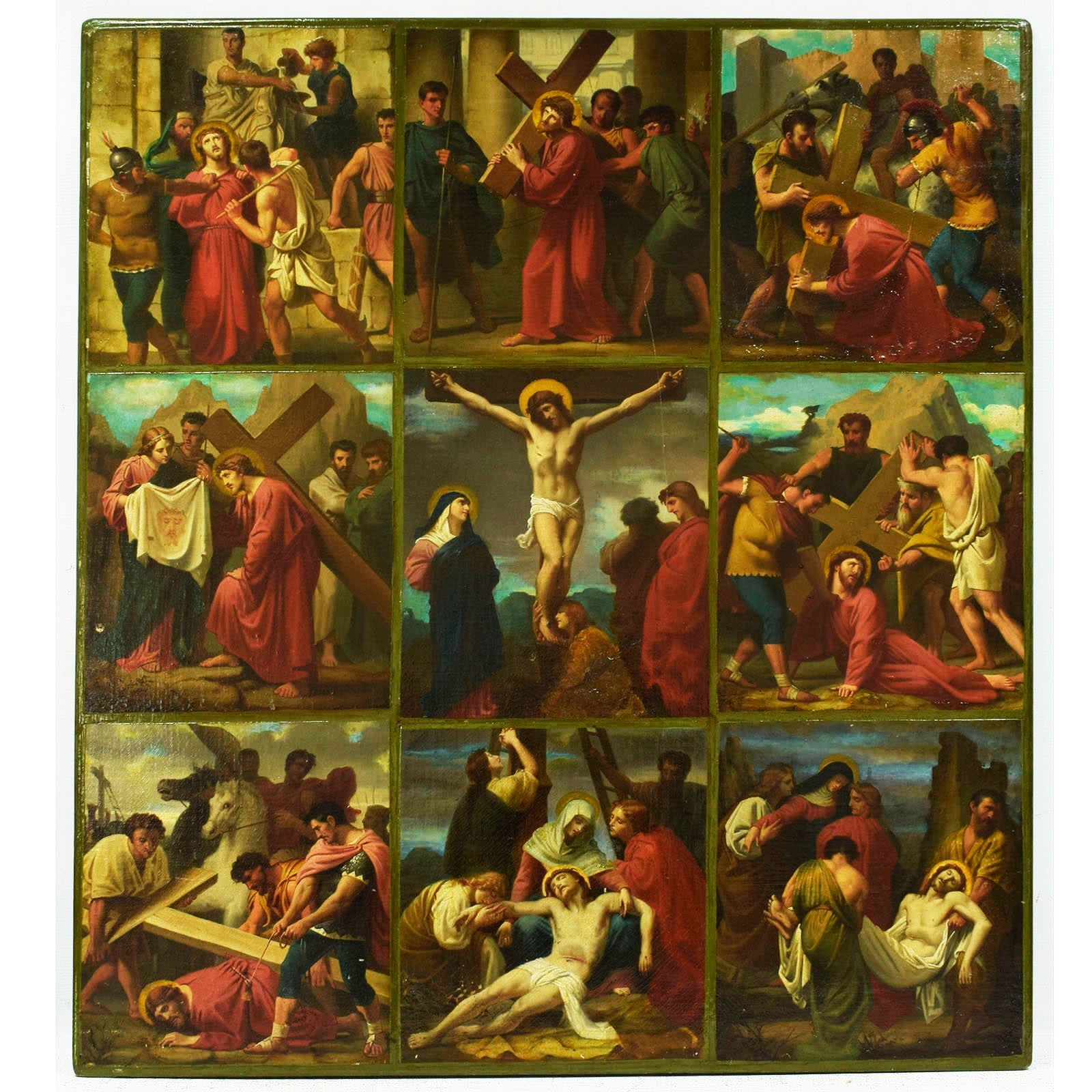
Circa 1840 – Old painting, icon depicting 9 Stations of the Cross, oil on panel.Dimensions with frame: 24.8x 21.8 inThe painting consists of nine separate scenes (originally most likely fourteen) depicting the Stations of the Cross, painted in oil on canvas and mounted on a plywood panel.
Overall dimensions: 24.8 x 21.8 in
The dimensions of the individual compositions are approximately:
width 12.0 x 12.2 inheight 13.8 x 14.4 in
The incomplete set includes the following stations, counted from the top right:
First row:Station I: Jesus is condemned to deathStation II: Jesus takes up His CrossStation III: The First Fall under the Cross
Second row:Station VI: Veronica wipes the face of JesusStation XII: Jesus dies on the CrossStation VII: The Second Fall under the Cross
Third row:Station V: Simon of Cyrene helps Jesus carry the CrossStation XIII: Jesus is taken down from the CrossStation XIV: Jesus is laid in the tomb
On the reverse of the painting, there is an inscription in French reading:
Chemin de croix de L’Eglise de Ducy – Oise – mis en rétable et restauré en 1970–1971 pour le Docteur Pierre PERROTON – médecin à RULLY – Oise – par Philippe PERROTON en souvenir de leur maman Suzanne PERROTON.
Translated into Polish: The Stations of the Cross from the Church of Ducy on the Oise, once placed in the altar, were restored in 1970–1971 for Doctor Pierre Perroton – physician in Rully on the Oise – by Philippe Perroton, in memory of their mother Suzanne Perroton.
According to the inscription, the stations originate from the Church of Saint Margaret in Ducy (Église Sainte-Marguerite de Ducy), located on the Oise River in the Oise department of French Normandy.The Church of Saint Margaret in Ducy was built in the first half of the 12th century and later, in the 14th century, enriched with Gothic architectural elements — including a tracery window in the eastern part of the chancel and large windows in the western nave.
The condition of the painting corresponds to its age, as shown in the photos.Please see the attached images for details.
The attached photos are an integral part of the painting description.
Number:39193/10950