When you click on links to various merchants on this site and make a purchase, this can result in this site earning a commission. Affiliate programs and affiliations include, but are not limited to, the eBay Partner Network.
THOMAS RYANRECOLLECTIONS OF AN OLD MUSICIANNew York: E. P. Dutton & Company, 1899First EditionFine Three-Quarter Morocco Leather BindingElaborate Gilt Musical Tooling46 Portraits and ViewsTop Edge Gilt
RYAN, Thomas. Recollections of an Old Musician. New York: E. P. Dutton & Company, 1899.
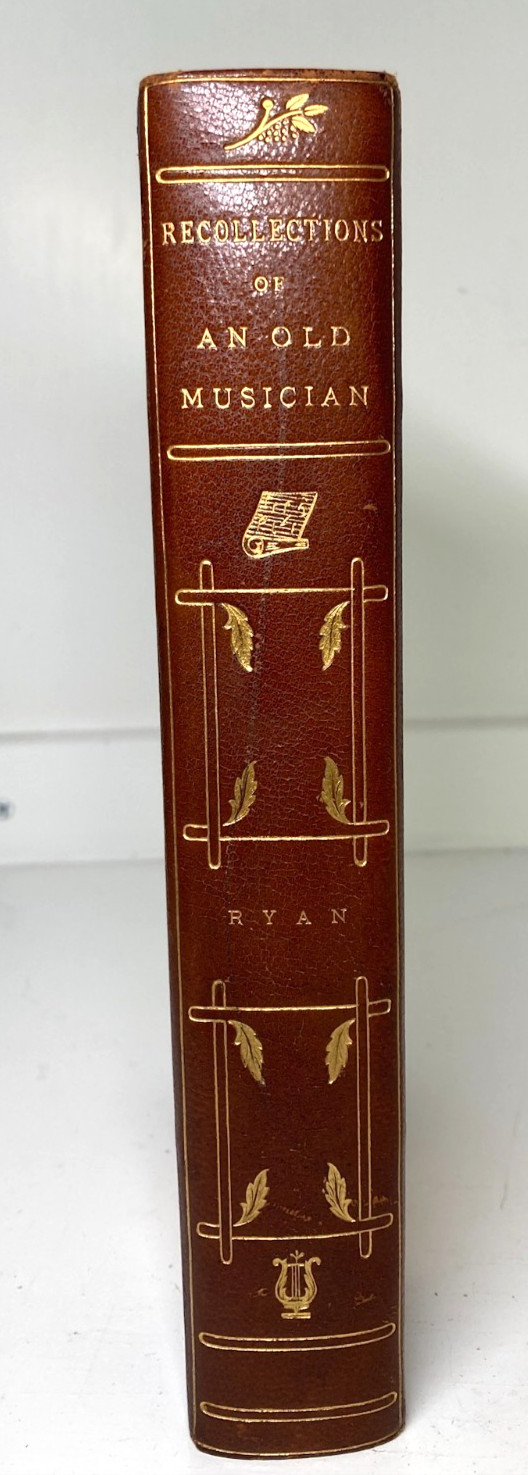
First edition. Octavo. xvi, 274 pages. Illustrated with a portrait frontispiece and 45 additional portraits and views. Bound in three-quarter brown morocco leather over marbled paper-covered boards, with raised bands, elaborate gilt musical tooling, marbled endpapers, top edge gilt, and untrimmed fore and lower edges.
A particularly handsome first edition of Thomas Ryan’s important firsthand memoir of nineteenth-century American musical life, preserved in an uncommon fine leather binding decorated with musical instruments, sheet music, lyres, and related gilt ornaments.
Ordinary copies of the first edition were issued in decorated cloth and remain relatively affordable. Copies in elaborate leather bindings are much less frequently encountered. The present copy is especially desirable for the subject-specific ornament of its spine, which transforms an important musical memoir into a striking decorative object.
Thomas Ryan and the Mendelssohn Quintette Club
Thomas Ryan was an Irish-born American clarinetist, violist, arranger, teacher, and musical organizer.
After emigrating to the United States in the 1840s, Ryan settled in Boston and became a founding member of the Mendelssohn Quintette Club in 1849. He performed with the ensemble on viola and clarinet, arranged repertory for its distinctive instrumentation, and also served as its manager.
The Mendelssohn Quintette Club became one of the best-known chamber ensembles in nineteenth-century America. Over the course of nearly half a century, it toured throughout the United States and farther abroad, introducing audiences to chamber music at a time when permanent orchestras and professional concert institutions were still developing outside the largest cities.
Ryan ultimately became the last surviving member of the original ensemble.
An eyewitness history of American musical life
Recollections of an Old Musician is valuable not merely as an autobiography but as a substantial primary source for the development of professional music in the United States.
Ryan writes from the perspective of a working musician who participated directly in theatrical orchestras, chamber ensembles, touring companies, musical societies, festivals, educational ventures, and public concerts.
His memoir records:
- musical training in Ireland;
- emigration to the United States;
- early theatrical work in Boston;
- nineteenth-century orchestra and theater culture;
- the founding of the Mendelssohn Quintette Club;
- touring conditions and concert management;
- American musical societies and institutions;
- changing audiences and repertory;
- encounters with major European and American performers;
- travel across the United States and in the Pacific.
Ryan’s narrative is lively, anecdotal, and rich in practical detail. He discusses not only celebrated artists but also the everyday realities of rehearsal, transportation, lodging, programming, financial risk, audience taste, and professional rivalry.
Performers and personalities
Among the musicians, singers, conductors, actors, impresarios, and public figures appearing in the book are:
- Jenny Lind;
- Ole Bull;
- Anton Rubinstein;
- Henryk Wieniawski;
- Hector Berlioz;
- Christine Nilsson;
- Julius Eichberg;
- Anne Louise Cary;
- Madame Sontag;
- Carl Zerrahn;
- Patrick S. Gilmore;
- Jonas Chickering;
- P. T. Barnum;
- John Brougham;
- members of the Booth theatrical family;
- conductors, instrumentalists, and singers active in Boston and on the American touring circuit.
Ryan’s recollections provide a rare insider’s picture of the cultural world in which these performers worked.
Boston and American chamber music
The memoir is particularly important for the history of Boston.
Ryan describes the city’s theaters, concert rooms, music societies, orchestral players, teachers, instrument makers, conductors, and audiences during the formative decades of American professional music.
The Mendelssohn Quintette Club helped establish chamber music as a viable form of public entertainment in the United States. Its extensive touring brought European instrumental repertory to communities that had little or no regular access to professional concert ensembles.
For that reason, Ryan’s book remains relevant to the study of:
- Boston music history;
- American chamber music;
- nineteenth-century touring ensembles;
- immigrant musicians in the United States;
- musical education;
- theater orchestras;
- concert management;
- the professionalization of American musical life.
The fine musical binding
The book is bound in three-quarter brown morocco leather over marbled paper-covered boards.
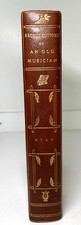
The spine is divided by raised bands into six compartments and richly decorated in gilt with subject-specific musical devices.
The ornament includes:
- a lyre;
- open sheet music;
- crossed or grouped musical instruments;
- foliate musical emblems;
- gilt compartment borders;
- gilt author and title lettering.
Additional binding features include:
- three-quarter brown morocco leather;
- marbled paper-covered boards;
- raised spine bands;
- gilt rules and ornaments;
- top edge gilt;
- marbled endpapers;
- untrimmed fore edge;
- untrimmed lower edge.
The musical tools are especially effective and unusually appropriate to the text.
The binding appears contemporary or near-contemporary with the publication. It may represent a deluxe bookseller’s, publisher-associated, or privately commissioned binding, but no binder’s signature or documentary evidence has been identified that would justify a definite attribution.
It is therefore catalogued conservatively as a fine contemporary or near-contemporary musical binding.
Illustration
The volume contains 46 portraits and views, including the tissue-guarded portrait frontispiece of Thomas Ryan.
The remaining illustrations depict musicians, singers, conductors, theatrical personalities, members of the Mendelssohn Quintette Club, concert venues, and institutions connected with Ryan’s career.
The plates significantly enhance the documentary value of the memoir and provide a visual record of the nineteenth-century musical world described in the text.
Bibliographical details
Author: Thomas Ryan
Title: Recollections of an Old Musician
Publication: New York: E. P. Dutton & Company, 1899
Edition: First edition
Language: English
Format: Octavo
Pagination: xvi, 274 pages
Illustrations: 46 portraits and views
Binding: Three-quarter brown morocco leather over marbled boards
Spine: Raised bands with gilt musical tools
Edges: Top edge gilt; fore and lower edges untrimmed
Endpapers: Marbled
Rarity and market interest
The first edition in ordinary decorated cloth is not rare and remains available in the antiquarian trade.
The present copy is materially more desirable because of its elaborate leather binding. Leather-bound examples with subject-specific musical tooling are far less frequently encountered than the standard cloth issue.
The binding gives the volume crossover appeal to collectors of:
- fine bindings;
- musical bindings;
- gilt-tooled leather books;
- American music history;
- Boston history;
- chamber music;
- musicians’ memoirs;
- nineteenth-century theatrical history;
- decorative arts;
- books illustrated with portraits of musicians.
The strongest feature of this copy is not merely that it is a first edition, but that the memoir has been given a highly appropriate and visually distinctive binding devoted to the imagery of music itself.
Condition
Very good or better overall.
The three-quarter morocco leather binding remains sound, attractive, and suitable for display.
The leather shows light rubbing and minor wear at the corners, joints, raised bands, and spine ends, consistent with age and normal handling. Any small scuffs, surface marks, or areas of dryness are visible in the photographs.
The gilt author and title lettering remain clear. The musical tools and decorative compartment borders remain bright and well defined.
The marbled paper-covered boards show mild rubbing, fading, and handling wear, with somewhat greater wear at the outer edges and corners.
The boards are firmly attached. The hinges and text block remain sound.
The marbled endpapers are well preserved, with light age toning and handling wear.
The interior is generally clean and securely bound, with light uniform toning, occasional minor foxing, and scattered handling marks consistent with age.
The portrait frontispiece and remaining plates are well preserved. Any tissue guards, marginal foxing, offsetting from the plates, or small edge tears should be assessed from the photographs and specifically noted where applicable.
The fore and lower edges remain untrimmed, preserving the original deckled character of the paper.
Please examine all photographs carefully. The images form an integral part of the condition description.
Collector interest
A distinguished copy for collections devoted to:
Thomas Ryan; Mendelssohn Quintette Club; Boston music; American chamber music; nineteenth-century concert history; Jenny Lind; Ole Bull; Anton Rubinstein; Henryk Wieniawski; Hector Berlioz; Christine Nilsson; theater orchestras; touring musicians; musical memoirs; fine leather bindings; morocco leather; musical gilt tooling; lyre bindings; sheet-music motifs; illustrated biographies.
A handsome and unusually appropriate leather-bound first edition of one of the most engaging eyewitness accounts of nineteenth-century American musical culture.