When you click on links to various merchants on this site and make a purchase, this can result in this site earning a commission. Affiliate programs and affiliations include, but are not limited to, the eBay Partner Network.
Germanic Miniature Memento Mori Coffin | Circa Late 18th – Early 19th CenturyHistorical Context & Origin Region: German-speaking Alpine region, likely Austria or southern GermanyMaterial: Carved and painted wood, textile wrapping, carved skull, metal hinges and clasp, painted decorationPeriod: Late 18th–Early 19th Century Description This unusual miniature funerary object is a Tödlein, a form of European memento mori traditionally produced in the German-speaking regions of Central Europe and particularly associated with Alpine devotional culture. The object takes the form of an elongated miniature wooden coffin, painted black and decorated across the lid with striking mortality symbols. A skull-and-crossbones appears prominently at one end, followed by additional painted motifs including a stylized letter or symbolic device, a geometric emblem, and a cross or cruciform element. A dotted border runs around the composition, creating a decorative frame. The hinged coffin opens to reveal a small anthropomorphic funerary figure secured within a fitted recess. The body is tightly wrapped in dark, aged textile in a manner reminiscent of a shrouded corpse, while the exposed head consists of a separately carved skull with deeply hollowed eye sockets, nasal opening, and incised teeth. Traces of vivid blue pigment survive throughout the interior of the coffin, providing a remarkable contrast with the predominantly black exterior. The construction incorporates small metal hinges connecting the lid to the coffin body and a surviving closure mechanism along the opposite side. Although macabre to modern eyes, objects of this type were not simply curiosities. Tödlein belonged to the broader European memento mori tradition and were intended to encourage contemplation of mortality, the brevity of earthly existence, and preparation for death. Comparable miniature coffins were known as Betrachtungssärglein, or contemplation coffins. Museum sources note that such objects were used during the 18th and 19th centuries for remembrance of the dead and meditation on mortality, while particularly small examples could even function as portable reminders of death. Features - Painted skull-and-crossbones motif - Cross and additional symbolic decoration - Dotted painted border surrounding the lid - Carved skull with hollow eye sockets and incised teeth - Textile-wrapped funerary figure - Fitted interior recess - Surviving blue-painted interior - Small metal hinges and closure fitting Cultural Significance Memento mori, Latin for remember that you must die, became an important theme in European Christian art and devotional culture. Objects incorporating skulls, skeletons, coffins, hourglasses and other symbols of mortality reminded their owners that worldly life was temporary and encouraged spiritual preparation for death. Within German-speaking Europe, miniature coffin objects became known as Tödlein, Mementosärglein and Betrachtungssärglein. Surviving examples range from elaborate carved skeletons to small shrouded or corpse-like figures enclosed within wooden coffins. The tradition itself is considerably older than this example. Scholarly references document Tödlein from the 16th through 18th centuries in France and German-speaking Europe, while the miniature coffin form continued into the 19th century. Particularly relevant comparisons have appeared at Dorotheum. One Alpine Tödlein dating to the first quarter of the 19th century consisted of a carved and painted figure housed within a miniature wooden coffin, while another early 19th-century example attributed to the Gröden region incorporated a painted wooden coffin containing a carved skeletal figure. Condition The object survives in well-aged condition consistent with its presumed period and materials. The wooden coffin exhibits surface wear, abrasions, small chips, cracking, losses to the black-painted finish, exposed wood along the edges, and general handling wear. The painted exterior decoration remains readily identifiable, although areas are worn and faded. The interior retains substantial traces of blue pigment with extensive rubbing, discoloration, scratches, losses, and age-related surface deterioration. The wrapped figure remains present within the coffin. Its textile covering exhibits considerable age, discoloration, dust, surface wear, fraying, deformation, and losses. The carved skull displays cracking and surface wear but retains its distinctive facial features. Dimensions (Approximate) Length: 4.25 inWidth: 1.15 inDepth: 0.75 in Age (Approximate) 200–250 years old Provenance Formerly part of a private collection in Falls Church, Virginia, USA. The object was preserved within a private collection of historical and decorative material. Learn More Explore a South German Tödlein dated 1756 and documented by Schloss Ahlden Browse our Collection of Rare Oddities, Curiosities & Unique Relics Germanic Miniature Memento Mori Coffin | Circa Late 18th – Early 19th Century
Historical Context & Origin
Region: German-speaking Alpine region, likely Austria or southern Germany
Material: Carved and painted wood, textile wrapping, carved skull, metal hinges and clasp, painted decoration
Period: Late 18th–Early 19th Century
Description
This unusual miniature funerary object is a Tödlein, a form of European memento mori traditionally produced in the German-speaking regions of Central Europe and particularly associated with Alpine devotional culture.
The object takes the form of an elongated miniature wooden coffin, painted black and decorated across the lid with striking mortality symbols. A skull-and-crossbones appears prominently at one end, followed by additional painted motifs including a stylized letter or symbolic device, a geometric emblem, and a cross or cruciform element. A dotted border runs around the composition, creating a decorative frame.
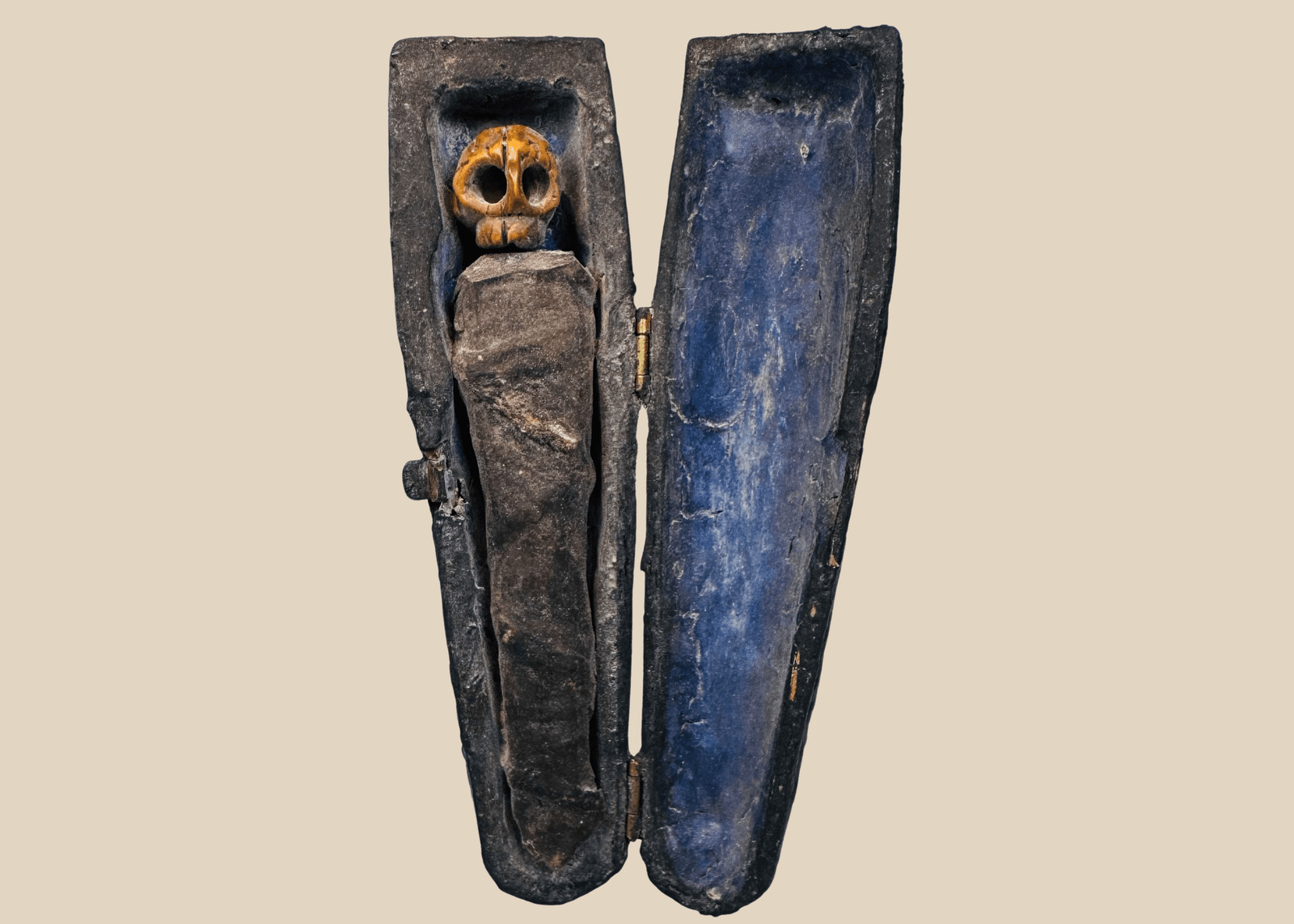
The hinged coffin opens to reveal a small anthropomorphic funerary figure secured within a fitted recess. The body is tightly wrapped in dark, aged textile in a manner reminiscent of a shrouded corpse, while the exposed head consists of a separately carved skull with deeply hollowed eye sockets, nasal opening, and incised teeth.
Traces of vivid blue pigment survive throughout the interior of the coffin, providing a remarkable contrast with the predominantly black exterior. The construction incorporates small metal hinges connecting the lid to the coffin body and a surviving closure mechanism along the opposite side.
Although macabre to modern eyes, objects of this type were not simply curiosities. Tödlein belonged to the broader European memento mori tradition and were intended to encourage contemplation of mortality, the brevity of earthly existence, and preparation for death.
Comparable miniature coffins were known as Betrachtungssärglein, or contemplation coffins. Museum sources note that such objects were uséd during the 18th and 19th centuries for remembrance of the dead and meditation on mortality, while particularly small examples could even function as portable reminders of death.
Features
- Painted skull-and-crossbones motif
- Cross and additional symbolic decoration
- Dotted painted border surrounding the lid
- Carved skull with hollow eye sockets and incised teeth
- Textile-wrapped funerary figure
- Fitted interior recess
- Surviving blue-painted interior
- Small metal hinges and closure fitting
Cultural Significance
Memento mori, Latin for remember that you must die, became an important theme in European Christian art and devotional culture. Objects incorporating skulls, skeletons, coffins, hourglasses and other symbols of mortality reminded their owners that worldly life was temporary and encouraged spiritual preparation for death.
Within German-speaking Europe, miniature coffin objects became known as Tödlein, Mementosärglein and Betrachtungssärglein. Surviving examples range from elaborate carved skeletons to small shrouded or corpse-like figures enclosed within wooden coffins.
The tradition itself is considerably older than this example. Scholarly references document Tödlein from the 16th through 18th centuries in France and German-speaking Europe, while the miniature coffin form continued into the 19th century.
éd within a miniature wooden coffin, while another early 19th-century example attributed to the Gröden region incorporated a painted wooden coffin containing a carved skeletal figure.
Condition
The object survives in well-aged condition consistent with its presumed period and materials. The wooden coffin exhibits surface wear, abrasions, small chips, cracking, losses to the black-painted finish, exposed wood along the edges, and general handling wear. The painted exterior decoration remains readily identifiable, although areas are worn and faded. The interior retains substantial traces of blue pigment with extensive rubbing, discoloration, scratches, losses, and age-related surface deterioration. The wrapped figure remains present within the coffin. Its textile covering exhibits considerable age, discoloration, dust, surface wear, fraying, deformation, and losses. The carved skull displays cracking and surface wear but retains its distinctive facial features.
Dimensions (Approximate)
Length: 4.25 in
Width: 1.15 in
Depth: 0.75 in
Age (Approximate)
200–250 years old
Provenance
Formerly part of a private collection in Falls Church, Virginia, USA. The object was preserved within a private collection of historical and decorative material.
Learn More
Explore a South German Tödlein dated 1756 and documented by Schloss Ahlden
Browse our Collection of Rare Oddities, Curiosities & Unique Relics
× × × × × × × × × × × × ×
Buy now and save! Shipping info
Click the Shipping & Payments tab above the listing description for more info
FREE Shipping
See more... Standard Shipping - $0.00 Standard Int\'l Shipping - $0.00
Click the Shipping & Payments tab above the listing description for more info!
Additional delivery notes
PICK UP OPTION
Sorry, our items are NOT available for pick-up.
PAYMENT
Immediate payment is required upon selecting \"Buy It Now\" or upon checking out through the cart.
We accept payment via All Major Credit Cards (Visa, Mastercard, AMEX, Discover), Google Pay, PayPal, & Apple Pay (on mobile & App).
Thank you for shopping with us on !
Additional Information
No additional information at this time
Ask seller a question
Contact
To contact our Customer Service Team, simply click the button here and our Customer Service team will be happy to assist.
Ask seller a question
© Relic and Rarity
Shipping & Payments
Shipping is FREE for this item
Payment
Accepted Payment Methods
Immediate payment is required upon selecting \"Buy It Now\" or upon checking out through the cart.
We accept payment via All Major Credit Cards (Visa, Mastercard, AMEX, Discover), Google Pay, PayPal, & Apple Pay (on mobile & App).
Thank you for shopping with us on !
Returns
Returns are accepted
Items must be returned within 7 days of the purchase
Buyer will pay for return shipping.
If you are not fully satisfied, items may be returned in their original condition within seven days for a full store credit toward any other item in our collection at its listed retail price. Store credits are non-transferable and non-assignable.
integration by