When you click on links to various merchants on this site and make a purchase, this can result in this site earning a commission. Affiliate programs and affiliations include, but are not limited to, the eBay Partner Network.
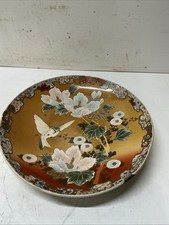
Japanese Kutani (1868–1912) Meiji Period 14.5" Earthenware Aka-e Charger w/ Kintsugi Repair
Size 14.5” x 2.5/8” tall
Has crazing as seen in pictures and some hairline cracks as seen in pictures.
Design DetailsCentral Scene: The middle of the charger depicts a delicately rendered songbird in mid-flight, flanked by large white and blush pink blossoms (resembling hibiscus or magnolias) with dark green foliage.
Color Palette: The background transitions dynamically from a warm, mustard-yellow ochre at the top into a deep, fiery iron-red or rust gradient along the bottom edge.
Border: A decorative, scalloped textile-patterned or moriage style border framing the circular composition uses repeating fan and floral motifs in contrasting cream, red, and gold gilt tones.
This object is an antique Japanese Kutani porcelain charger dating from the Meiji period (1868–1912).Key Characteristics & IdentificationStyle and Palette: It features a vibrant mustard-yellow background accented by traditional iron-red (aka-e), green, and white overglaze enamels. The detailed floral brocade border surrounding the rim is highly characteristic of Kutani ware.Artistic Motif: The central design depicts a classic Kacho-ga (flower-and-bird) scene, highlighting a bird in mid-flight surrounded by large blooming peonies and foliage.Origin: Kutani ware originates from the historic Ishikawa prefecture in Japan. Large shallow bowls or platters of this type—known as chargers—were heavily produced during the late 19th century for both local appreciation and Western export markets.
Designed PaletteIntentional Yellow: The rich, mustard-yellow or ochre-yellow background was applied intentionally as an overglaze enamel before firing. It is a signature base color for specific Kutani styles.The "Aka-e" Technique: The iron-red color (aka-e) was purposefully used only for the upper sky area and the intricate details in the border to create a vibrant contrast against the yellow.
While Kutani ware historically includes both porcelain and pottery, finding a piece of this exact style crafted on an earthenware body strongly suggests it is either Kutani earthenware from the Kaga region or an antique Satsuma-style charger.During the late Meiji period, many Kutani decorators collaborated across workshops or adapted techniques from the neighboring Satsuma tradition. Satsuma ware is famous for its warm, cream-colored earthenware base covered in a fine network of crackled glaze lines.
Based on the style and the markings on the base, this piece is likely a Japanese Kutani ware (九谷焼) or Kutani-style earthenware charger, dating from the late Meiji.
Key CharacteristicsThe Body and Glaze: The creamy, slightly off-white body with visible fine crackling (crazing) on the base is very typical of earthenware bodies produced for the export market during this era. While iconic Satsuma pottery features a similar crackled ivory body, Kutani workshops frequently utilized a comparable earthenware aesthetic for large ornamental chargers and plates decorated with their signature iron-red and gold color palettes.
The Markings: The faint, hand-painted grey/black characters inside the foot rim are a classic example of artisan or workshop signatures applied prior to the final kiln firings. Export pottery from this era often included marks specifying the region (such as Kutani 九谷 or Kaga 加賀) alongside the specific painter or decorator.
This traditional Japanese repair method is called Kintsugi (金継ぎ), which literally translates to "golden joinery". It is also known as Kintsukuroi (金繕い), or "golden repair".
Key Characteristics of KintsugiPhilosophy: Unlike Western restoration that tries to hide damage, Kintsugi follows the philosophy of wabi-sabi, which finds beauty in imperfection and treats the repair as a celebrated part of the object's history.
Materials: The process traditionally uses urushi lacquer (natural tree sap) to bond fragments or fill chips. While the lacquer is still tacky, it is dusted with powdered gold, silver, or platinum.
Keep in mind the shipping price also covers handling fees, packaging materials & time, not just postage.
See our store for thousands of our other items.
A39