When you click on links to various merchants on this site and make a purchase, this can result in this site earning a commission. Affiliate programs and affiliations include, but are not limited to, the eBay Partner Network.
✦ KINGDOM OF AKSUM ✦ KING ARMAH c. 600–640 AD Bronze Coin | Ge\'ez Legends | Gilt Cross The monumental stelae field at Aksum, the ancient capital of the kingdom in northern Ethiopia. A bronze coin of King Armah from one of the final phases of Aksumite coinage, combining royal imagery, the Ge\'ez language, and an explicitly Christian reverse highlighted by surviving central gilding. ✦ ✦ ✦ ✦ Dating & Attribution
Armah\'s precise chronology remains uncertain. Numismatic references generally place him in the late sixth or early seventh century, with published dates varying somewhat. The conventional c. 600–640 AD attribution is used in this listing.
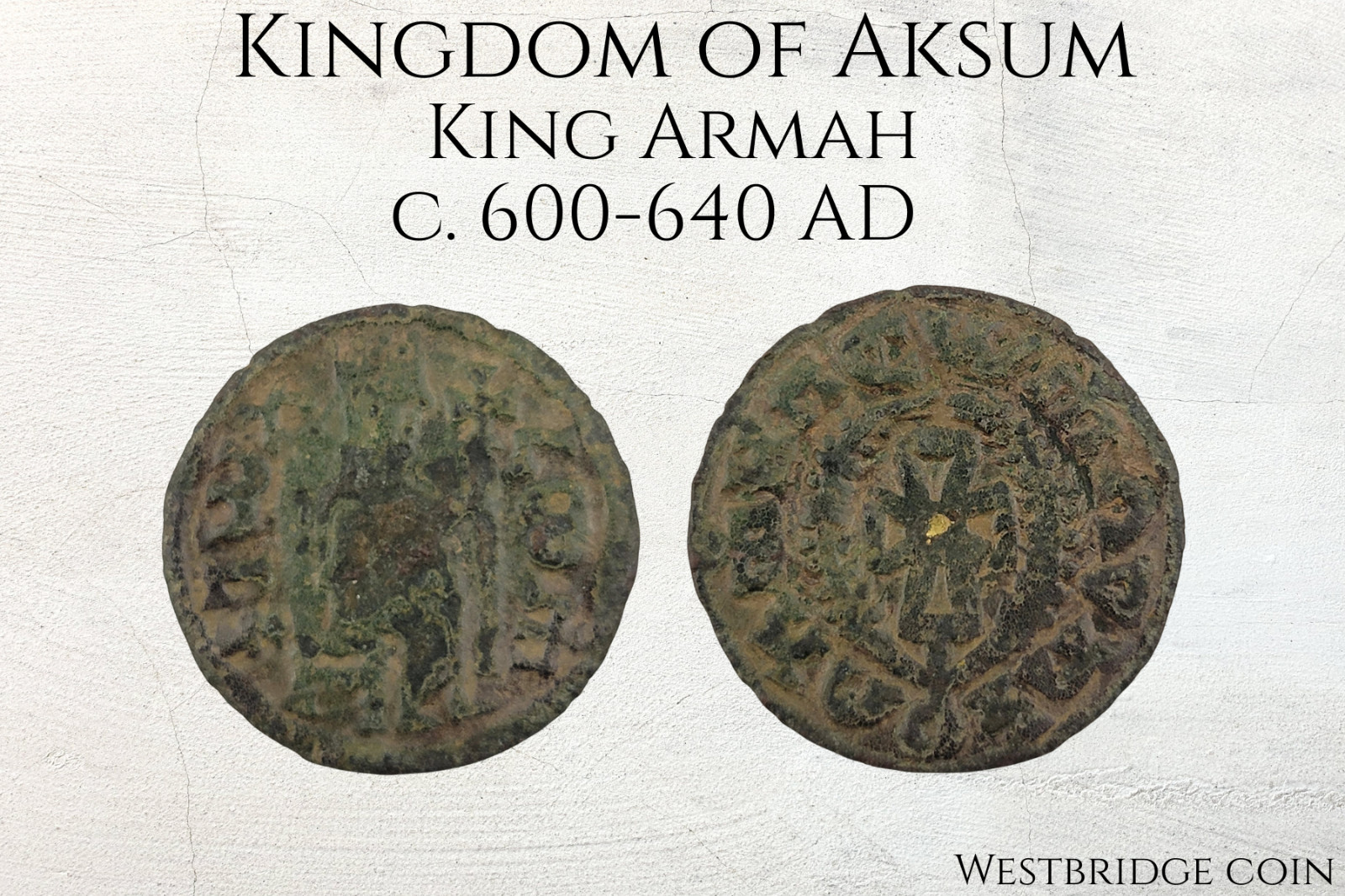
✦ Coin Details Ruler King Armah Kingdom Aksum Date c. 600–640 AD, approximate Metal Bronze Diameter 19 mm Weight 1.66 g Reference cf. BMC Aksum 573, 589; Hahn 72 The Design Obverse — King Armah The king is shown enthroned to the right, holding a long cross scepter. The surrounding inscription is written in Ge\'ez and identifies the ruler as “King Armah.” Reverse — The Cross A large voided Christian cross dominates the reverse, surrounded by a wreath and accompanied by a small area of gold gilding at the center. The Ge\'ez inscription carries the remarkable message: “Let there be joy to the people.” ✦ The Gilded Cross
One of the most distinctive features of Armah\'s bronze coinage is the deliberate use of gold at the center of the cross. Examples of this copper type are known both with and without this gilded treatment.
On this example, a small surviving golden area remains visible at the heart of the reverse design, drawing the eye directly toward the Christian cross.
The Kingdom of Aksum Africa, Arabia & the Red Sea World
The Kingdom of Aksum developed in the highlands of what is now northern Ethiopia and Eritrea and became one of the major powers of the Red Sea world.
Through its port at Adulis, Aksum participated in long-distance trade connecting the African interior with Arabia, the Mediterranean, Egypt, and regions farther east.
Among the goods moving through these networks were ivory, gold, aromatics, and other valuable commodities, making Aksum an important participant in the commercial world of Late Antiquity.
✦ The Aksumite World Aksum and its Red Sea setting during the sixth century Map showing the Kingdom of Aksum and its wider Red Sea sphere during the sixth century. An African Coinage Tradition
Aksum began issuing its own coins during the third century AD, making it the first state in sub-Saharan Africa known to develop its own struck coinage.
Aksumite rulers produced coins in gold, silver, and bronze. Their inscriptions and imagery reflected the kingdom\'s connections with both African traditions and the wider Mediterranean and Red Sea worlds.
By the period of Armah, that monetary tradition had existed for centuries and had become one of the most distinctive coinages of Late Antique Africa.
✦ Christianity in Aksum
Christianity became closely associated with Aksumite kingship during the fourth century under King Ezana.
Earlier Aksumite coins had displayed traditional religious symbols. Following Ezana\'s conversion, those symbols were replaced by the Christian cross.
More than two centuries later, Armah\'s coinage still placed the cross at the center of royal monetary imagery — and on this type, literally emphasized its center with gold.
King Armah Known Through His Coinage
Much about Armah remains uncertain. Unlike rulers whose reigns are extensively documented by surviving chronicles, he is known primarily through the coins bearing his name.
His known issues include silver and bronze coinage with Ge\'ez inscriptions and strongly Christian imagery.
Scholars differ over the precise ordering of the final Aksumite coin-producing kings, but Armah belongs firmly to one of the closing phases of this centuries-old monetary tradition.
Armah & the Early Seventh Century
The early seventh century was a period of enormous change around the Red Sea, involving the Byzantine Empire, Persia, Arabia, and Aksum.
Some scholars have proposed that Armah may have been connected with — or even identical to — the Aksumite ruler remembered as the Najashi who sheltered early Muslim emigrants around 615–616 AD. This identification remains uncertain and should be regarded as a scholarly hypothesis rather than an established attribution.
Aksumite Timeline 3rd century AD — Aksumite rulers begin issuing their own coinage.
4th century AD — King Ezana adopts Christianity; Christian crosses begin appearing on Aksumite coins.
6th century AD — Aksum reaches deeply into the Red Sea and southern Arabian world.
Late 6th / Early 7th century — Armah belongs to one of the final phases of Aksumite coinage.
c. 600–640 AD — This bronze type is conventionally dated to the period of King Armah.
7th century AD — Changing Red Sea trade and political conditions contribute to Aksum\'s gradual decline. ✦ Condition Ungraded ancient coin, About VG/F.
This coin has not been graded by a third-party grading service. Any grade, condition, or descriptive wording is the seller’s opinion only and is not a professional grade, guarantee, or prediction of how NGC, PCGS, ANACS, ICG, CAC, or any other grading service may evaluate the coin. Grading is subjective. Please review the photos and video, where available, and make your own judgment regarding condition and overall appearance before purchasing.
Ancient coins were individually struck by hand. Differences in centering, flan shape, patina, deposits, wear, and surface characteristics are normal features of ancient coinage. Please examine every listing photograph carefully when evaluating condition and appearance.
✦ A Coin of Christian Aksum
This small bronze preserves an extraordinary combination of Aksumite kingship, the Ge\'ez language, and Christian symbolism. The enthroned king, the message “Let there be joy to the people,” and the tiny surviving touch of gold at the center of the cross come from one of the final chapters of a coinage tradition that had connected an African kingdom with the wider commercial and religious world of Late Antiquity for centuries.
WESTBRIDGE COIN ✦ ✦ ✦ Historical images are included for educational and historical context and are not part of the item offered. Aksum stelae photograph: Jnyssen / Wikimedia Commons, CC BY-SA 4.0.
Sixth-century Aksum map: Trokiodero / Wikimedia Commons, CC BY 4.0.