When you click on links to various merchants on this site and make a purchase, this can result in this site earning a commission. Affiliate programs and affiliations include, but are not limited to, the eBay Partner Network.
MONUMENTAL 18TH-CENTURY FRENCH GRADUAL
Stenciled Latin Choir Book with Hand-Painted Flowers, Birds, Butterflies, and Insects
Graduel de Paris. Propre des Saints.
France, probably Paris, mid- to late eighteenth century, extensively repaired, reorganized, and renumbered by J. L. Tardif in 1847.
Approximately 62 × 45 cm, or 24.4 × 17.7 inches.
A remarkable monumental French Catholic choir book, created for communal performance of Latin plainchant and preserved in its enormous historic leather-over-wood binding.
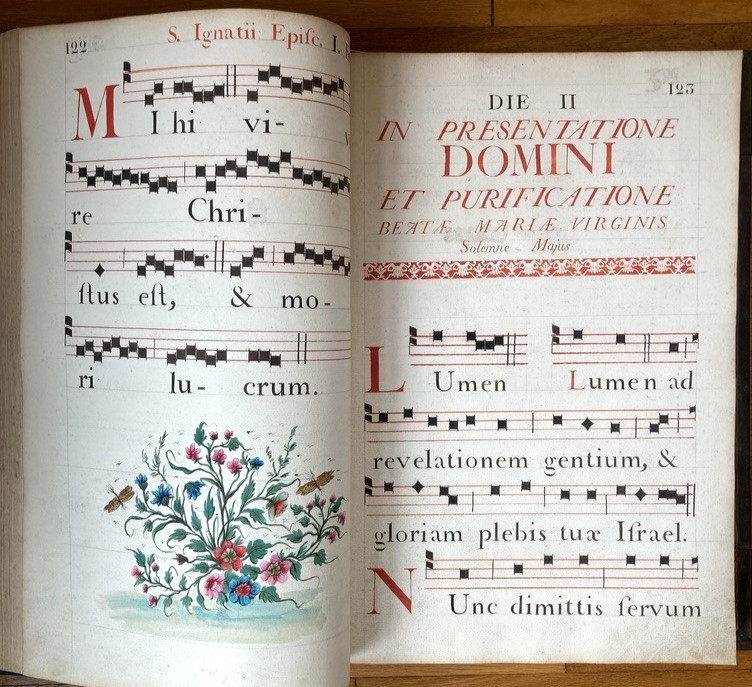
The volume contains the Proper of the Saints, or Sanctorale, according to the Parisian liturgical tradition. Its monumental lettering and black square musical notation on red four-line staves were designed to be read simultaneously by several singers gathered around a central choir lectern.
The book is principally stenciled rather than produced by ordinary movable-type printing. Five major floral, botanical, avian, and entomological compositions were painted freely by hand, giving the volume an unusual character somewhere between a liturgical manuscript, a monumental printed choir book, and a work of ecclesiastical decorative art.
The surviving older leaves are written on substantial handmade laid paper bearing watermarks associated with Thomas Dupuy and the Dupuy papermaking concern of Auvergne.
The volume also preserves a mounted nineteenth-century title recording its reconstruction:
“GRADUEL DE PARIS
PROPRE DES SAINTS
RÉPARÉ PAR J. L. TARDIF. L’AN MDCCCXLVII”
This is an imposing survival at the intersection of Catholic liturgy, plainchant, music history, stencil typography, French papermaking, ecclesiastical painting, monumental bookbinding, and the history of book repair and reuse.
WHAT IS A GRADUAL?
A gradual is the principal musical book used by the choir during the Catholic Mass. Unlike a missal, which contains the portions used by the celebrating priest, a gradual contains the music sung by the cantors and choir, including Introits, Graduals, Alleluias, Offertories, and Communions.
This volume is the Proper of the Saints, or Sanctorale, containing chants assigned to saints’ feast days and other fixed observances in the liturgical calendar.
Its immense format was practical rather than merely decorative. The book would have rested on a large choir lectern so that multiple singers could read from the same page. The heavy paper, massive wooden boards, substantial sewing, and protective metal fittings were designed for repeated institutional use.
A STENCILED LITURGICAL BOOK
The volume belongs to the specialized tradition of large stenciled liturgical choir books.
Such books were often produced individually for churches, abbeys, and religious communities. Stenciling allowed craftsmen to create uniform letters, musical notes, rubrics, initials, and borders on very large sheets without the expense of producing a commercial typographic edition.
Fine construction lines remain visible on numerous leaves. Reusable stencils were employed for:
• Latin text
• Feast headings and rubrics
• Page numbers
• Red musical staves
• Black square notes
• Initial letters
• Friezes and repeating borders
Small interruptions within some letters and notes preserve evidence of the bridges used to hold stencil forms together.
The floral, avian, and insect decorations were executed freely with brush and pen rather than simply repeated from a stencil. These painted compositions distinguish the volume from an ordinary printed liturgical book.
THOMAS DUPUY PAPER
The older body of the Gradual is written on substantial eighteenth-century French laid paper bearing watermarks associated with the Dupuy family of papermakers in Auvergne.
Several leaves carry a watermark conventionally described as:
“T – well-shaped emblem – D”
Other leaves contain a larger heraldic watermark consistent with a related Dupuy emblem: a crowned double-headed eagle bearing a heart.
Related Dupuy papers are recorded with countermarks incorporating the well device and wording such as “DUPUY FIN / AUVERGNE / 1742.”
The date associated with a watermark should not automatically be treated as the exact production date of the book, since named and dated paper stocks could remain in circulation for years. The watermarks nevertheless provide strong material evidence for an eighteenth-century origin.
The safest description is:
France, probably Paris, mid- to late eighteenth century, on Thomas Dupuy paper bearing related well and heraldic watermarks; extensively reconstructed in 1847.
No attribution to a particular named stenciller is claimed.
PRESENT COLLATION AND CONTENTS
The current sequence begins on page 5 with:
“PROPRIUM SANCTORUM
PARS HYEMALIS
DIE XXX NOVEMBRIS
IN FESTO S. ANDREAE APOSTOLI”
The volume opens with the Feast of St. Andrew on 30 November and proceeds chronologically through the Sanctorale.
The present sequence includes chants for numerous universal, French, and regionally important observances, including:
• St. Andrew
• St. Eligius
• St. Nicholas
• The Conception of the Blessed Virgin Mary
• St. Geneviève
• St. Rigobert of Reims
• St. Hilary of Poitiers
• St. Agnes
• The Purification of the Virgin
• The Annunciation
• St. Mark
• The Finding of the Holy Cross
• St. Honoratus
• St. John the Baptist
• Saints Peter and Paul
The text concludes on page 496 with the Vigil of the Assumption on 14 August.
The present numbering runs continuously from page 5 through page 496, representing 492 numbered pages on 246 leaves, together with preliminary material and the mounted 1847 title.
The volume is complete in the sequence established during Tardif’s 1847 reconstruction. It is not represented as preserving the exact original arrangement of the earlier eighteenth-century Gradual before that intervention.
FIVE HAND-PAINTED DECORATIONS
The volume contains five major hand-painted polychrome compositions, together with at least one smaller colored ornament.
Page 18: Floral Initial J
The Feast of the Conception of the Blessed Virgin Mary opens with a large red initial J surrounded by curling green stems, blue, pink, red, and yellow flowers, buds, berries, and delicate decorative marks.
Page 122: Bouquet with Moths or Butterflies
A large bouquet of pink, red, and blue flowers rises from a pale blue-green ground wash. Two finely rendered moths or butterflies hover among the foliage, their wings patterned in ochre, red, blue, and black.
Page 266: Flowering Tree
A large flowering tree or shrub is formed from olive-green branches, curling tendrils, and blue, pink, and red blossoms. Its symmetrical design resembles both a botanical study and an elaborate terminal ornament.
Page 326: Blue Initial D with Bird
The Nativity of St. John the Baptist opens with a large blue initial D set within a miniature landscape of pale sky, green trees, and foliage. A red-and-black bird flies within the letter, accompanied by smaller birds in the distance.
Page 330: Floral and Entomological Initial T
The Introit Tu es Petrus for the Feast of Saints Peter and Paul opens with a large red initial T surrounded by foliage, flowers, and finely painted insects within a broad lace-like red stencil border.
The paintings retain vivid and attractive color and give the Gradual unusual decorative appeal beyond its musical and liturgical importance.
J. L. TARDIF’S 1847 RECONSTRUCTION
The word “réparé,” or “repaired,” on the mounted title appears to describe a comprehensive reconstruction rather than a minor repair.
Physical evidence includes:
• Older pagination scraped from many leaves
• Reorganized gatherings
• New continuous numbering
• Replacement or supplementary leaves
• Historic paper repairs
• Structural work to the binding and sewing
• A newly mounted title recording the 1847 intervention
Pages 23–30 form a visually and materially distinct section. These leaves lack the erased former pagination found on surrounding older sheets and contain chants for the Feast of the Conception of the Blessed Virgin.
The leaves were carefully matched to the scale and stencil vocabulary of the older book. An internal direction on page 27 refers the singer to the Offertory on newly numbered page 30, confirming that the material was intentionally prepared or adapted for the reconstructed sequence.
One older leaf has a substantial historic paper infill replacing an irregular loss in the lower blank margin. The repair is visible from both recto and verso but does not affect the text, musical notation, or principal ruling.
The title identifies Tardif as the named repairer or reconstructor. It does not establish that he was the original binder, painter, or stenciller.
HISTORICAL CONTEXT
The older text block probably originated during the decades before or around the French Revolution.
The Revolution profoundly disrupted French ecclesiastical music. Religious houses and chapters were suppressed, church property was nationalized, and many institutional choirs were dissolved. Choirs were reconstituted after the Concordat of 1801, often with reduced resources.
Older liturgical books were consequently dispersed, damaged, reorganized, and adapted for renewed use.
This Gradual preserves unusually visible evidence of that continued institutional life:
• Eighteenth-century Dupuy paper
• Erased former pagination
• Reordered leaves
• Supplementary material
• Historic repairs
• Renewed numbering
• A formal 1847 reconstruction title
The book was not merely preserved as an antiquarian object. It appears to have been rebuilt so that it could continue to function as a working choir book.
REPORTED ABBAYE DU GARD PROVENANCE
The title Graduel de Paris identifies the Parisian liturgical use. It does not necessarily mean that the book remained physically in Paris.
The Parisian rite spread beyond the capital during the eighteenth century and was adopted in numerous French dioceses before the Revolution.
The volume was reportedly preserved at the Abbaye du Gard in Picardy and later entered the private collection of Mr. and Mrs. L.
That provenance is presented as reported rather than independently documented by a contemporary ownership inscription. Any connection between Tardif’s 1847 reconstruction and the relocation of the Gard religious community remains historically plausible but unproven.
MONUMENTAL LEATHER-OVER-WOOD BINDING
The volume is bound in full mottled brown leather, probably sheepskin or basane, over massive wooden boards.
The covers are decorated in blind with:
• Multiple ruled rectangular frames
• An inset central panel
• Diagonal corner compartments
• A large central geometric lozenge
• Repeated narrow ornamental impressions
The massive spine is sewn over eight substantial raised supports, forming nine compartments. These are genuine structural sewing supports rather than false decorative bands.
SURVIVING METAL FURNITURE
The binding retains substantial but incomplete brass or latten furniture, including:
• Large corner guards
• Edge guards
• Narrower guards beside the spine
• Scalloped fore-edge corner pieces
• Square boss plates on one cover
The square plates originally supported projecting bosses that elevated and protected the covers when the book rested horizontally. The bosses themselves are no longer present.
The rear board preserves evidence of missing furniture, including empty nail and rivet holes, attachment scars, abrasions from missing plates, and marks from the former clasp system.
The original straps and functioning catches are no longer present.
CONDITION
A monumental eighteenth-century working choir book in worn but compelling historic condition.
The leather is extensively rubbed, scratched, scored, stained, darkened, and abraded, with numerous old incisions and handling marks. There is widespread dryness, crazing, flaking, and localized leather loss.
The spine is heavily worn, with losses at the head and tail, abrasion across the raised supports, and exposed pale sewing material at several bands.
Both enormous wooden boards remain attached.
The metal furniture is incomplete. Several fittings, the projecting bosses, and all clasp straps are missing. The surviving brass or latten fittings show patina, scratches, discoloration, and evidence of historical adjustment.
The plain inner board linings are stained, worn, and locally lifted.
The mounted 1847 title has a repaired horizontal split or fold, creasing, staining, handling wear, and minor surface marks.
Internally, the substantial paper leaves are remarkably well preserved in comparison with the binding. The red-and-black stencil work remains strong, highly legible, and visually impressive.
Additional condition points include:
• Scattered spotting
• Occasional stains
• Marginal dust and handling soiling
• Offsetting and show-through
• Minor edge wear
• Localized smudging
• Deliberate historic scraping of former page numbers
• A small irregular upper-corner loss on page 92, confined to the blank margin
• One leaf with a substantial lower-margin paper infill, not affecting the text or music
The five major painted decorations retain vivid color, with no major loss apparent.
The current numbering runs continuously from page 5 through page 496 without a missing number.
The volume is described as complete only in its present 1847 arrangement.
BIBLIOGRAPHICAL DETAILS
Title: Graduel de Paris. Propre des Saints
Opening heading: Proprium Sanctorum. Pars Hyemalis
Place: France, probably Paris
Date: Mid- to late eighteenth century
Reconstruction: Extensively repaired, reorganized, and renumbered by J. L. Tardif in 1847
Language: Latin, with the 1847 title in French
Material: Handmade laid paper
Dimensions: Approximately 62 × 45 cm, or 24.4 × 17.7 inches
Pagination: Pages 5–496
Extent: 492 numbered pages on 246 leaves, plus preliminary material and mounted title
Notation: Black square plainchant notation on red four-line staves
Production: Principally stenciled in red and black, with freehand polychrome decoration
Binding: Historic leather over massive wooden boards, with surviving brass or latten furniture
Reported provenance: Abbaye du Gard in Picardy; subsequently the private collection of Mr. and Mrs. L.
COLLECTOR AND INSTITUTIONAL INTEREST
This monumental Gradual will appeal to collectors and institutions interested in:
• French ecclesiastical history
• Catholic liturgy
• Gregorian and plainchant notation
• Music manuscripts and choir books
• Stencil typography
• Historic French papermaking
• Watermarks and paper history
• Monumental bindings
• Monastic and church material culture
• Botanical and entomological painting
• The history of book repair and reuse
• The French Revolution and the reorganization of religious institutions
Monumental stenciled choir books were created individually for particular churches, abbeys, and religious communities rather than as ordinary commercial editions. Their immense size, institutional use, damp exposure, structural failure, changing liturgical requirements, dispersal after the French Revolution, and later removal of decorated leaves have made survivors uncommon.
This volume is particularly distinguished by the combination of monumental format, 492 consecutive pages, identifiable Dupuy paper, five hand-painted decorations, strong internal preservation, massive leather-over-wood binding, surviving brass furniture, erased former pagination, supplementary leaves, and a named and dated nineteenth-century reconstruction.
A remarkable French Catholic choir book and monumental bookbinding survival, preserving the physical evidence of liturgical use, nineteenth-century reconstruction, and the continued life of an eighteenth-century institutional object.