When you click on links to various merchants on this site and make a purchase, this can result in this site earning a commission. Affiliate programs and affiliations include, but are not limited to, the eBay Partner Network.
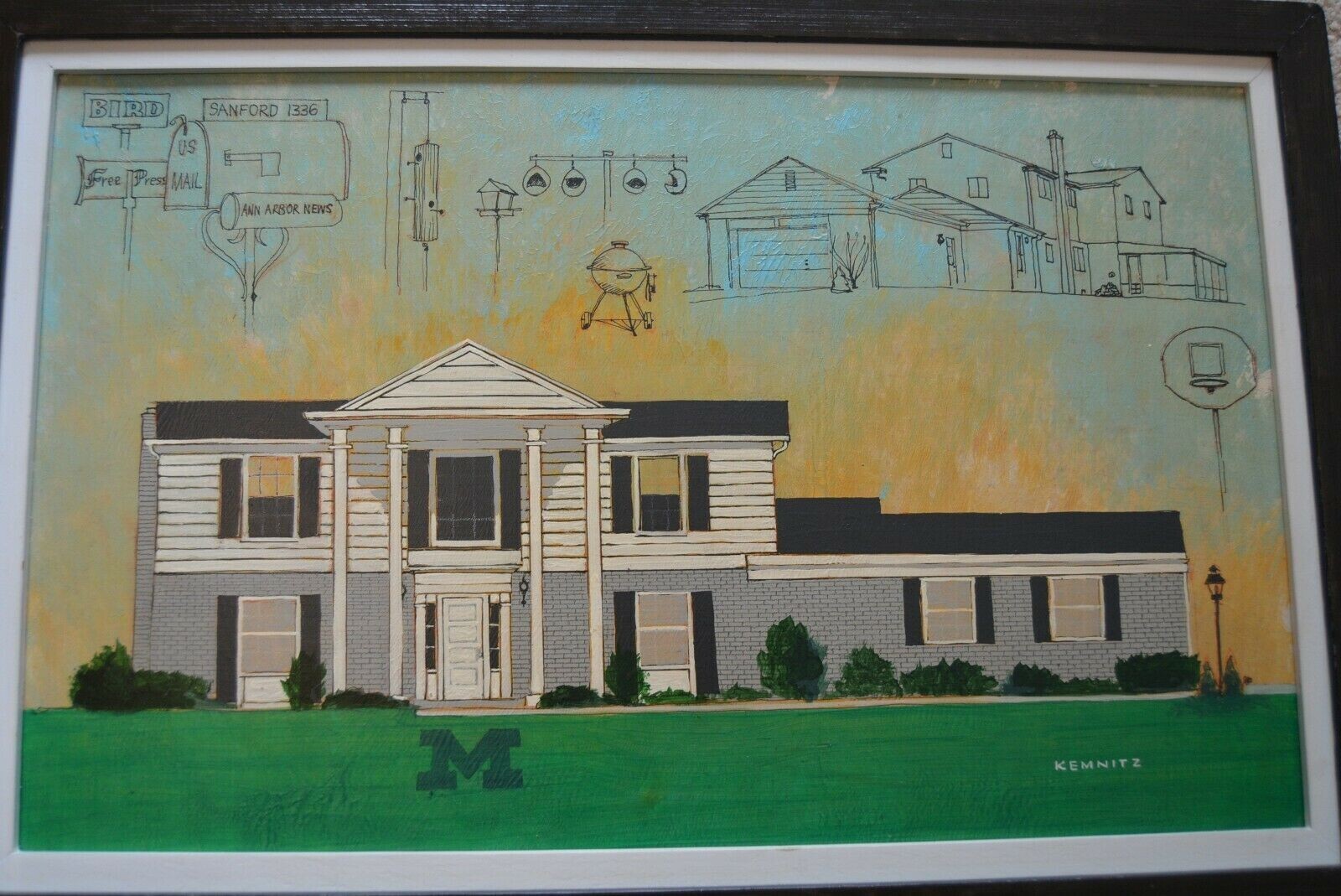
A FANTASTIC PAINTING BY ANN ARBOR ARTIST MILTON KEMNITZ MEASURING OVERALL 12.5\" X 18.5 INCHES (WTH PAINTING MEASRING 10\" X 16\" INCHES)
on back is handwritten in pencil by milton kemnitz
PAINTED FOR THE SANFORDS OUR BELOVED NEIGHBORS, MAY 1979 - FROM EDDIE & MILT
a vintage photo is also attached to back of the area where Kemnitz\'s and Sanford\'s livedMilton Kemnitz is one of Ann Arbor\'s best known artists. His drawings and paintings all have a unique, identifiable style and have been widely reproduced -- on greeting cards, shopping bags, calendars and magazine covers. His work also appears on the walls of the city -- both inside and outside. In 1974 the mayor of Ann Arbor recognized his contributions and declared a \"Milt Kemnitz Day.\"
Kemnitz was born in Detroit, Michigan and graduated from the University of Michigan with a degree from the College of Literature, Arts and Sciences, in 1933. During World War II he served as a merchant seaman, and started to paint on a stint to the Mediterranean. Once the war was over, he returned to Ann Arbor, and together with his wife and collaborator Eddie, whom he married in 1939, has made the city his home ever since.
His work has been shown in numerous group and one-man shows, mainly in galleries in his home state. The Forsythe Gallery in Ann Arbor represented him for decades, and he has had connections with many other galleries over the years. His work is in the collections of many museums, institutions and corporations. He has published several books of drawings: Old West Side, Michigan Memories (1965), Ann Arbor Now and Then (1972)and London and Back (1977). Eddie helped him design and edit the books, a role she often filled in conjunction with Milt\'s larger projects.
Kemnitz did many commissioned pieces, especially drawings of buildings for individuals and corporations. In addition to these commissions, he often donated artwork or his expertise to support local activities. For instance, he sat on the Ann Arbor Sesquicentennial Committee and designed the commemorative silver bar, did lettering and drawings for the \"Y\" for over a decade, and helped keep The Ark, a local performance space, open.
In addition to supporting the arts in Ann Arbor, an effort that included membership in the Ann Arbor Art Association and numerous other organizations, Eddie and Milt were involved in other local causes. The biggest effort was to \"Save Bird Hills Park\" in 1971. This was a grassroots effort to fight the building of luxury condominiums on what had been parkland. The city agreed to buy the land from the developer and leave it as parkland if the people of Ann Arbor could raise one-fourth of the purchase price. 1500 people pledged a total of $90,000 but the developer still got the land.
His involvement with local organizations includes over fifty years of membership in the First Unitarian Universalist Church. Naturally, he did quite a bit of work for them over the years. In addition to his drawing of the church, which was used on programs and stationary for years, he experimented with a new medium and created a memorial stained glass window dedicated to Edward H. Redman, who had been minister from 1943 to 1960.
Milton Kemnitz, an early crusader for civil rights who traded his protest sign for the artist\'s brush in the 1940s, died a week ago at his son\'s home in Monroe, where he had lived since 2000. He was 93.
Kemnitz, a Michigan native, began his career as a social worker in the 1930s but soon discovered his calling as an activist by organizing welfare recipients — a project that at first cost him his social-worker job.
He went on to become secretary of the Detroit-based Conference for the Protection of Civil Rights, which expanded into the National Federation for Constitutional Liberties. He went to work for that organization in Washington, D.C., in 1941.
In April 1942, Kemnitz spoke at an NFCL conference in Washington to protest the South\'s racist Jim Crow policies and poll tax, the internment of Japanese-Americans, the suspension of strike rights and other wartime measures.
Kemnitz moved to New York City in 1942 to run the NFCL there and then spent much of World War II as a merchant seaman in Europe. It was during that service that he learned to paint through a National Maritime Union program.
After the war, he returned to New York and then to Ann Arbor in his native Michigan, bent on making his living as an artist. And that\'s what he did. He painted Ann Arbor streetscapes and Great Lakes ships, birds and trains, and scenes of the Georgian Bay. Ever the activist, Kemnitz used his paintings of old buildings in Ann Arbor to fight for their preservation.
His books of art included \"Michigan Memories,\" \"Ann Arbor Now and Then\" and \"London and Back.\"
Kemnitz and the former Esther Lichtenstein married in 1939. After she died in May 2000, Kemnitz moved to Monroe to live with his son, Dr. Thomas Milton Kemnitz.
ObituaryEarly Civil-Rights Leader and popular Michigan artist. Milton Neumann Kemnitz died peacefully in his sleep on 26 February 2005. He was born in Detroit, Michigan on March 31, 1911 to William Hermann and Amanda Neumann Kemnitz.
He graduated from the University of Michigan in 1933 and immediately took a job as a social worker in Washtenaw County. He was fired from that position in 1935 for his activities in organizing the welfare recipients. Although he was rehired, he was launched on a career of social, political, and union activism. He took part in the sit-down strike at the General Motors facility in Flint, shared a house with Walter and Victor Reuther and Norman Thomas when they founded the UAW, and became secretary of the Detroit-based Conference for the Protection of Civil Rights [CPCR].
Milton Kemnitz remained secretary when the CPCR grew into the National Federation for Constitutional Liberties [NFCL]. In June of 1941, he moved the NFCL to Washington, D.C. While many of the causes they took up were futile, all had to be fought, and they had many successes. Among them was getting an unconditional pardon in January of 1939 for Thomas J. Mooney who had been sentenced to death for bombings of the 1916 San Francisco Preparedness Day parade. A grateful Mooney sent the pardon to Milt Kemnitz with an inscription thanking him. In Natchitoches Parish, Louisiana, they won the freedom of an African-American farm labor union organizer named Clinton Clark. Their modus operandi was to win a case, and with each victory they put authorities throughout the country on notice to cease and desist practices that were as clearly unconstitutional as they were widespread.
In April of 1942, the NFCL held a National Action Conference for Civil Rights in Washington to protest Jim Crow, the poll tax, the internment of the Japanese, the suspension of the rights of labor to strike, and many other war-time measures. As secretary, Milton Kemnitz voiced from the podium his protest against the attempts to create a national unity at the expense of the constitutional liberties of all Americans. Time has endorsed the vision of the delegates to this conference. Every law that they said was wrong in 1942 has been repealed. Every action they protested in 1942 the country now regrets. Every right they said should be guaranteed in 1942 has been established as a right.
In 1942, the sources of support of the NFCL shifted, and Milt Kemnitz moved to New York City to continue to run the NFCL. He spent much of World War II as a merchant seaman on Liberty ships in the European theatre. During his time on board ship, he aided the National Maritime Union and was a delegate to its congress in 1945. The National Maritime Union had a program to teach seamen to paint, and Milt took advantage of the opportunity. After the war, he returned to New York to the NFCL, but now he had his eye set on a return to Ann Arbor and a career as an artist. His great friend Dashiell Hammett took him to Ben Shahns studio where they discussed how he might make a living as an artist in southeastern Michigan. In October of 1947, Milt moved his family back to Ann Arbor determined to spend as much of his life as possible making art.
Through the rest of his life, Milton Kemnitz painted the buildings, old homes and street scenes of Ann Arbor and University of Michigan; he did many paintings of ships-particularly the Great Lakes ships-and of birds and landscapes of Georgian Bay, and of trains and automobiles. Repeatedly, he painted, drew and made prints of the buildings he thought should be preserved, and he played a great part in efforts to preserve the character of Ann Arbor. He was always interested in learning and using new media: watercolors, oils, pen and ink, silk screen, collage, stained glass.
By a variety of means, Kemnitz managed to make his art widely owned. Among the books he produced are Michigan Memories, Ann Arbor Now and Then, and London and Back. His car drawings were collected in Cars That Caught My Eye, and lately his paintings have been extensively used in a series of grammar books called Grammar Island, Grammar Town, and Grammar Voyage.
He married Esther Lichtenstein on August 18, 1939, and she was the central focus of his life until her death in May of 2000. Thereafter, he moved to Monroe, New York where he lived in the house of his son. He is survived by his son Dr. Thomas Milton Kemnitz and his grandson Thomas Jr.
For many, he\'s to Ann Arbor what Toulouse Lautrec is to Pigalle, what Al Hirschfeld is to Sardi\'s, or what Norman Rockwell is to romanticized Americana.
His renderings--signature views of State St. and the Michigan Central Depot, among countless others--thread the fabric of this town like Ann Arborites you only know by sight. His pictures are so much a part of how Ann Arbor remembers itself that those who\'ve lived here long enough might be excused for taking them for granted.
But like the unassuming uncle you\'re startled to learn was a bartender at Studio 54, there\'s so much more to Milt Kemnitz than his paintings. To peel back the layers of his life is to be continually astonished at the diversity--and historical significance--of his work. His is a Zelig-like tale in which famous names crop up with textbook regularity.
Kemnitz was involved in the earliest days of union organizing, sharing a house with UAW founders during the union\'s creation. In the earliest rumblings of the Red Scare, he was fired from his job as a Washtenaw County social worker. And, decades before the 1964 Civil Rights Act, he played a central role in the movement for racial equality.
Kemnitz was an activist by nature and by profession. In later years, while literally painting the town, he fought to protect not just people but spaces, both open and built--a beloved Ann Arbor of elm-lined streets and Victorian gables that by the mid-twentieth century had become increasingly endangered.
---
Milton N. Kemnitz, who died in 2005 at age ninety-three, was born in Detroit in 1911. His mother, Amanda, a first-generation German American, was the daughter of Ann Arbor pastor G.A. Neumann. His father, William, a Detroit lawyer, emigrated from Germany as a toddler. One of three siblings (his brother Walt was also locally famous, as sub-postmaster of the Nickels Arcade post office), Milt grew up in German-speaking affluence.
When WWI broke out, young Milt didn\'t speak English, and one of the...continued below...painter\'s first brushes with social intolerance was the era\'s harassment of German Americans. You might think this had everything to do with his lifelong war on bigotry, but his son Tom Kemnitz, a historian and publisher who now lives in New York state, says that while his father\'s anti-German schoolyard drubbings left a crucial impression, there was much more to it than that.
\"The Kemnitz family,\" explains Tom, \"came from a German pacifist Christian tradition where pacifism, socialism, and Christianity were all part of an extremely strong mix of Lutheranism that really goes all the way pretty directly back to Martin Luther.\"
Pacifism is a major theme. Family lore has it that Milt\'s widowed grandmother left Germany for America solely to keep her triplet sons\' godfather, Kaiser Wilhelm, from whisking them off to military school. Decades later in Detroit, Milt\'s childhood family minister would be theologian Reinhold Niebuhr, a famous proponent of social justice who profoundly influenced civil rights leader Martin Luther King.
In 1930, having graduated from Detroit\'s Northwestern High School and spent a year at Elmhurst College, Milt transferred to the University of Michigan, living with his family in a farmhouse on Plymouth Rd. His ties to the community were already deep. \"You know that big stone church near the library?\" asks Tom of the Bethlehem United Church of Christ on Fourth Ave. \"Much of that was built by his grandfather.\"
Milt\'s union organizing began in 1933, when, straight out of college, he was hired as a social worker for Washtenaw County. He and Henry Meyer (later a U-M professor of social work) rallied recipients to form a union to protect their dignity against what was then a dehumanizing process of applying for and receiving aid--and lost their jobs as a result. \"They sued and won and were reinstated, but by that time my father had already gone to the Flint sit-down strike and played a part in the founding of the UAW.\"
His unionization efforts grew as his focus shifted to the Detroit auto industry. Jimmy Hoffa tried to recruit him to organize for the Teamsters, but, Tom says, \"He didn\'t like Jimmy Hoffa and his goons ... He was very much a pacifist. He did not like aggression.\"
By the late 1930s, Milt had become active in the Detroit-based Conference for the Protection of Civil Rights, serving as executive secretary as it blossomed into the National Federation for Constitutional Liberties (NFCL).
\"It was very deliberately called the National Federation for Constitutional Liberties,\" says Tom, a U-M history grad who later took his doctorate in nineteenth century British literature from the University of Sussex. \"That\'s what they were about. They were about the Constitution.\"
It was during this time, in a cottage overlooking Barton Pond, that Milt married his soul mate and champion, Esther (\"Eddie\") Lichtenstein, a marriage that would last more than sixty years. In 1941, the NFCL drew the couple to Washington, D.C., where Tom was born; a daughter, Martha, followed after the family returned to Ann Arbor.
In early 1942, at the outset of U.S. involvement in WWII, the NFCL split over support of the war, a dilemma which pitted Milt\'s innate pacifism against his hatred of fascism. His opposition to fascism won out, but the ongoing discord caused Milt to relocate the NFCL that year to New York City.
Eligible for the draft and willing to be shot at, but not to kill anyone, Milt avoided conscription by signing up with the Merchant Marines, which took him to the European war zone. There he organized the seamen into the National Maritime Union and was elected delegate to the 1945 union convention by his ship.
The union provided various skill-building workshops, including art, and it was there that Milt honed his as-yet-untapped talent as an artist. More than skills, the workshops built for him a creative epiphany. By the end of WWII, Milt knew he wanted to do art full time. He also knew he wanted to be back in Ann Arbor, the leafy college town he always considered home.
---
Kemnitz was now in his mid-thirties and determined to launch a career in painting. One question remained: How?
\"A good buddy of my father\'s was [the writer] Dashiell Hammett,\" Tom recalls, \"and Dashiell Hammett and my father went to talk to Ben Shahn, who was the great artist of the American left in the thirties and forties--in fact one of the great American artists of the twentieth century--and the three of them game-planned how my father was going to make a living as an artist.\"
It was the late 1940s. The Red Scare was fully aflame. Aware that the country\'s postwar mood was against him and blacklisted from any work involving government money--which ruled out teaching or social work--he moved back to Ann Arbor and took a job at Saunders frame shop in Nickels Arcade.
Though he\'d left the union movement, he hadn\'t given up on activism. His move back to Ann Arbor, says Tom, unfolded during a period when he was meeting with legendary actor, singer, and outspoken socialist Paul Robeson brainstorming possible alternatives to the NAACP, which they felt had become too tame. (Robeson went on to found the American Crusade Against Lynching.)
Tom Kemnitz\'s fond, commemorative booklet on the life of his father details how, in the eyes of the U.S. government at least, the painter was painted red.
As former NFCL secretary, Milt was summoned to appear before the House Un-American Activities Committee. NFCL chairman George Marshall would bravely step forward and take the fall on behalf of the organization, claiming constitutional protection and being summarily shipped off to jail for contempt of Congress (the fate of anyone invoking the First or Fifth Amendments during these proceedings). And when Milt returned to Ann Arbor from the hearings, his job at Saunders had vanished. He\'d been replaced, according to Tom Kemnitz, at the behest of \"a couple of well-dressed men representing the government,\" an intimidation that Milt never blamed the small shop for submitting to.
\"Basically,\" recalls Tom, who remembers being taken out of school to watch the McCarthy hearings on TV, \"when I was growing up, all kinds of people, like Will Gear [the actor and social activist best known for his portrayal of \"Grandpa\" in the 1970s TV show The Waltons] or [physicist J. Robert] Oppenheimer or [movie producer] Norman Cohen, when they came through Ann Arbor, they came to our house.
\"I can remember people at dinner saying, \'If that\'s what [red-baiting Wisconsin senator] Joe McCarthy calls a communist, then I am for sure a communist.\' ... A number of these people were blacklisted. And some of these people were communists; there was no question about it. It wasn\'t just that they were being called communists; some were members of the Communist Party. And whatever they believed, there\'s the First Amendment, which protects that sort of thing. And that\'s what mattered to my father, not what the doctrines were, but the right to believe, the right to have convictions, the right to say them.
\"And you know, everything he stood for the country has come to understand, and everything he stood against the country has come to more or less apologize for. Sometimes very explicitly. He was against the internment camps in WWII. He was against the suppression of labor rights in WWII. He was against Jim Crow in WWII.\"
Much that Milt fought for became the law of the land in 1964, when the Civil Rights Act outlawed racial discrimination. Tom recalls that his father welcomed its passage with quiet satisfaction.
---
Milt found commissions as a sign painter and artist, many of them from Ann Arbor merchants. Milt Rochman, former owner of the venerable Sam\'s clothing store recalls the time his wife gave him a Kemnitz painting of Sam\'s. After seeing it, he contacted Milt about doing something to brighten up the alley behind the store. Milt responded with an enormous copy of a Rembrandt self-portrait. \"He painted it on 4x8 sheets of plywood and fastened it on the wall,\" recalls Rochman--where it stayed for many years until it was damaged in an arson fire.
Retired engineer Dave Brooks,who met Milt during their regular morning visits to the YMCA pool, commissioned a drawing of the Coast Guard icebreaker Mackinaw. Weeks went by without a word, until one morning at the Y Milt invited Dave and his wife to his house--an ultramodern structure he and Eddie had built on Bird Rd.
There, propped against the furniture, were picture after picture of the Mackinaw. When Dave happened to choose the one Eddie had already reserved for greeting cards and stationery, Milt, ever the diplomat, created another version of the picture especially for Dave.
\"He was just a wonderful guy,\" Brooks recalls. \"Just the nicest person you could imagine.\" So nice, in fact, that the job of holding everything together fell to Eddie. \"She was a little tougher and ornerier,\" Brooks remembers, \"and she kept Milt organized and kept meticulous track of his artwork and how much it got sold for.\"
Although his subjects varied widely, from Wolverine game balls to ships on the Great Lakes to the last of the steam locomotives to classic cars, many reflected his political passions. In response to the DDT threat publicized by Rachel Carson\'s Silent Spring, he did many paintings of birds. And his passion for protecting the rights of individuals flowed into documenting and protecting historic places.
\"For him,\" remembers Tom, \"the Ann Arbor of human dimension was extremely important--the idea that buildings didn\'t tower over people. Ann Arbor was a people-friendly environment to him, and that meant a great deal.\"
Protecting venerable structures like the Michigan Central Depot (now the Gandy Dancer) and the Huron St. firehouse (now the Hands-On Museum) was his most constant mission, and they remain his best-known images. \"Painting after painting was a protest about it,\" says Tom. \"He cared about each building. He had an eye for looking at these buildings and seeing the joy and the humanity in them and wanting to save them.\"
He used a variety of media--watercolor, oil, pen and ink, silkscreen, collage and stained glass. He designed the commemorative silver bar for Ann Arbor\'s 1974 sesquicentennial. He published several books, one of them devoted to early automobiles. His work was reproduced on shopping bags, calendars, greeting cards, and periodicals, including half a dozen Observer covers.
After Eddie died in 2000, Milt, nearing ninety, left town to live with Tom and his family. But he sorely missed his town. \"He loved Ann Arbor,\" says Tom. \"The tragedy of his life was that he finally had to move to New York and a safe and caring home.\"
Tom Kemnitz notes his father\'s displeasure with the political atmosphere in the years just before his death, recalling a speech Milt gave at a conference in Washington D.C. in 1942. \"One of the things he got up and said was that the current atmosphere of threat is being used by the government to abridge civil liberties. That was the same thing he saw again after 9/11 and the rush to pass the Patriot Act.\"
And today? \"He would be appalled by this whole trend to empower the rich over individuals, this whole business the Supreme Court is involved with, where you can now give any amount of money at all to [political campaigns]. It would appall him that people aren\'t out protesting against the abridgement of the rights of women, the abridgment of the rights of minorities to vote--the things that are happening state by state--he\'d be very unhappy that people aren\'t protesting this more.\"Milton N. Kemnitz, 1911-2005Milton N. Kemnitz was an artist and an early civil rights and union activist. He was born in Detroit on March 31, 1911, and his interest in automobiles began at an early age. His mother’s cousin was William Metzger, one of the founding fathers of the automobile industry, and his uncle was William F.V. Neumann, who designed engines and took part in early auto racing. Together, these two helped found the American Automobile Association.
Kemnitz graduated from the University of Michigan in 1933 and took a job as a social worker. He participated in the sit-down strike at the General Motors facility in Flint, and he shared a house with Walter and Victor Reuther and Norman Thomas when they founded the United Auto Workers.
Kemnitz became the secretary of the Conference for the Protection of Civil Rights and remained so when it grew into the National Federation for Constitutional Liberties in 1941, when he moved to Washington, D.C. Eligible for the draft, he signed up as a merchant seaman in the Merchant Marine and went to the war zone on Liberty ships. The National Maritime Union had a program to teach seamen to paint, and Kemnitz took advantage, taking classes in New York City when his ship was in port. His earliest works were done at sea of other ships in the convoys.
After the war he settled in Ann Arbor, Michigan, where he set about his life’s work of depicting through his art all that he saw around him: houses, birds, people, cars, and landscapes, both urban and rural. His art is well-known to students and teachers using the MCT language arts curriculum, where his illustrations provide both theme and enhancement of the text to delight readers young and old.