When you click on links to various merchants on this site and make a purchase, this can result in this site earning a commission. Affiliate programs and affiliations include, but are not limited to, the eBay Partner Network.
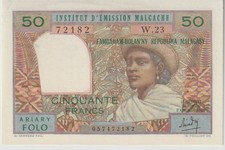
FOR SALE ARE 5 NOTES FROM MADAGASCAR, 2 TIME PERIODS1937 AND 1990s.
PMG GRADED, PICK#38 ND (1937-47) 50 FRANCS, MADAGASCAR BANQUE DE MADAGASCAR, 63 CU
PMG GRADED, PICK#37 ND (1937-47) 20 FRANCS, MADAGASCAR BANQUE DE MADAGASCAR, 63 CU
PMG GRADED, PICK#38 ND (1937-47) 5 FRANCS, MADAGASCAR BANQUE DE MADAGASCAR, 58 A UNC
PMG GRADED, PICK#76a ND (1994) 1000 FRANCS OR 200 Ariary, MADAGASCAR BANQUE DE MADAGASCAR, 67 Superb Gem UNC
PMG GRADED, PICK#75a ND (1994) 500 FRANCS OR 100 Ariary, MADAGASCAR BANQUE DE MADAGASCAR, 64Choice Uncirculated
PMG GRADED, PICK#78a ND (1995) 5,000 FRANCS or 1000 ariary, MADAGASCAR BANQUE DE MADAGASCAR, 67 EPQSUPERB GEM UNC.
PMG GRADED, PICK#79b ND (1937-47) 10,000 FRANCS or 2000 ariary, MADAGASCAR BANQUE DE MADAGASCAR, 66 EPQ GEM UNC.The notes you see are the notes you get. Thanks for visiting my page.Check out my other Top Pops, SPECIMENs, Highly Graded Notes and BEP Packs.The significance of the 3 notes from 1937.
The 1937 Madagascar 5, 20, AND 50 Francs notes issued by the Banque de Madagascar are significant ascolonial-era artifacts illustrating French economic control and paternalistic \"civilizing mission\" propaganda through classical European imagery paired with local themes prior to Malagasy independence.
Historical Context
- Colonial Administration: In 1937, Madagascar was tightly controlled as a French colony.
- Monetary Integration: The notes tied Madagascar’s local economy directly to the French franc zone, managing circulation through colonial banks before the eventual transition to the Malagasy franc and modern Ariary.
Artistic and Symbolic Design
- Cultural Subjugation Imagery: Denominations like the 20 Francs note explicitly featured visual allegories—such as a French woman holding hands with a Malagasy woman and child—to promote the political narrative of colonial assimilation and connection.
- Classical European Motifs: Lower and mid-tier notes (like the 5 Francs depicting the Roman goddess Juno and the 50 Francs featuring Minerva/Fortuna) relied on classical Western mythology rather than indigenous Malagasy Pantheon figures, asserting European cultural dominance.
The 4 notes from 1994 and 1995 mark the end of Malagasy Franc.
The 1000 Francs (1994) and 10,000 Francs (1995) banknotes issued by the Central Bank of Madagascar (Banky Foiben\'i Madagasikara) hold deep historical significance.They mark Madagascar’s total economic break from French monetary ties and the beginning of the end for the colonial-era Malagasy Franc.
1. Economic Liberation and Inflation Triage
- The May 1994 Currency Float: For decades, the Malagasy Franc was pegged to the French Franc. In May 1994, Madagascar unpegged and floated its currency freely. This resulted in an immediate, severe devaluation.
- Hyper-Inflation Relief: As the currency’s purchasing power collapsed, the central bank had to introduce completely redesigned, higher-denomination banknote families to cope with soaring daily consumer prices.
💡 2. The Cultural Shift in Banknote DesignUnlike the 1937 notes that heavily leaned on classical European themes and colonial subjugation narratives, the 1994–1995 series completely reclaimed the nation\'s identity.
- The 1000 Francs Note (1994): Celebrated maritime and coastal commerce. The front showcased an everyday young Malagasy man alongside traditional boats, while the back honored local fisherwomen gathering shellfish.
- The 10,000 Francs Note (1995): Focused entirely on internal industries, culture, and rich biodiversity. The front featured an elder Malagasy man alongside sculpted wooden artifacts. The back depicted local artisans at work, mineral crystals, and Madagascar\'s endangered radiated tortoises.