When you click on links to various merchants on this site and make a purchase, this can result in this site earning a commission. Affiliate programs and affiliations include, but are not limited to, the eBay Partner Network.
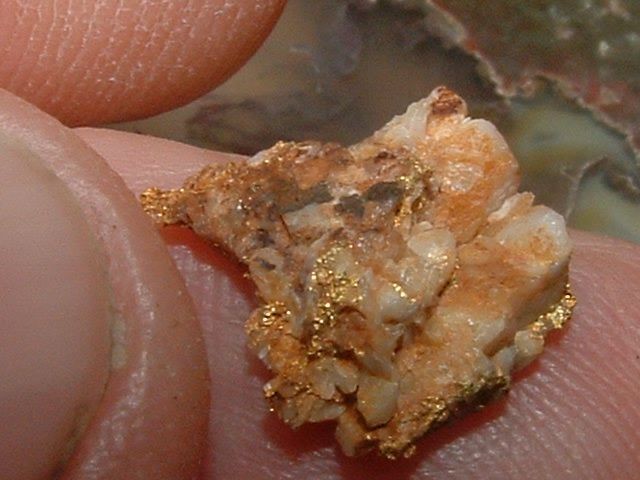
GOLD QUARTZ SPECIMEN from ARIZONARuler is 1/4\" wide (6 mm). U.S. 10 cent coin is 17 mm in diameter.Specimen weight: 13.2Grains (Troy) - .85Gram Size:13.1X10.3X4.7 mm
Here\'s a highly-oxidized chunk of silicate gold and quartz. There\'s more oro here than it appears and nobody \'salted\' it. The gold crystallized inside a vein of quartz. My source in Scottsdale identified it\'s origin as an Arizona mining district. No further details were provided. For those interested in buying only the real Mccoy, you will be. No, you won\'t get your money\'s worth since these specimens contain silicon dioxide (quartz), oxidation, and other gangue minerals.That said, it\'s a great little stained-specimen and inhabited with naturally-occurring, high-purity gold.
U.S. SHIPPING $6.00 (includes USPStracking to all U.S. destinations) INTERNATIONAL CUSTOMERS S&H $17.00
FAST REFUND OFFERED (If, for any reason, you\'re not happy with this item). Contact me indicating you wish to return the item. As soon as it\'s received by me and everything\'s as it should be, you\'ll be issued a refund.
I poured through old Arizona mining dumps for years looking atorange-yellow-rustyrocks through a loupe. In all that time, not once did I ever spot a piece with visible gold in it. I seem to have been hitting all the wrong dumps and ledges.In many auriferous/gold districts, the most prevalent type of lode deposits occur when super-heated, high-pressure hydrothermal fluids carrying gold and silica crystallize inside natural fissures of the country rock. Weight Conversions: 15.43 GRAINS = 1 GRAM31.103 GRAMS = 1 TROY OUNCE24 GRAINS = 1 PENNYWEIGHT (DWT) 20 DWT = 1 TROY OUNCE480 GRAINS = 1 TROY OUNCES&H Discounted for combined shipments.
PAYMENTS For U.S. buyers: We accept paypal et al.
Pay securely with [link removed by ]. Payment must be made within 7 daysfrom close of sale. We ship as soon as funds clear. If you have questions, please ask them before offerding. REFUNDSWe leave no stones un-turned insuring our customersget whatthey bargained for.If you\'re not satisfied with thisitem, contact me. Then, if the problem can\'t be fixed,returnproduct within 30 daysin \'aspurchased\'conditionfora fullrefund
Gold ofEldorado 8-13-17 THE WORLD OF NATURAL GOLD QUARTZ
Welcome to the world of natural Gold Quartz. For the uninitiated, GQ is, essentially, gold ore found in the earth\'s outer crust. It\'s recovered from hard rock lode mines, as placer, or as float (displaced pieces of freed-up, floating ore. When geological conditions align, metallic and non-metallic mineral solutions (fluids) carry dissolved gold and quartz (silicon dioxide) through passageways inside the earth\'s mantle. Fluidization is the operative word often used by exploration geologists. Faults, fissures, shear zones are the contact zones which act as conduits for these pregnant fluids. In the process, an enormous variety of minerals eventually cool down and crystallize. This, then, is how classic quartz vein lode deposits form. Silicate quartz veins are not the only ore bodies which host gold. During the past fifty some years, a handful of pragmatic geologists started thinking outside the box. They theorized that other types of auriferous lode deposits could exist. After extensive and careful core drill analysis, they discovered that high-pressure, percolating fluids invading permeable sediments had been producing massive lode deposits all along. The gold was microscopic in size, but it was there in minable and highly-profitable amounts. Eventually, geologists went on to discover even more diverse types of lode gold provinces.
Placer gold in a \'free state\' isn\'t generally associated with these micron gold deposits. It emanates from fissure-type quartz veins. Gold in quartz veins tends to occur in larger particles; even masses. That\'s why a quartz specimen sometimes shows a lot of Au while other types of gold ores don\'t. By and large, auriferous rocks tend to be run-of-the-mill, not bonanza ores. Most of this ore assays considerably less than an oz of Au per ton. At the beginning of the California gold rush, the 49ers were chasing \'free gold\' i.e. placer gold. Being basically soft and malleable, larger pieces of oro, once separated from the vein, it tends to take on unique, interesting shapes. Character is imparted to each individual piece. Even the most featureless gold flake won\'t be without some distinctive marks. Vein filling which retains the host matrix rock (gangue) and harbors metalliferous gold also becomes one of the earth\'s more highly-prized gemstones. I deal in this material as well as in specimen-grade GQ. Again let me convey the value of GQ specimens is not in how much gold they contain. Their value lies in the fact that gold is there; visible to the naked eye; the product of dynamic, elemental forces in the earth\'s crust.
The ideal criteria for GQ gemstone is a hard matrix or host rock, the richness of the gold, and it\'s purity.High purity usually equates to that gorgeous golden coloration we love so well. The best grades of gem rock are dense, unbrecciated, and contain minimal cracks or fissures. The commonest quartz color is white. Personally, I prefer the vari-colored ores. Through the years, I\'ve come across a wide spectrum of matrices. From amongst this diversity, I\'ve created cabs of every shape, color, and stripe. Where they\'re found, the hardest of cryptocrystalline quartzes are highly-prized by gemologists/lapidaries/jewelers/and collectors. Overall mineral compositions and characteristicsof GQ varies from district to district. This results in a variety of differently-colored matrix (host rock) occurrences. The fineness/karatage of the Au differs as well. This effects both the gold\'s color and it\'s purity.The metallic mineral, gold, occurs in many different geological formations. Within the U.S., Nevada, in particular, has become a world-class, gold-mining juggernaut. In modern-day mining operations, entire mountains are blasted down and piled into heaps. Oxide Ores are soaked with cyanide solution, an acid which leaches precious metal from these ores. Other ore types exist as well. Chief amongst them are carbonaceous and sulphide ores. Within these groupings, different processes are employed to separate, concentrate, and thus extract the gold.
A century ago, a more-likely scenario went like this. Some lone-burro prospector liked how some quartz outcropping looked. Spotting some section which appeared more highly-altered then the rest, he chipped away samples. Maybe his pack animal (donkey/mule/horse) carried all the equipment needed to perform a fire assay. At the very least, he would have been outfitted with a mortar, pestle, and gold pan. In these times of astronomical gold prices, even a few tiny pinpricks might warrant further investigation. If he was lucky, once his sample had been crushed, maybe a nice line of color remained in his pan. Encouraged by the result, he commenced to sink a shaft into the exposed quartz vein. Perhaps instead the tunnel would be driven horizontally or at an incline. It all depended on what strike the vein took. All this, of course, would have been accomplished using basic hand tools unless, that is, he had dynamite. Just placing charges to shoot and break loose the rock took countless man-hours of single-jack drilling. This was unimaginably-hard work. Well, actually, I can imagine it. After ore had been mucked and hauled from the mine-shaft, it needed to be crushed to free up the gold. Production and progress was extremely slow. Maybe our prospector resorted to using a \'dolly pot\' or some sort of improvised arrastra. With primitive tools, only the most readily-identifiable high grade was processed i.e. crushed and milled up. Possibly, ore from his new mine was hauled off on a pack team to some far-off millsite better equipped to handle volume. If gold was visible in the rock, that obviously would have qualified as ore rich-enough to crush on-site.
Arrastras were commonly used in pre-gold rush times to pulverize ore. One would think these devices or some variation thereof might be practical to use in any day and age. After it’s release, depending upon the practices commonly in use at that particular time and region, gold was most-likely sluiced (using water) or amalgamated using \'quick\' i.e. mercury. Later-on, stamp mills arrived on the scene. These replaced the more antiquated methods improving and speeding up the rate of gold extraction. Though noisy, toxic contraptions, they increased production a hundred-fold how much ore could be crushed and milled. Because of silica dust, an extremely-hazardous powder released into the air, some mines were branded \'widow-makers\'. Dust ingested by humans over a prolonged period of time becomes lethal inasmuch as it causes silicosis, the gold miner\'s version of the dreaded black lung disease responsible for millions of fatalities in the countless coal mines through antiquity. It\'s a historical fact that silicosis filled many cemeteries. Try to imagine clouds of finely-powdered silica enveloping both workers and townspeople day and night. In the old days, the classic, lone-burro prospector\'s first inkling of a lode was usually an exposed quartz ledge. This wasn\'t always the case, but many times it was. Miners digging rich placer below some vein system, one bleeding out coarse, gnarly, crystalline gold into the surroundings, understood that a local vein system was the most likely source. Today, core drills are the main geo-exploratory tool used to test the tenor of rock at depth. Many fissure-type lode deposits such as the Homestake Mine in South Dakota and California\'s Sixteen to One Mine were followed deep into the earth. Oftimes it happens that prior earthquake slip episodes cause productive veins to abruptly disappear. Their position in the earth is rendered unreadable and unknown. In such instances, if the ore body was panning out handsomely, miners undoubtedly would make attempts to relocate their lost lead. Sometimes, they were successful, but often they were not. Past movement in the earth\'s outer crust over long periods of time reshapes it\'s internal morphology. In-situ veins shift to unpredictable positions. Mountainsides are adept at hiding their treasures. As history relates, many rich leads were lost perhaps never to be found again. There\'s no shortage of reasons why deep quartz fissure mines become unprofitable. Water seepage was another major challenge encountered by miners.Prices for metals also fluctuate. Many factors influence the availability, production, and profitability of gold quartz mining and the end product itself. Only a scant handful of mines around the world produce gem-grade material. Even when a new deposit is found, collectors and dealers are tasked with procuring something not publicly offered or made available by the mines themselves.