When you click on links to various merchants on this site and make a purchase, this can result in this site earning a commission. Affiliate programs and affiliations include, but are not limited to, the eBay Partner Network.
BOOK OVERVIEW
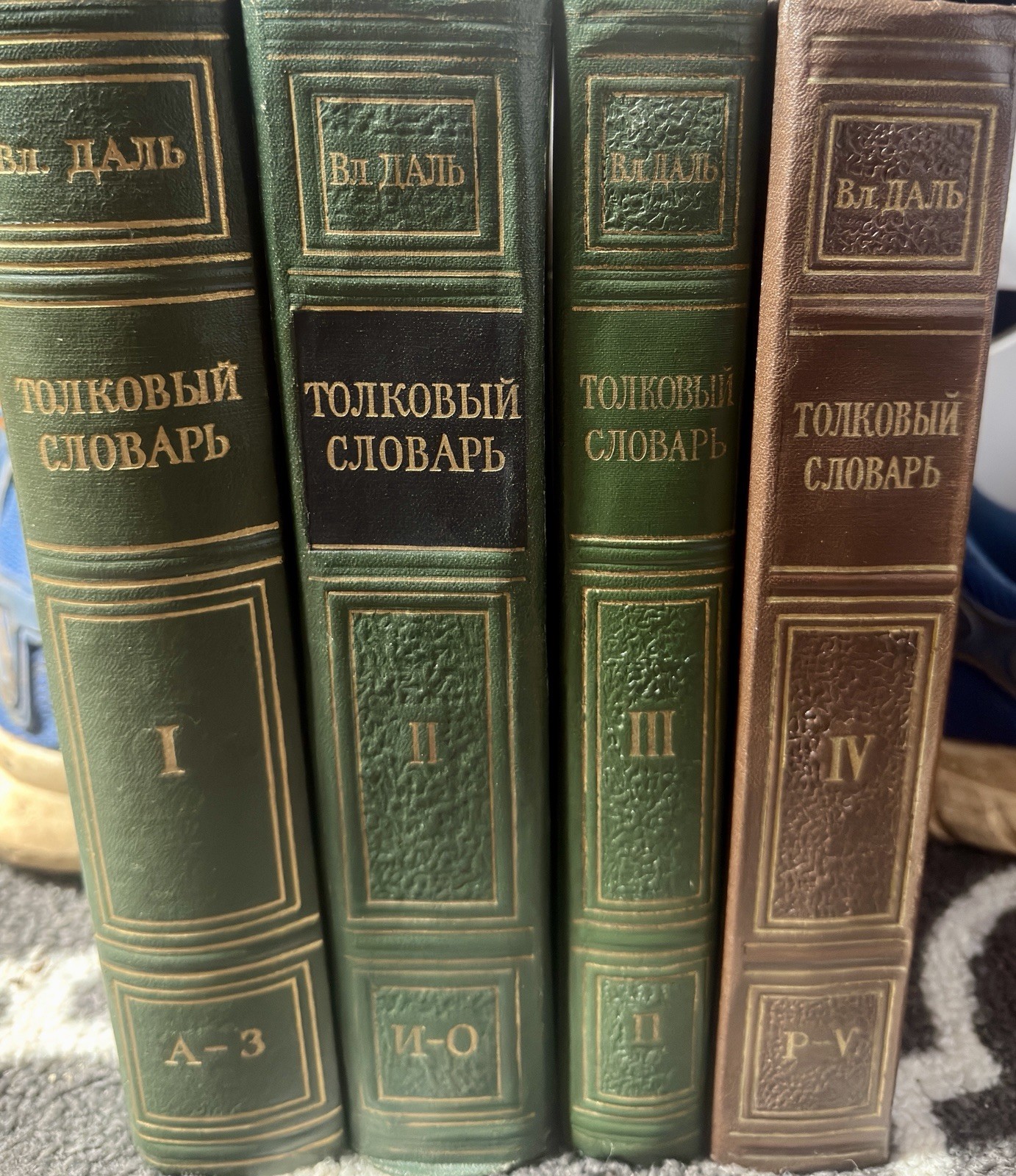
This is the best-known explanatory dictionary of the Russian language. It was compiled in the 19th century by the philologist Vladimir Dal' (1801-1872). The dictionary has about 200,000 words. In addition to the lexicon of the literary language of the first half of the 19th century. It also includes local words, professional terms, sayings, and proverbs.VOLUME I - A~ 3
Covering letters A–Z. First published in the early 20th century, the dictionary is considered one of the most influential Russian reference works of its time.VOLUME II - И~ О
First published in the 19th century, this influential dictionary has about 200,000 words and is still a key reference for Russian language study.VOLUME III – П
19th-century Russian lexicographical work by Vladimir Dal. First published in 1865, the dictionary is considered one of the most important resources for understanding the structure and usage of the Russian language in the 1800s.VOLUME IV - P~V
Published in 1956 by the Gosudarstvennoe izdatel'stvo inostrannikh i nacional'nykh slovarей in Moscow. The work is a major reference in Russian lexicography, having over 200,000 words and including many previously unrecorded terms.DESCRIPTION
The dictionary contains about 200 thousand words, of which 63-72 thousand are well-known words in the 19th century, which were not previously included in other dictionaries. Approximately 100,000 words are taken from the Dictionary of Church Slavonic and Russian Language (1847), 20,000 from the Experience of the Regional Great Russian Dictionary (1852) and the Supplement to it (1858), the Experience of the Terminological Dictionary of Agriculture, Factory, Crafts and Life of the Folk (1843-1844) by V. P. Burnashev, the Botanical Dictionary (1859) by Annenkov, and others. The number of proverbs and sayings is about 30 thousand, in some articles their number reaches several dozen (will - 73, head - 86, eye - 110). Words of the same root that differ in meaning are located in one article, forming a nest of words. It may contain words with a similar sound or meaning, but with different roots (act, actor, action; podpech, podprint). The first word of the article (title) is its title and is in the dictionary alphabetically. When interpreting foreign borrowings, Dahl selects a number of Russian words that are close in meaning, including those invented by him himself (gymnastics — dexterity, atmosphere — mirokolitsa, horizon — nebozyom, address — nasylka. There are no more than 245 such composed words. In certain cases, the Dictionary explains not only the meaning of words but also describes the objects they name (methods of weaving bast shoes, rules for performing the wedding ceremony of handshaking). which is characteristic not of explanatory, but of encyclopedic dictionaries. A deep understanding of some subjects is served by the proverbs and sayings that go with them.