When you click on links to various merchants on this site and make a purchase, this can result in this site earning a commission. Affiliate programs and affiliations include, but are not limited to, the eBay Partner Network.
Payment | ShippingRESTORED ANTIQUE ERNST REINHOLD SCHMIDT 4/4 VIOLIN MARKNEUKIRCHEN W/CASE -C1900
RESTORED ANTIQUE ERNST REINHOLD SCHMIDT 4/4 VIOLIN MADE IN MARKNEUKIRCHEN, SAXONY, GERMANY WITH A NEW CARRYING CASE - CIRCA 1900
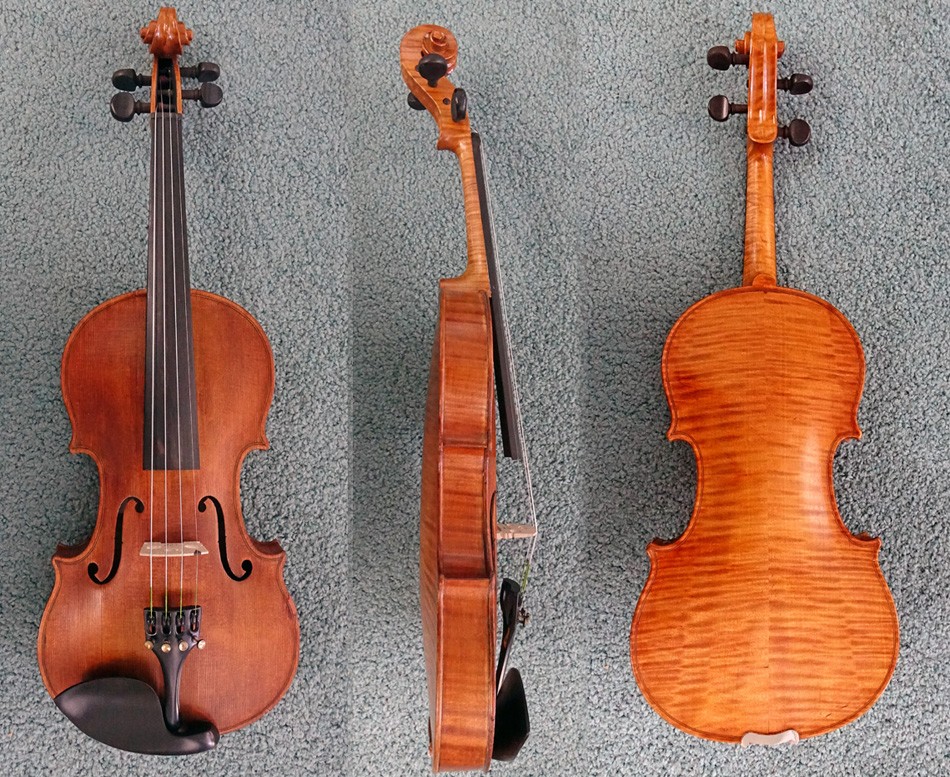
You are invited to purchase an absolutely superb genuine antique handcrafted 4/4 (full size) violin labeled E. Reinhold Schmidt dating from circa-1900. This violin was made in Markneukirchen, Saxony, Germany and is also billed as an Antonius Stradivarius copy as stated on its internal printed paper label.
As you will soon learn if you take the time to carefully consider the full text of the listing that follows, this instrument has been rescued from an unfortunate potential permanent fate as a mere decorative wall hanger art piece and now revealed to be a truly valuable genuine historical antique violin made by a very talented German maker - Ernst Reinhold Schmidt. It has been very carefully and lovingly repaired, updated and fully restored to playability. Included with the violin is a nice new internally padded rectangular cloth carrying case.
This is an exceptionally well made 4/4 size violin - constructed of aged tone woods and provided with new quality accessories along with its inherent close attention to details, it positively exceeds the general specifications of most mass produced violins on the market today (see below for details). The higher than average level of violin craftsmanship found in this instrument translates to superior tone and projection found in an antique instrument from Germany.
We have completed a series of relatively difficult and somewhat complex set of repairs and restorative actions associated with this violin as detailed below. The violin has also been upgraded and modernized with a new Ebony fingerboard, new synthetic core metal strings, new Maple bridge, new Ebony endpin, new Ebony Guarneri-style chinrest, and a reconditioned Austrian tailpiece with four (4) built-in fine tuners making it ready to be played and enjoyed by its new owner. The new tailpiece with fine tuners for all four strings will be especially helpful to keep the violin in perfect tune.VIOLIN INTERNAL LABEL & REPAIR LABEL:
This violin bears the following pasted-in paper label found under the left f-hole (See accompanying image):
\"COPY OF Antonius Stradiuarius Fecit E. Reinhold Schmidt Made In Germany Saxony\" Note 1:Stradivarius is spelled in the label as \"Stradiuarius\" replacing the English \"v\" with the older Latin \"u.\" This substitution is often found on labels inside antique European violins. By the way, \"Fecit\" is from the Latin meaning \"Made By.\"
Note 2: The last sentence in the label, \"Made In Germany Saxony\" is very lightly stamped onto the paper label and is very hard to read. However, oblique lighting was very helpful to us in discerning the full text of this faint imprint. In addition, this lettering is partly obscured by some black staining of the label but enough of the text is discernable to piece together the full text.
Note 3: The left side of the paper label also has the Schmidt Company logo that indicates that the subject violin represents \"Schmidt\'s Standard.\" This special attribution is located within a banner located at the top of the logo. The logo also depicts mountain peaks in the center background (depicting the Saxon Ore Mountains) along with an Eagle holding a violin in its talons in the lower center (See image of the label).
The violin also has the initials of the maker heat stamped into the wood of the bottom plate directly under the paper label as follows:
\"E.* R.* S.\"
Note: This stamp is a recognized additional sign of authenticity of the instrument by the maker, Ernst Reinhold Schmidt (See more details in the history of this maker below).
In addition, this violin bears a repair label and serial number from our workshop found inside the violin also under the left f-hole (See accompanying image):
\"THE OLDE VIOLIN SHOPPE HAMILTON, MONTANA USA REPAIRED/RESTORED VIOLIN ANNO 2026 SN-08102026\"
VIOLIN ORIGIN & ESTIMATED DATE OF MANUFACTURE:
This violin was manufactured in Markneukirchen located in the Vogtland region, Saxony, Germany, which was the location of the E. Reinhold Schmidt Company for the manufacture of violins and other string instruments since the year 1880. Markneukirchen is a town located in the shadow of the Saxon Ore Mountains, close to the border with Czechoslovakia (now known as the Czech Republic). .Note: Please see below for a brief history of Ernst Reinhold Schmidt and the E. R. Schmidt Company.
Based in part on the type of aged European tone woods used in its construction, its internal labeling, along with the effort it took to repair it and to restore it to full playability, we estimate its date of manufacture as circa 1900.
IMAGES:
Several images of the violin as it was found prior to restoration along with images of the fully restored violin are included with this listing. Please click on the images for a larger view. The images are to be considered as an integral part of this listing.KEY PHYSICAL FEATURES:
* A warm, attractive Walnut brown spirit varnish over a golden ground.
* Very attractive two-piece Tiger Maple back with ribs, scroll and neck of Tiger Maple to match the back. The internal central seam of the back was nicely cleated by the original maker (See images).
* Two piece Spruce top with a relatively consistent grain pattern throughout (See accompanying close-up image of the lower bout showing the grain pattern).
* Top plate has a moderate arch.
* The pre-restored violin interior features the expert blocking of all four rib corners by the original maker, a smoothly carved top plate interior and the installation of a properly sized and located glued-in bass bar - all signs of a very well made violin in harmony with the well known reputation of the higher quality instruments produced in Germany by the E. R. Schmidt Company (See accompanying images of the violin interior).MEASUREMENTS:
* Length Overall (Loa): 23 1/2\"* Length of the body (LoB): 14\"* Rib Height: 1 1/8\"* Max Width of Upper Bout: 6 1/2\"* Avg. Width at Waist or C-Bout: 4 3/8\"* Max. Width of Lower Bout: 8 1/4\"
NATURE OF REPAIRS & RESTORATION:
This vintage violin was received by us in fair structural condition and fair to poor cosmetic condition (See images of the violin before and after restoration). There were two long open cracks present in the top plate that needed to be cleaned, glued and internally cleated to restore the structural and cosmetic integrity of the top plate. The violin was missing its original nut and fingerboard. Rather, a faux fingerboard was painted in black paint on the top of the neck and continuing onto the center of the upper bout of the instrument such that, from a distance, it appeared that a fingerboard was present on the instrument (See close-up image that shows this). There was also an eye bolt screwed into the top of the scroll evidently to allow the violin to be hung in a vertical position as an \"artistic wall hanger\"(See image of the scroll with the eye bolt attached). In addition, there was some missing edge wood in the top plate in an area just below the right rib corner that needed to be replaced. The violin was also in need of a new Maple bridge, a new chinrest, a new set of modern strings, a new tailpiece, and a new sound post, as well as, a good cleaning, an application of touchup varnish to areas needing it and a final polish to restore its original finish.
Following is a summary of the actions taken by us to repair and restore this antique German violin to full playability:
1. We removed the top plate from the violin body in order to complete the repair of the existing open cracks. We cleaned, glued and internally cleated the large open cracks. At the same time we were able to clean, glue and cleat some newly developed short cracks in both the upper and lower center of the top plate. Now all cracks in the top plate have been properly addressed (See image of the top plate internal repairs).
2. After removing the top plate from the violin, we discovered that there was a lot of black paint or old varnish residue present around the f-holes that needed to be removed (See pre-restoration image of the top plate interior). We removed this residue. In addition, we discovered that all 4 rib corners were very neatly blocked by the original maker and that the inside of the top plate was very smoothly carved. In addition, we found that the bass bar was properly sized, located and glued into the underside of the top plate. Also, the center seam of the bottom plate was very neatly cleated by the original maker. These internal features were excellent indications of a very well made violin. We also found that the original sound post was glued to the bottom plate likely by another party sometime in the past. As this is not standard practice, we removed the original sound post along with the glue residue.
3.While the top plate was off the violin, we discovered that the ribs in the area of the lower block were loose from the bottom plate. We cleaned this area of old glue residue and re-glued the ribs in this area to the bottom plate. We also took this opportunity to remove the eye bolt from the top of the scroll and to fill the hole left by the bolt with wood putty.
4. After work on the interior of the violin was completed, we added our shop label to the interior of the bottom plate and restored the top plate to the violin ribs using Hide Glue.
5. At this time, we carefully removed the black paint from the top of violin neck and the central area of the upper bout of the top plate using a product called \"Clean Strip.\" We followed this up with a rinse of denatured alcohol to remove all traces of the black paint from these surfaces and sanded these areas with 600 grit sandpaper. We also added new wood and a small segment of new purfling to the damaged edge of the top plate located just below the right corner. We stained and varnished this area to match the rest of the violin (See accompanying image of this repair).
6. At this time, the exterior surfaces of both the top and bottom plates as well as the ribs and scroll box were wet sanded with successive grades of sandpaper (600 followed by 1,000 git) thereby removing most age related surface imperfections. The surfaces were then cleaned with denatured alcohol and all areas needing it were touched up with Walnut Brown Varnish. Finally, a coating of French Polish was then added to all exterior surfaces of the violin as a final cosmetic treatment.
7. We installed a new Ebony fingerboard to the violin neck. We also scraped and sanded the surface of the fingerboard to achieve a smooth surface. In addition, we fitted a new Ebony nut to the violin and established grooves for the strings in concert with accepted design standards.
8. At this time we added a new Ebony endpin to the violin. In addition, we installed a newEbony Guarneri-style chinrest to the violin.
9. We added a refurbished Otto Infeld tailpiece (made in Vienna, Austria) to the violin that included integral fine tuners for all 4 strings.
10. Finally, we completed the setup of the violin by properly fitting a new Viotti Maple bridge to the violin, installing a new Maple sound post and installing a new set of Pirastro Chromcor medium tension strings.
All of the aforementioned repairs have resulted in a completely restored and upgraded Ernst Reinhold Schmidt violin. This violin is now very easy to play. It now has a powerful sound that is very focused and projects with great clarity at all registers. Thus, this antique instrument that could have easily been lost to time has been fully repaired, improved and reborn to live a second life in the present.
VIOLIN CASE:
Included with this restored violin is a very nice new rectangular cloth covered internally foam formed carrying case with side and end carrying handles, dual zipper closure, lock with key and a set of additional shoulder straps for the back. Also included inside the case are dual racks for bows (no bow included), a hygrometer or humidity meter (see close-up image), a soft cloth cover for the violin, a pocket for accessories and a formed niche for an optional shoulder rest (not included). In addition, there is a zippered pocket on the top of the case for carrying sheet music. The case measures 31 inches long by 10 inches wide and 5 inches deep (See images of this case). This case is suitable for safe shipping of the violin to its new owner and for ongoing use by the new owner for both storing and transporting the violin after it is received.
ABOUT E. REINHOLD SCHMIDT & THE E. R. SCHMIDT & COMPANY:
Ernst Reinhold Schmidt (1857-1928) was born in Markneukirchen, Saxony, Germany in 1857. His career as a violin and viola maker began with an apprenticeship to Wilhelm Julius Kretzschmann from 1871 to 1874. He also worked as a journeyman for Otto Bausch, J.F.C. Emde and Heinz Hammig in Leipzig. Then, between 1874 and 1877 he was with August Anton Riechers in Berlin.
In September 1880, Schmidt founded what was to become a very prosperous string instrument factory in Markneukirchen under the name of E.R. Schmidt & Company, of which he became sole owner in 1902.He developed the workshop into an extensive and productive business along with his brother, employing a large staff of skilled artisans. Violins manufactured by the firm were patterned after all common European models. Both oil and spirit varnish was used on his instruments. He also developed his own viola model, which he sought to achieve a special tonal richness without imitating the excessive physical dimensions associated with violas made by other contemporary makers.
Early on, Schmidt produced commercial work in various grades, including \"Artist\" and \"Solo\" models, which are generally considered to be his personal work. However, as the business grew and other artisans were involved in instrument production, the better quality violins produced by the firm were labeled as \"Schmidt\'s Standard\" and were awarded gold medals at the Vienna Exposition in 1892 and in Leipzig in 1913. As time went on quality tended to vary, but the better quality instruments were also given an inside stamp of \"E.R.S\" to further distinguish them from lesser quality products.
After the year 1920, the elder Schmidt was joined by his son Reinhold Willy Schmidt, who proved to be as skillful as his father both in terms of his artistic ability and also in terms of his business acumen. It was during this period and thereafter that many thousands of E.R. Schmidt violins were imported into the United States.
Ernst Reinhold Schmidt died in Markneukirchen in 1928, but the company continued on under his son\'s direction. It was during this time that the company began to expand production into the manufacture of lutes and mandolins. Also in 1928, the Tonk Brothers Company, musical wholesalers based in Chicago USA, began to import the better quality Schmidt violins. In their 1928 Musical Merchandise Catalogue #46, they featured four Ernst Reinhold Schmidt violin models, two Stradivarius copies and two Guarnerius copies.
Recent sale and private sales records for Ernst Reinhold Schmidt violins tend to yield relatively high prices in the range of $4,200 on the low end to upwards of $12,000 to $15,000 on the upper end.
PURCHASE:
The Montana Logger is very pleased to offer this professionally restored and upgraded antique E. Reinhold Schmidt 4/4 violin along with a new carrying case a very reasonable buy-it-now price. We will also entertain reasonable offers for this antique German-made violin that dates from circa 1900.
PAYMENT: Payment is due within 3 days of purchase. Prompt payment is always very much appreciated. PaymentBack to Top
I accept the following forms of payment:
Shipping & HandlingBack to Top
US Shipping
$49.00 FedEx Ground®
$49.00 FedEx Home Delivery®
International Shipping
$149.00 USPS Priority Mail International (Worldwide)
$98.00 USPS Priority Mail International (Canada)FREE scheduling, supersized images
and templates. Get Vendio Sales Manager.Make your listings stand out with
FREE Vendio custom templates!
FREE scheduling, supersized images
and templates. Get Vendio Sales Manager.
Over 100,000,000 served. Get FREE counters from Vendio today!