When you click on links to various merchants on this site and make a purchase, this can result in this site earning a commission. Affiliate programs and affiliations include, but are not limited to, the eBay Partner Network.
Having sold a number of Ruth\'s collagraph from a collection I purchased a few years ago, I\'m listing a few more. I likely have about a dozen left- the previous owners were big collectors of her work.
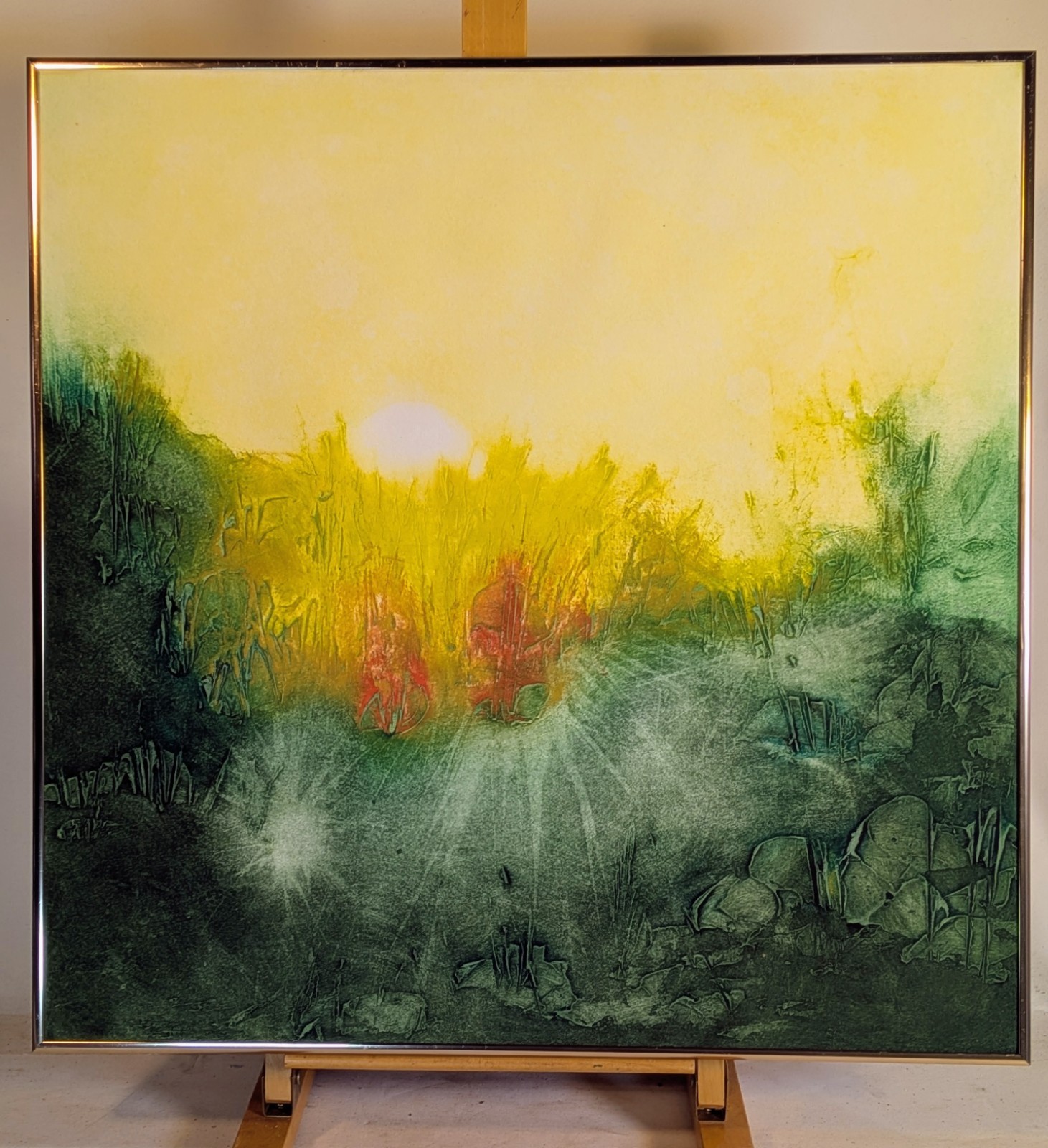
measures roughly 24\" x 24\" including vintage frame. frame does not currently have glass -easy to have a piece cut locally for display, or keep it bare to really show off the incredible texture and rich tones of this piece.
One of my absolute favorite works of hers. Apparently unsigned, but undoubtedly hers -this is the only unsigned one in the collection and the title is clearly her own hand.
Ruth Rodman (1928–2024) was a highly accomplished mid-century and contemporary American printmaker and sculptor based in the Boston area. Known for her deeply textured, atmospheric depictions of the natural world, she mastered hybrid, complex print processes that treat paper almost like a three-dimensional canvas.
Background and Training
Born in Brighton, Massachusetts, Rodman immersed herself in the Boston art scene from a young age. She pursued rigorous formal training, studying at institutions including the School of the Museum of Fine Arts (Boston), Brooklyn College, and the Art Students League of New York.
Crucially, she also studied at Atelier 17 under the legendary Stanley William Hayter. Hayter’s experimental intaglio and viscosity methods revolutionized modern printmaking, and this deeply influenced Rodman’s approach to building dense, tactile, and layered surfaces.
Artistic Style and the Collagraph Technique
The collagraph process was perfectly suited to her style. In collagraphy, the printing plate is constructed as a collage—the artist builds up a rigid substrate using materials like handmade papers, gesso, textiles, or organic elements to create a highly embossed, multi-level relief. When inked and run through a high-pressure press, this plate produces an incredibly deep, sculptural impression on heavy rag paper.
Rodman frequently paired collagraphy with deep etching and aquatint, using multiple plates and translucent ink layers to give her prints their characteristic glowing, organic complexity.
Career & Institutional Recognition
Throughout the 1970s and 1980s, Rodman’s print work gained significant traction. She exhibited regularly with the Boston Printmakers and was represented by major graphic arts institutions of the era, including Associated American Artists in New York.
Her prints were also sought after by major publishers like the New York Graphic Society and John Szoke Graphics, which helped place her work in prominent public, corporate, and private spaces.
Her work is held in numerous permanent museum and public collections, including:
- The Boston Public Library
- The New York Public Library
- The Worcester Art Museum
- The Minneapolis Institute of Art
- The Honolulu Museum of Art
- The Rose Art Museum at Brandeis University
In her later career, she expanded her interest in texture into physical space, creating large-scale mixed-media abstract sculptures designed for both interior and outdoor public installations.