When you click on links to various merchants on this site and make a purchase, this can result in this site earning a commission. Affiliate programs and affiliations include, but are not limited to, the eBay Partner Network.
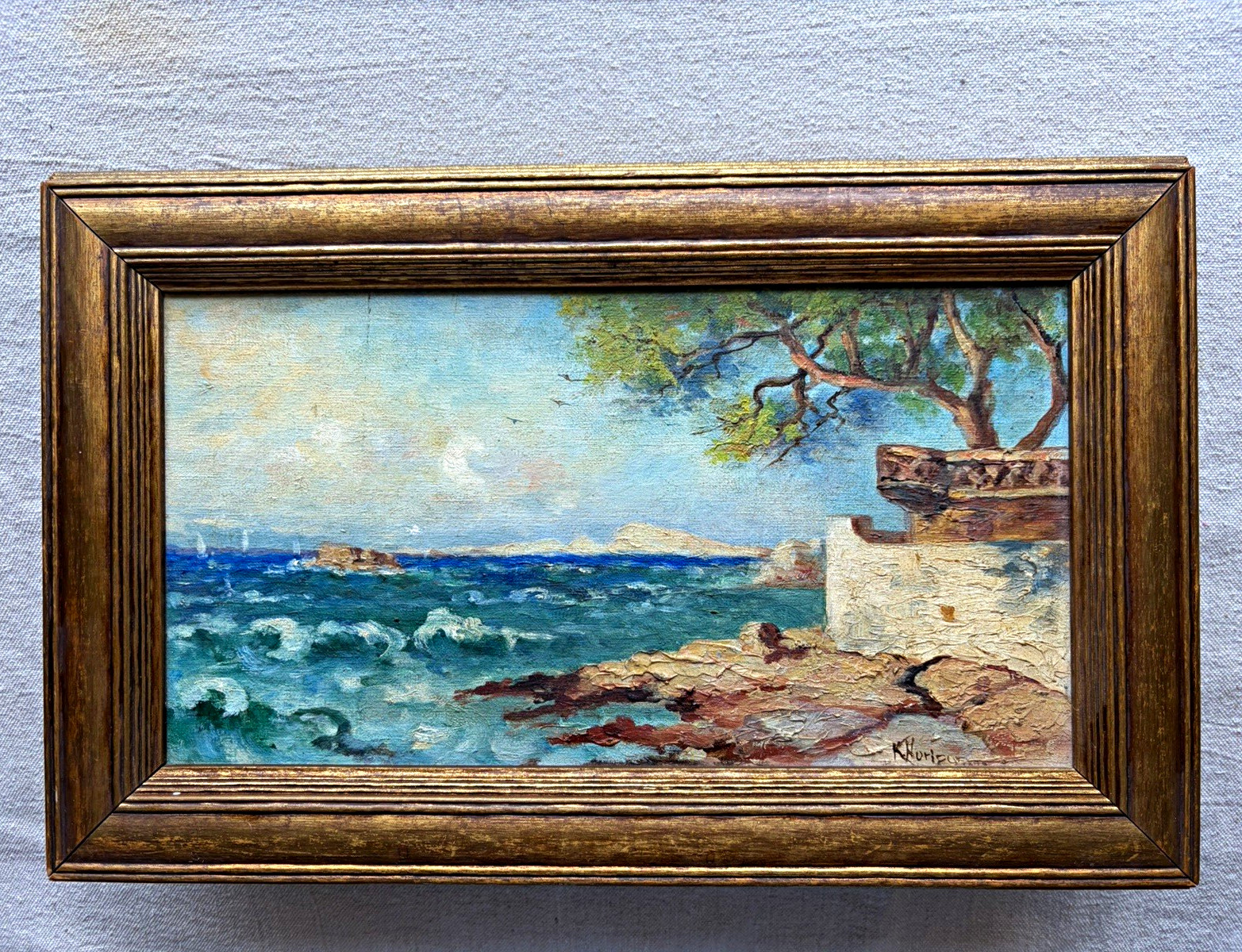
Signed Continental Seascape 14”x7.85” framed oil on board c1895-1915.
The panel is oil on board, about 14 by 7.75 inches inside a gilt molded wood frame. Paint is laid on thickly, with loaded brush and knife strokes in the cliff, wall, and tree. Lower left is signed in dark paint; the letters read most like K. Huripa (or Khuripa). That name does not match a catalogued painter in ordinary sale or signature records, so the signature alone does not identify the hand.
The reverse label is clearer. It is printed Emery, Bird, Thayer Co. / Kansas City, Mo., with handwritten entries in the Line, Price, and No. columns (the number looks like 16091; the price figure is worn). Emery, Bird, Thayer was a downtown Kansas City department store under that name from the 1890s until it closed in 1968. Tags of this Line / Price / No. form were stock labels from the picture or framing department, so the painting was sold or framed there, not necessarily painted in Kansas City. The torn gray dust paper, cardboard backing, and wire are consistent with that retail framing.
Subject and handling place it in the 1920s–1940s decorative market. The view is a narrow southern coastal terrace: ochre cliff, pale masonry parapet, deep blue inlet, pale sky, and a twisted pine on the right. That combination is the stock Riviera or Amalfi/Capri motif sold to American buyers, painted in a loose impressionist manner rather than as a finished plein-air study. Nothing in the view is specific enough to name a town.
As a retail oil of this size and type, it is a period decorative picture. Value depends on whether the signature can be tied to a recorded artist; as it stands, the Kansas City store label and the frame are the firmest facts.
Emery, Bird, Thayer was a Kansas City dry-goods house whose name came from three late partners, not from the original owners. Family control lasted until 1945; the stores closed in 1968.
The firm began before 1860 at 6th and Main as Franklin Conant’s wholesale and variety business, outfitting Santa Fe Trail traffic. In 1861 debt forced Conant to sell to William Gilliss and Kersey Coates (Gilliss & Coates). In 1863 Gilliss’s share went to Lathrop and Thomas B. Bullene, and the name became Coates & Bullene. William E. Emery, then a clerk, bought in in 1867; the store was Bullene Brothers & Emery. Emery’s nephew, Joseph Taylor Bird (1848–1918), arrived about 1868, bought a small interest by 1875, and became a full partner in 1881 in Bullene, Moore & Emery. The store had moved to a three-story building at 7th and Main in 1870.
In 1890 the firm, then Bullene, Moore, Emery & Company, opened the “Big Store” on a full block at 11th Street between Walnut and Grand, designed by Henry Van Brunt. After Thomas B. Bullene died, the name settled as Emery, Bird, Thayer & Company in 1894 or 1895. The three names were William E. Emery, Joseph Taylor Bird, and William B. Thayer. Bird was vice president. Thayer died in 1907; Emery died in 1912, and Bird became president. By 1915 the store had about 2,000 employees and was the main draw on Petticoat Lane, with a tea room and a pneumatic-tube cash system.
Bird died of a heart attack in Colorado Springs on September 8, 1918, and left his wife, Annie Ridenbaugh Bird (1856–1937), as trustee of a controlling interest. An all-male board elected her president in 1920. She held that post until her death on January 28, 1937. Their daughter Josephine was named vice president in 1929; Josephine’s husband, Porter T. Hall, joined management the same year and became president after Annie’s death. Under Annie the firm opened a Country Club Plaza store at 47th and Broadway in 1925 and a third store on Independence Square. One later account dates the Bundschu purchase in Independence, restyled Emery, Bird, Bundschu, to 1959.
Josephine died in 1943. In 1945 Porter Hall sold the controlling interest to a St. Louis company, ending Bird-family control. He died in 1947. Downtown retail then declined. The downtown store closed on August 7, 1968, after a crowded going-out-of-business sale; about 800 jobs were lost. The Plaza and Independence stores went to Macy’s.
The 11th-and-Grand building was listed on the National Register in 1971 and demolished in 1972 after R. Crosby Kemper Jr.’s City National Bank, later United Missouri Bank, took the property. UMB later built on the site. A few fixtures, including elevator cages, were reused in an EBT restaurant that operated from 1979 to 2015.
The Line / Price / No. label on your painting is a retail stock tag from that store, so the picture was framed or sold there sometime between the mid-1890s and 1968.
Annie Ridenbaugh Bird’s influence in Kansas City ran from 1880 to her death in 1937, first as the wife of a leading merchant and then, for 17 years, as president of the city’s largest department store.
She was born Annie Creal Ridenbaugh in St. Joseph on April 24, 1856, daughter of William Fahnestock Ridenbaugh, founder of the St. Joseph Gazette. She married Joseph Taylor Bird in June 1880 and moved at once to Kansas City, first into rooms at the Coates House. Joseph became a full partner in Bullene, Moore & Emery in 1881. From then until 1918 she was inside the decisions of the firm that became Emery, Bird, Thayer, though without a title. The couple lost two infant sons; their only surviving child, Josephine, was born in 1889. They lived on Quality Hill at 704 W. 10th from 1897 to 1904, then at Elmhurst, an 18-room house on five acres at 36th and Broadway, from 1904 until Annie’s death.
Her public span begins after Joseph died of a heart attack in Colorado Springs on September 8, 1918. He left her trustee of the estate and of a controlling interest in the store. An all-male board elected her president in 1920, when she was 64. Kansas City Public Library’s account calls her the first Kansas City woman to head a concern of that size. She treated the job as a trusteeship, not a career, and described herself as a “floorwalker,” moving the aisles and greeting employees rather than sitting at a desk. By the mid-1910s the store had about 2,000 employees and was the anchor of Petticoat Lane. Under her, EBT opened the Country Club Plaza branch at 47th and Broadway in 1925 and a store on Independence Square. She also fought Treasury appraisals of the store’s stock and of the estate, recovering roughly $75,000 and later settling another claim for $25,000.
Philanthropy was the other channel. With Joseph she had financed a World War I field hospital in France. In 1924 she and Josephine deeded land at 15th and McGee to Mercy Hospital, now Children’s Mercy. Sale of that land paid for the $185,000 Joseph T. Bird Nurses’ Home and School of Child Nursing at 24th and Gillham, dedicated in 1927. She gave to other local causes, though the hospital gift is the one that is documented in detail.
Family management extended the reach a little past her own activity. Josephine became vice president in 1929 and married Porter T. Hall in 1928; he joined management the same year Josephine did. Annie broke a hip in 1936 and died of pneumonia at Elmhurst on January 28, 1937, age 80. Her estate to Josephine was just over $500,000, including Emery, Bird, Thayer Realty Company and more than $200,000 in EBT shares. Porter then became president. Josephine died in 1943, and in 1945 Porter sold the controlling interest to a St. Louis company, so the Bird family’s direct control ended eight years after Annie’s death. The stores themselves lasted until August 7, 1968.
What remains of her personal footprint is slight. Elmhurst was razed about a year after her death; a stone gate and wall just north of Valentine on Jefferson still mark the entrance. The downtown store building was demolished in 1972. Her influence was commercial and civic rather than political: control of the main dry-goods house west of the Mississippi, a rare female corporate presidency for the 1920s, and a named nursing school tied to the city’s children’s hospital.
Emery, Bird, Thayer used that name only from 1894/95 until the 1968 closing, so the tag has to fall in that span. Within it, $2 is a bottom-end picture price. In the 1880s Chicago frame wholesalers already sold sofa-size oils, 22 by 36 inches, unframed, in grades from about 45 cents to $3.50. Dry-goods and picture departments retailed the small framed panels at a few dollars. A 14 by 7.75 inch continental oil on board, in a molded gilt frame, at $2 retail sits in that market: imported or factory coastal and landscape panels sold as decoration, not as named art.
After about 1920 the same object is a poor fit for $2. The frame alone, plus glass and the store’s margin, usually pushed a small framed oil into the $5–$15 range in the 1920s and 1930s. By the 1940s and 1950s, $2 was a print, a markdown, or a damaged-goods price, not a normal ticket for an oil on board in a gilt frame. Inflation makes the contrast sharper: $2 around 1900 was roughly a day’s skilled wage; $2 in 1960 was pocket money.
Two cautions. The label columns are Line, Price, and No., which on department-store stock tags is often an internal or cost figure, not the price on the sales floor. And the handwriting is worn, so $2.00, $12.00, and $22.50 can look alike. If it really is $2 retail, the painting belongs with the late-1890s to World War I decorative imports. If the digit is a 1 or a 2 in front of that, the 1920s–1930s is still open.
SOURCE: Grok AI