When you click on links to various merchants on this site and make a purchase, this can result in this site earning a commission. Affiliate programs and affiliations include, but are not limited to, the eBay Partner Network.
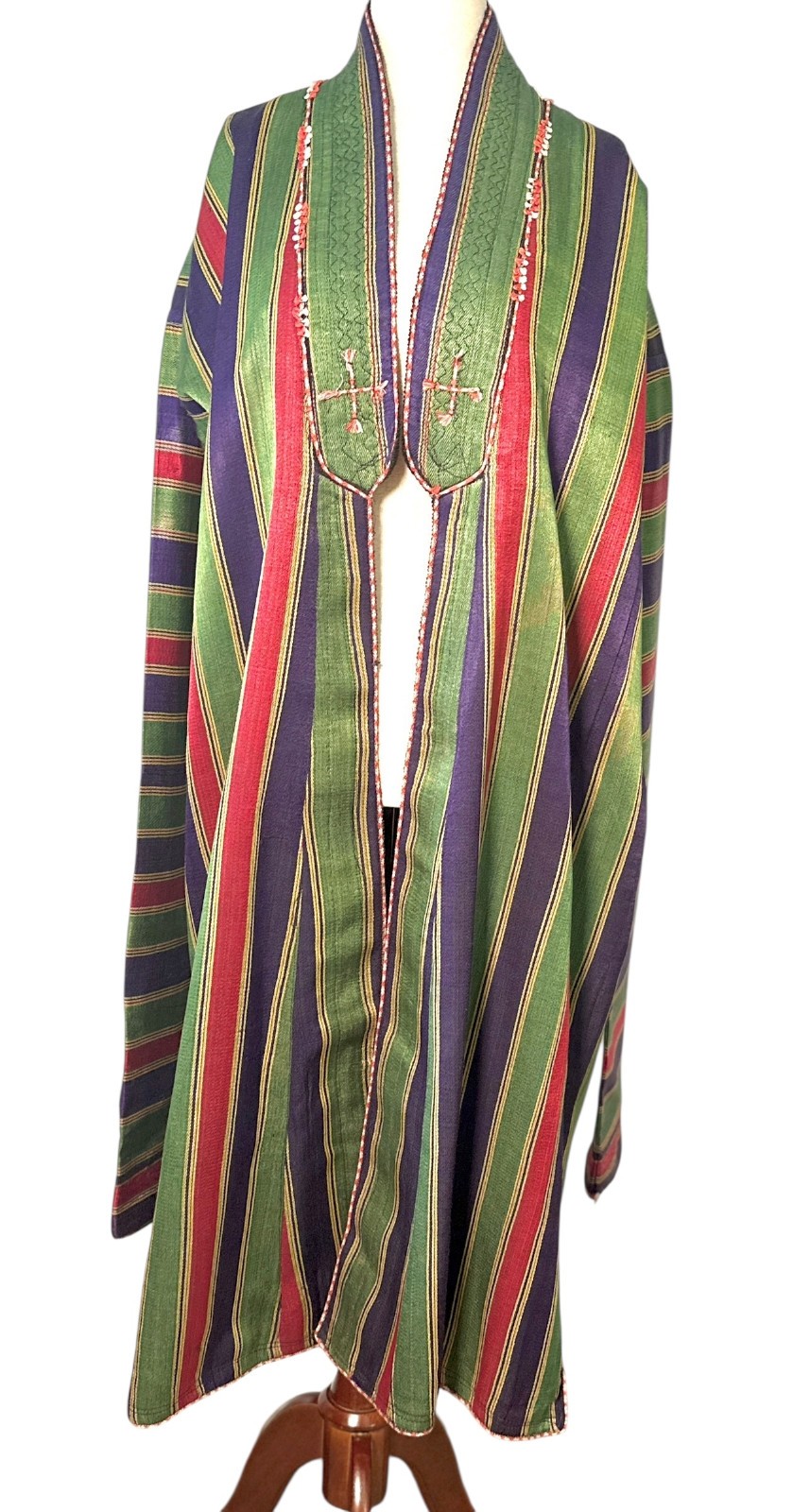
An exceptional antique Central Asian chapan ortraditional long robe, probably Uzbek or Tajik and dating to the late 19th orearly 20th century.
The robe is constructed from striking handwoven stripedsilk in rich green, deep purple-blue, crimson red and fine yellow striping. Thesilk has a beautiful natural sheen and subtle variation characteristic of anolder handwoven textile.
Particularly fine details distinguish this piece. Thelong front facings are made from a contrasting green woven silk with a subtlegeometric pattern and are edged with intricate red and white looped textilework. Small handworked motifs embellish the lower ends of the facings. Relateddecorative loop techniques are documented on 19th- and early-20th-centuryCentral Asian chapans.
The interior is lined predominantly in indigo-bluecotton decorated with a repeating small white resist-style geometric pattern.The combination of a valuable silk exterior with a more utilitarian cottonlining is characteristic of traditional Central Asian robes.
The construction is equally interesting. The broad lowerbody measures approximately 64" around the hem, comprising twoapproximately 20" front sections and a 24" back section. Longsleeves, side vents and the generous open-front cut create the distinctivesilhouette of a traditional chapan.
Center back from base of neck to hem: approximately46"
Sleeve length from shoulder seam: approximately 331/2"
Hem circumference: 64"
Front panels at hem: 20" wide each; Back at hem:approximately 24" wide
Front section just below yoke/collar: approximately13" wide
Side vents: approximately 7" long
Condition: This is an antique garment that appears tohave been genuinely worn and repaired during its working life rather thanpreserved as an unused ceremonial textile.
The silk exterior retains exceptionally rich color andconsiderable visual impact, with expected age and wear.
The interior provides particularly interesting evidenceof the robe's history. Portions of the high-wear areas were reinforced with adark greenish-black corduroy fabric. The corduroy is pieced in places and hasunfinished edges, suggesting that it represents an old utilitarian repair orreinforcement rather than the robe's original construction.
The two sleeve interiors are lined with differentfabrics and also appear to have been repaired or replaced at some point. Onehas a darker, somewhat waxy-feeling textile, while the other has a heaviercanvas-like cotton. The light-colored lining is substantially age-discoloredand has a hole.
These old repairs have been left entirely as found. Noattempt has been made to remove, replace or modernize them. They are aninteresting part of the garment's history and should be carefully examined inthe photographs.
Please expect other minor irregularities, wear andevidence of age appropriate to a hand-constructed textile of this period.
The exterior fibers have been examined and identified assilk; the principal interior lining is cotton.
A beautiful and increasingly difficult-to-find exampleof traditional Central Asian textile and clothing traditions, particularlyappealing for a collector of Uzbek and Tajik textiles, antique silk garments,ethnographic clothing, Islamic decorative arts or historic handwoven fabrics.
Dating/attribution is based on textile, construction and comparison withdocumented Central Asian examples and is offered as an informed assessmentrather than a documented provenance.