When you click on links to various merchants on this site and make a purchase, this can result in this site earning a commission. Affiliate programs and affiliations include, but are not limited to, the eBay Partner Network.
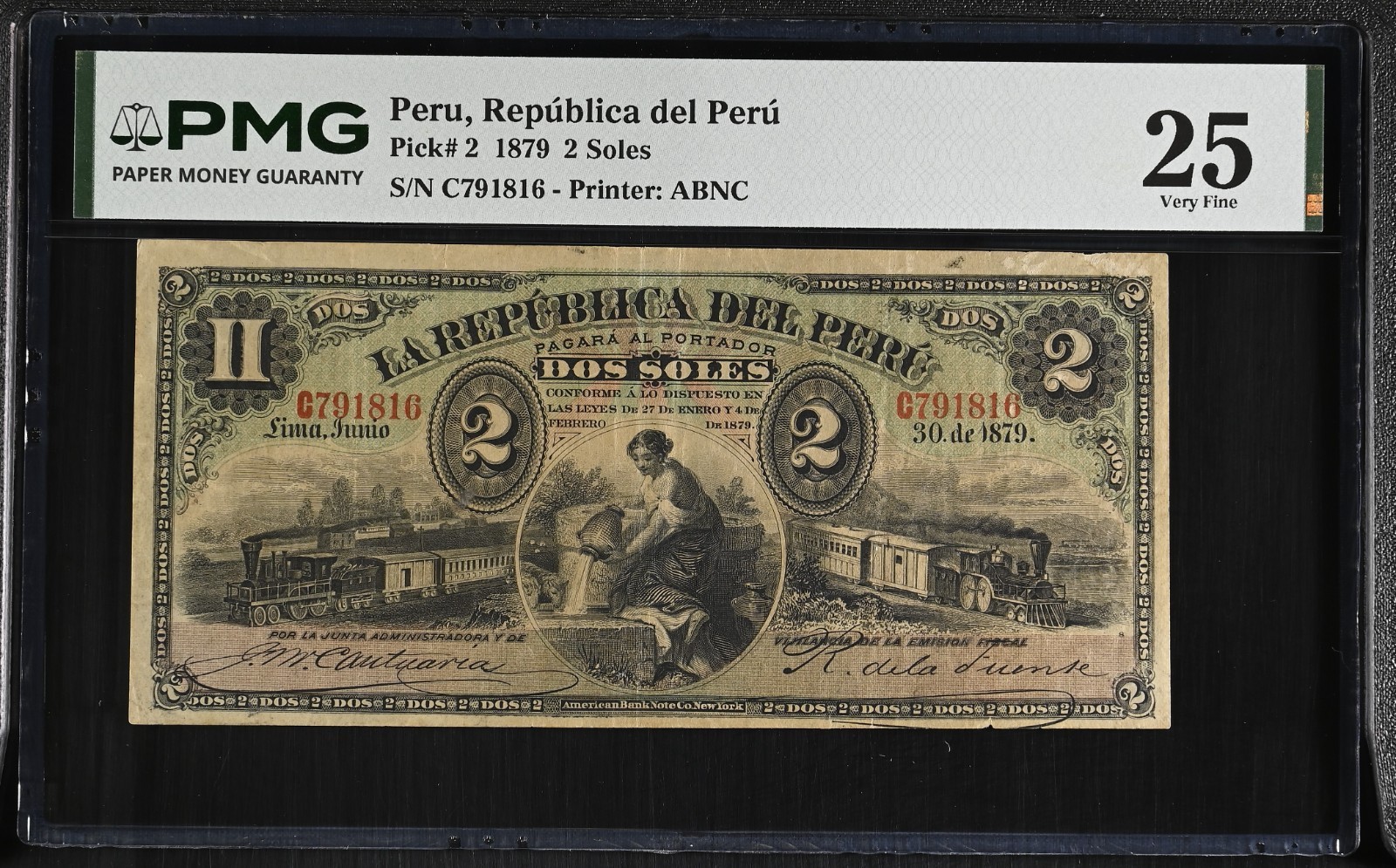
For sale is aPeru, Republica del Peru, 1879 2 Soles P# 2, Steam Train Locomotive, PMG 25 Very Fine.
Pick #2) is historically significant as one of the first official fiscal notes issued directly by the national government under the title \"República del Perú\" rather than by private commercial banks.
Historical Significance & Context
- War of the Pacific Crisis: Released in 1879, this note was part of an emergency regular issue. The outbreak of the War of the Pacific forced the Peruvian government to quickly take control of the money supply.
- Nationalization of Currency: Before this period, paper currency was primarily printed and managed by private commercial institutions like the Banco Nacional del Perú. The Pick #2 series moved fiscal responsibility directly to the central state under the official header \"República del Perú\".
- Design Elements: Printed by the American Bank Note Company (ABNC), the obverse features an allegorical woman seated at the center, flanked by steam locomotives (trains) on both the left and right sides.
Before 1879, much of Peru’s paper money was issued by private commercial banks. This series was among the first fiscal notes issued directly under the authority of the Peruvian government and among the first to prominently carry the title “República del Perú.”
2. Issued during the War of the Pacific
The note is dated June 30, 1879, only a few months after the War of the Pacific began between Peru and Bolivia on one side and Chile on the other. Peru faced enormous military and financial pressures, and government paper-money issuance expanded substantially to help meet wartime expenses.
That makes the note more than old currency—it is a tangible artifact from one of the most consequential wars in South American history.
3. Part of Peru’s transition to centralized currency
The 1879 fiscal-note program attempted to replace and consolidate the many different private-bank notes circulating in Peru. The series included denominations from 1 to 500 soles, including this 2 Soles note.
It therefore represents an early effort by Peru’s national government to control and standardize the country’s paper money—decades before the establishment of Peru’s central reserve bank.
4. The locomotives represent modernization
The front depicts steam passenger trains on both sides, along with an allegorical woman at a fountain in the center.
Railways were powerful symbols of industrialization, commerce and national development in nineteenth-century Peru. The railroad imagery likely promoted a vision of progress and economic expansion, even though the country was entering a severe wartime and financial crisis.
Do check my summary picture with other offerings from Peru from 1879-1881. ( Picture # 3).
I also have for sale 2 SPECIMEN Notes: Picture #4
Thanks for visiting my page. The note you see is the note you get.Check out my other SPECIMEN, Top Pops and High Graded Notes.