When you click on links to various merchants on this site and make a purchase, this can result in this site earning a commission. Affiliate programs and affiliations include, but are not limited to, the eBay Partner Network.
1787 · Isaiah Thomas’s Copy · Revere-Engraved Bookplate Emblems for the Improvement and Entertainment of Youth Containing Emblematical, Hieroglyphical, and Aenigmatical Devices, relating to all Parts and Stations of Life . . . Curiously engraved on Sixty-Two Copper-Plates 1787
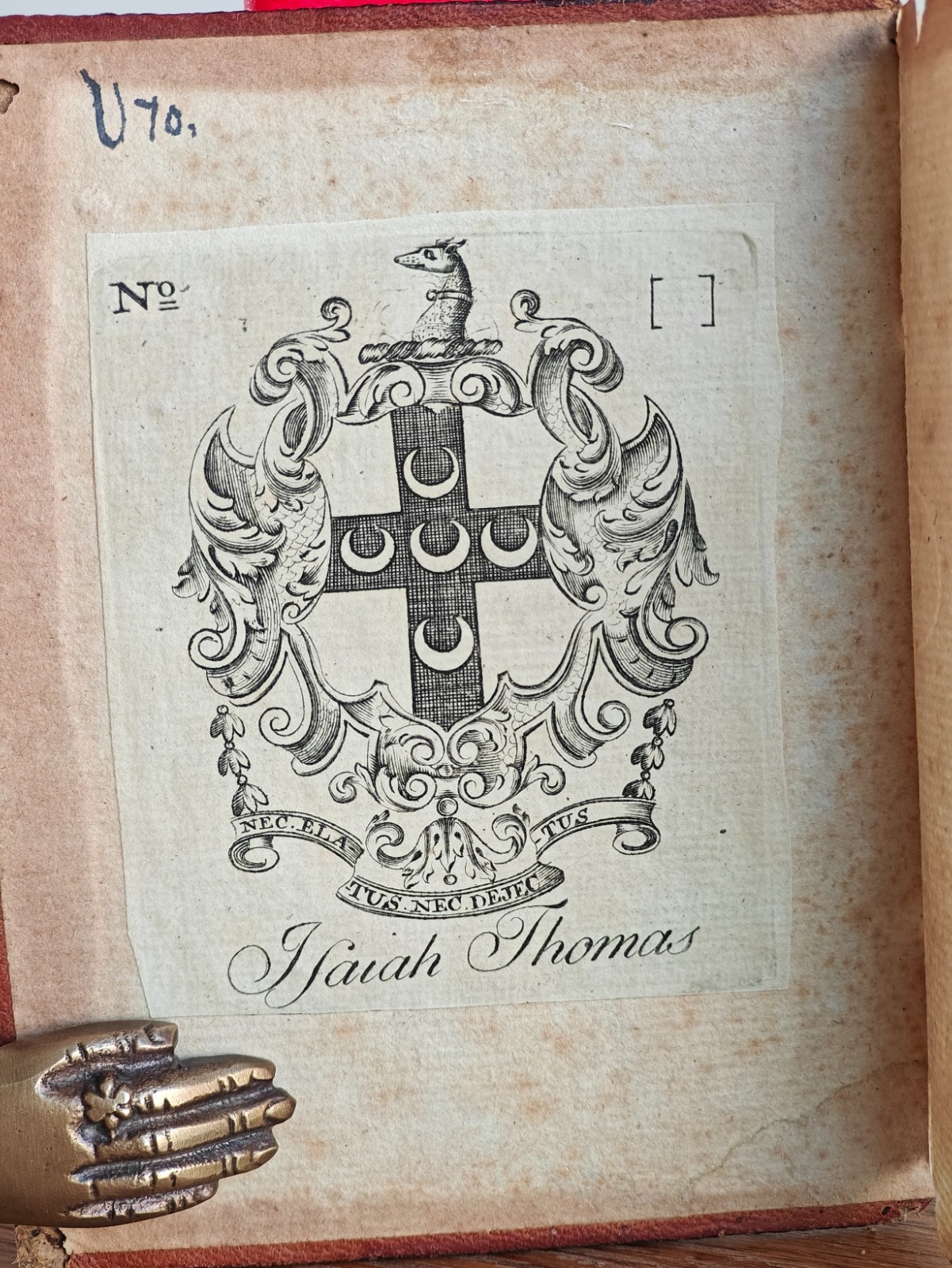
Printer Isaiah Thomas’s copy, with his armorial bookplate engraved by Paul Revere, in the preferred later state. Revere engraved two bookplates for his friend. This is the second, described by the American Antiquarian Society as being “in Revere’s characteristic style, although much better than the first.” According to Brigham, though unsigned, the bookplate “was probably engraved by Revere,” as it is in his distinctive style complete with the “abbreviation ‘No’” in the corner — “a characteristic of Revere’s bookplates and also of his colonial paper currency.”
Thomas was apprenticed to the Boston printer Zechariah Fowle as a small boy and had his own paper, the Massachusetts Spy. The shop was branded a “sedition foundry,” the Sons of Liberty met there, and Thomas was repeatedly in trouble with the royal government. By April 1775, he had learned that Thomas Gage meant to seize the press and try him for treason. On the evening of April 16, he packed his press up and, in his own words, “stole it out of Boston,” rowing it across the Charles and carting it to Worcester, where it was reassembled in Timothy Bigelow’s cellar. It was just one example of a printer fleeing with his press during the Revolutionary War.
Days later Thomas was at Lexington and Concord, and, on May 3, he printed his eyewitness account of the fighting, writing on one copy:
“This is the first thing ever printed in Worcester.”
He remained in Worcester and built one of the largest printing, publishing, and bookselling businesses in the early republic, becoming one of the wealthiest men in the country. His History of Printing in America appeared in two volumes in 1810, and in 1812 he founded the American Antiquarian Society, his own collection forming the basis of its library.
The book itself is less remarkable. It was first published around 1730 and reissued repeatedly through the century, one of the most popular English moral emblem books, intended “to promote morality, virtue, and religion.” Its sixty-two copperplates offered allegory and amusement in equal measure to young readers.
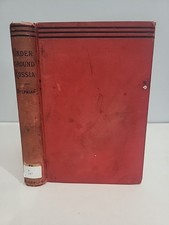
Description Format Small format (5½ × 4¾ in.) Collation [18], 131, [10] pp. Sixty-two copperplates. Binding Contemporary binding. Housed in a plain modern clamshell. Provenance Engraved armorial bookplate of Isaiah Thomas, 94 × 75 mm, to the front pastedown. Small “Sold by AAS” stamp in the rear gutter. Condition Front board detached and rear hinge cracked but holding. References ESTC T64639. Brigham, Paul Revere’s Engravings, plate 53. Allen, American Bookplates, 853.
Please see photographs, which form part of the description. Additional images available on request.